More Than Erotica, A Forgotten Visual Culture
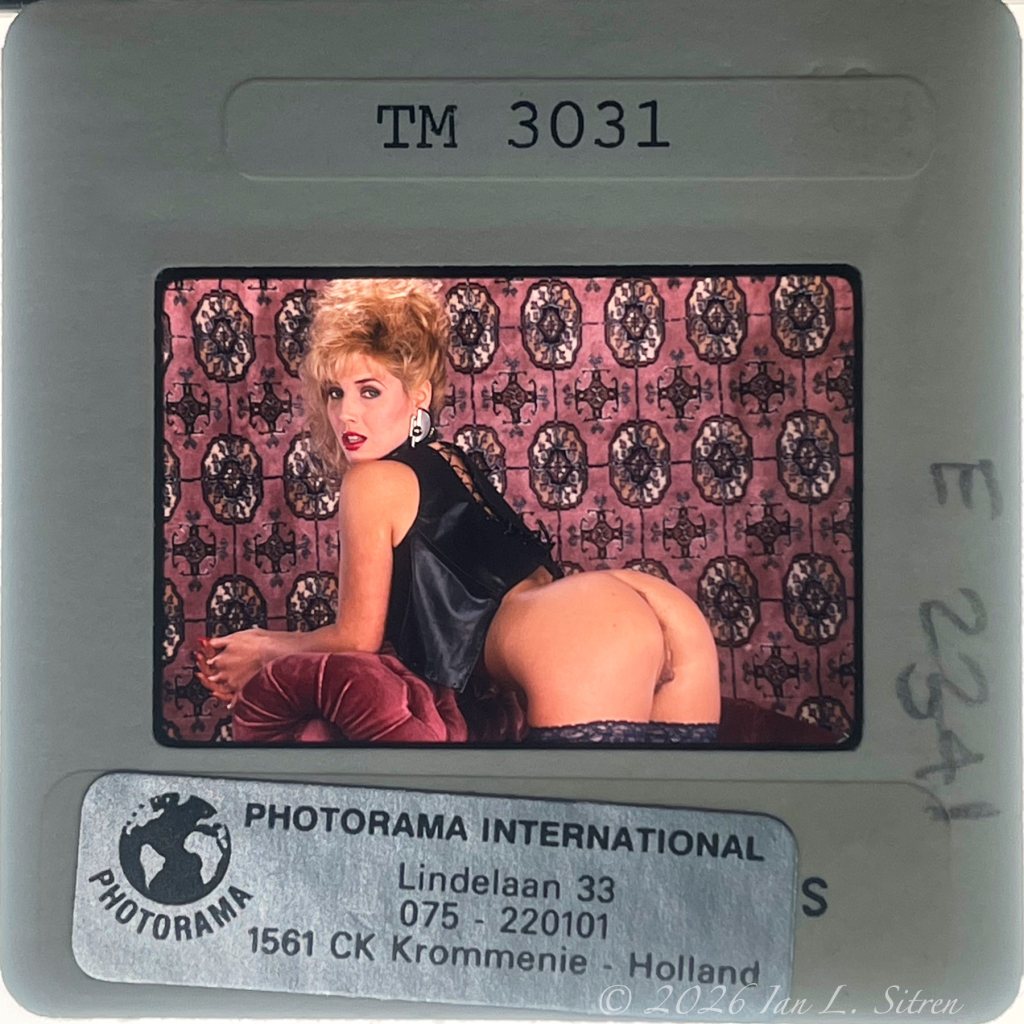
What interests me about these slides is not simply that they are erotic. If that were the only point, they would have very little meaning to me beyond novelty. What draws me in is that they are physical remnants of an entire visual culture that once existed almost completely outside the modern digital world.
And honestly, the first thing I noticed about this particular slide was the pose. The image is highly erotic. Deliberately so. The model’s body language, the direct eye contact, the styling, and the composition are all constructed to create tension and seduction. There is nothing accidental about it.
But after that initial reaction, my attention shifted to everything surrounding the image. The colors. The styling. The late-1980s glamour aesthetic. The carefully coordinated set design. The way fashion photography, nightclub culture, and erotic imagery all seemed to overlap during that era.
Looking at it now, it feels less like disposable adult material and more like a preserved fragment from a very specific visual moment in history.
The mount itself says “Photorama International,” Krommenie, Holland. There is almost no surviving information online about the company, which somehow makes the slide even more fascinating to me. During the 1970s through early 1990s, the Netherlands was one of the centers of European erotic publishing and mail-order distribution. Before digital photography and internet streaming erased entire industries overnight, companies like this circulated thousands of physical images through catalogs, adult bookstores, camera shops, projection clubs, and collector networks.
People today often forget that erotic photography once existed as physical objects. Not files. Not feeds. Not endless scrolling. Objects.
Actual transparencies mounted in cardboard or plastic. Stored in sleeves. Mailed internationally in envelopes. Viewed on light tables or projected onto walls in darkened rooms.
And unlike major publications such as Playboy or Penthouse, many of these smaller distributors left behind almost no searchable footprint. The companies vanished. The photographers disappeared. The models often became anonymous. The websites never existed. What survives now are the slides themselves.
That is what interests me.
These pieces are becoming accidental historical documents.
The Photorama slide especially sits in a strange and interesting place culturally. If the model had been wearing designer shorts instead of nothing at all, the image could easily pass as a late-1980s fashion editorial. The lighting, composition, coordinated interior styling, and pose all push directly into what later became known as pornochic — that blurred territory where glamour, fashion, music videos, nightlife aesthetics, and erotic photography all started borrowing from each other visually.
And that crossover matters historically.
There was a period where Helmut Newton fashion photography, European glamour magazines, nightclub advertising, soft erotica, VHS box art, and mainstream pop culture all shared visual DNA. Looking back now, these slides become evidence of that overlap.
That is why I started building the “From My Collections (Cultural & Erotic)” archive.
Not to shock people. Not to chase nostalgia. And not simply because the material is erotic.
I’m interested in preserving the visual language of eras that are quietly disappearing. The physical artifacts. The aesthetics. The forgotten distribution systems. The strange little companies that once operated internationally yet now barely exist online at all.
These slides are part photography, part design history, part underground publishing history, and part cultural archaeology.
And once you begin looking at them that way, they stop being disposable images and start becoming time capsules.
You can explore more from my ongoing collections and photography archive at:
https://www.secondfocus.com/

