The Photograph That Forgot Its Name
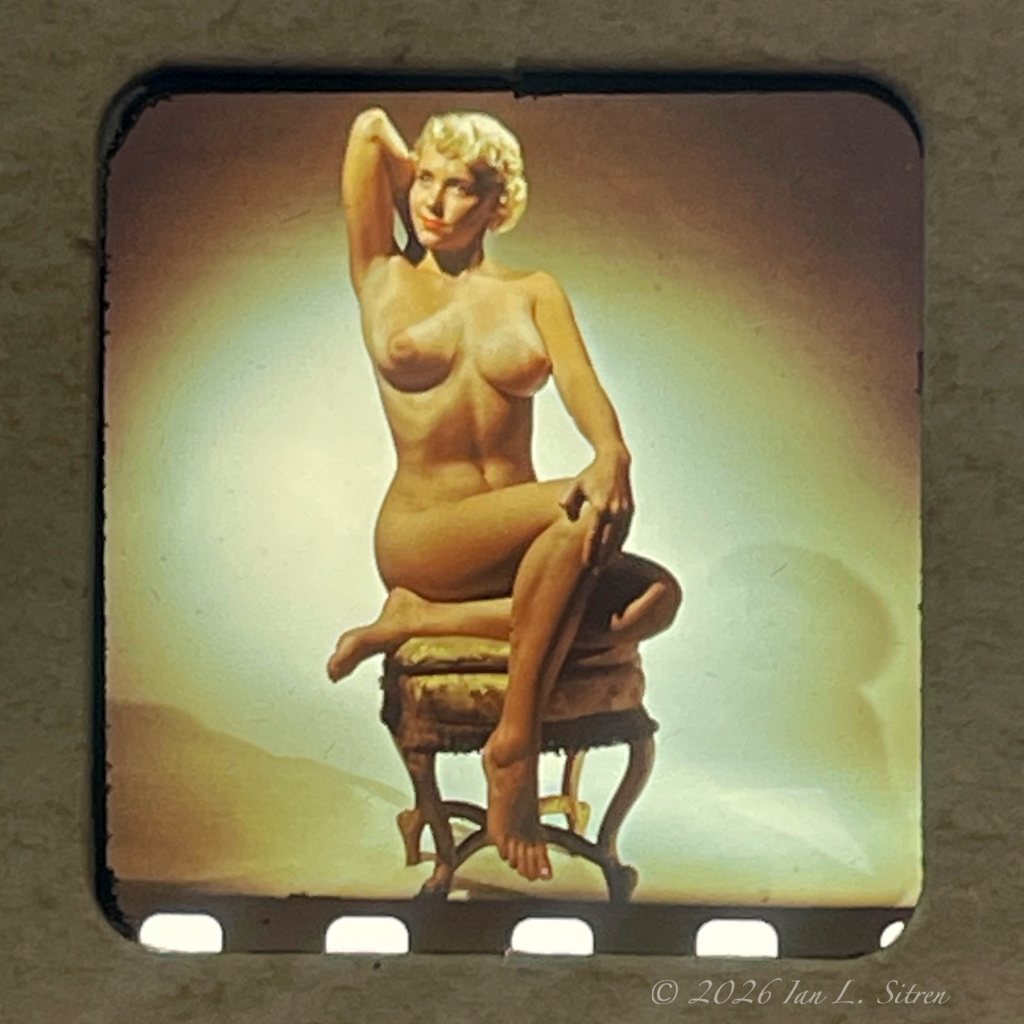
I bought this 35mm color slide simply because it interested me.
It came mounted in an ordinary cardboard slide carrier with absolutely no identifying information. There is no photographer’s name, no date, no studio stamp, no model identification, and not even a handwritten note to suggest where it came from.
What remains is the photograph itself.
The image shows an unidentified blonde model seated on what appears to be a Louis XV-style stool in a carefully lit studio. The hairstyle, lighting, and the fact that it is a color transparency all suggest it was probably photographed sometime during the 1950s or early 1960s, although without any documentation that can only be an educated guess.
One of the things that attracted me is that it represents a period when glamour photography was changing. Earlier artistic nudes were often presented in black and white, while color transparency film was becoming practical enough for professional photographers and serious amateurs willing to invest in it. Every exposure had to count. There was no instant review, no deleting mistakes, and no Photoshop waiting at the end of the process.
We’ll probably never know whether this was made by a commercial glamour photographer, a camera club member, or simply someone who enjoyed creating carefully crafted studio photographs.
Photography has produced millions, perhaps even billions, of images over the years, but surprisingly few remain connected to the people who created them. Slides become separated from their boxes, handwritten notes disappear, studios close, and estates are dispersed. Eventually an image survives while everything that once explained it is gone.
This transparency is one of those survivors.
If you enjoy discovering unusual pieces of photographic history, take a look through my From My Collections gallery. While you’re there, you’ll also find my editorial, aviation, food, fashion, and fine art photography, my growing Motion page, and regularly updated Blog. Everything is available at https://www.secondfocus.com
More Than Erotica, A Forgotten Visual Culture
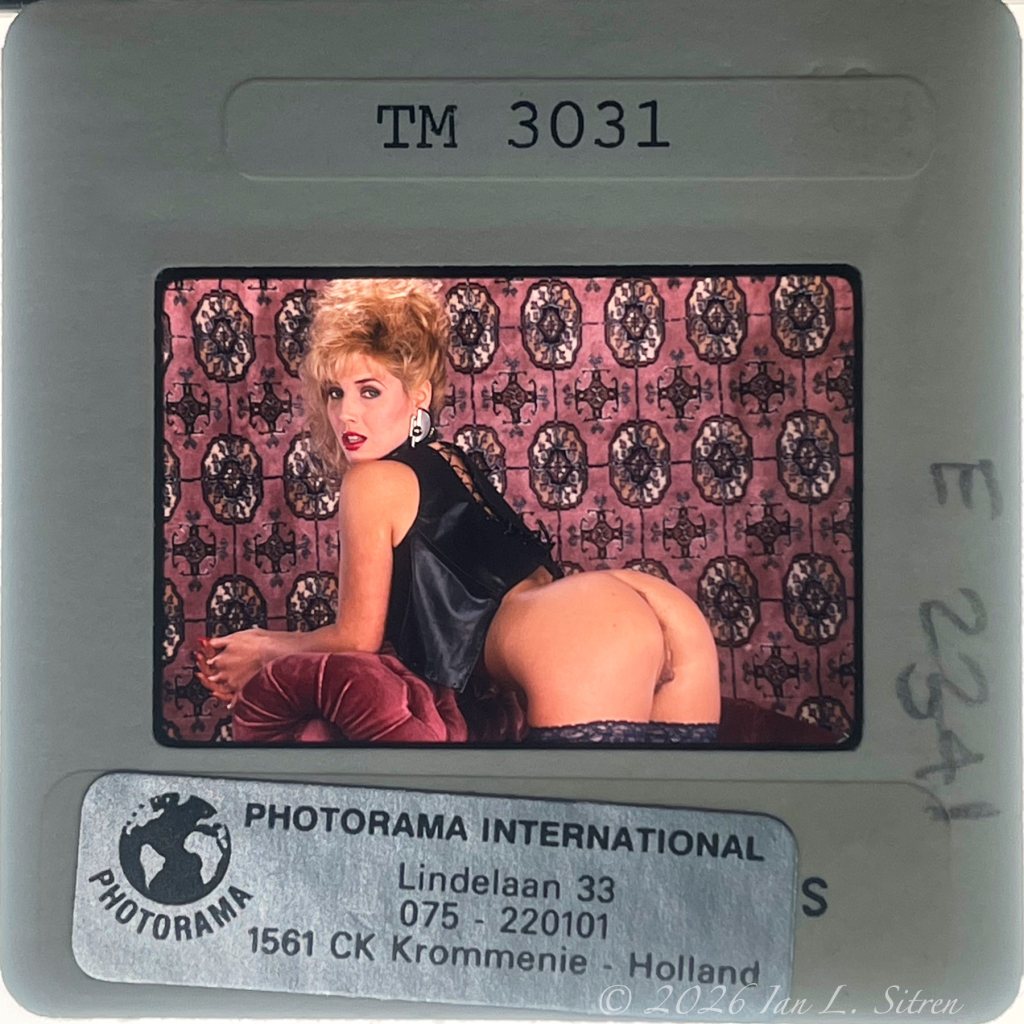
What interests me about these slides is not simply that they are erotic. If that were the only point, they would have very little meaning to me beyond novelty. What draws me in is that they are physical remnants of an entire visual culture that once existed almost completely outside the modern digital world.
And honestly, the first thing I noticed about this particular slide was the pose. The image is highly erotic. Deliberately so. The model’s body language, the direct eye contact, the styling, and the composition are all constructed to create tension and seduction. There is nothing accidental about it.
But after that initial reaction, my attention shifted to everything surrounding the image. The colors. The styling. The late-1980s glamour aesthetic. The carefully coordinated set design. The way fashion photography, nightclub culture, and erotic imagery all seemed to overlap during that era.
Looking at it now, it feels less like disposable adult material and more like a preserved fragment from a very specific visual moment in history.
The mount itself says “Photorama International,” Krommenie, Holland. There is almost no surviving information online about the company, which somehow makes the slide even more fascinating to me. During the 1970s through early 1990s, the Netherlands was one of the centers of European erotic publishing and mail-order distribution. Before digital photography and internet streaming erased entire industries overnight, companies like this circulated thousands of physical images through catalogs, adult bookstores, camera shops, projection clubs, and collector networks.
People today often forget that erotic photography once existed as physical objects. Not files. Not feeds. Not endless scrolling. Objects.
Actual transparencies mounted in cardboard or plastic. Stored in sleeves. Mailed internationally in envelopes. Viewed on light tables or projected onto walls in darkened rooms.
And unlike major publications such as Playboy or Penthouse, many of these smaller distributors left behind almost no searchable footprint. The companies vanished. The photographers disappeared. The models often became anonymous. The websites never existed. What survives now are the slides themselves.
That is what interests me.
These pieces are becoming accidental historical documents.
The Photorama slide especially sits in a strange and interesting place culturally. If the model had been wearing designer shorts instead of nothing at all, the image could easily pass as a late-1980s fashion editorial. The lighting, composition, coordinated interior styling, and pose all push directly into what later became known as pornochic — that blurred territory where glamour, fashion, music videos, nightlife aesthetics, and erotic photography all started borrowing from each other visually.
And that crossover matters historically.
There was a period where Helmut Newton fashion photography, European glamour magazines, nightclub advertising, soft erotica, VHS box art, and mainstream pop culture all shared visual DNA. Looking back now, these slides become evidence of that overlap.
That is why I started building the “From My Collections (Cultural & Erotic)” archive.
Not to shock people. Not to chase nostalgia. And not simply because the material is erotic.
I’m interested in preserving the visual language of eras that are quietly disappearing. The physical artifacts. The aesthetics. The forgotten distribution systems. The strange little companies that once operated internationally yet now barely exist online at all.
These slides are part photography, part design history, part underground publishing history, and part cultural archaeology.
And once you begin looking at them that way, they stop being disposable images and start becoming time capsules.
You can explore more from my ongoing collections and photography archive at:
https://www.secondfocus.com/
A Studio Nude From the Mid-1960s
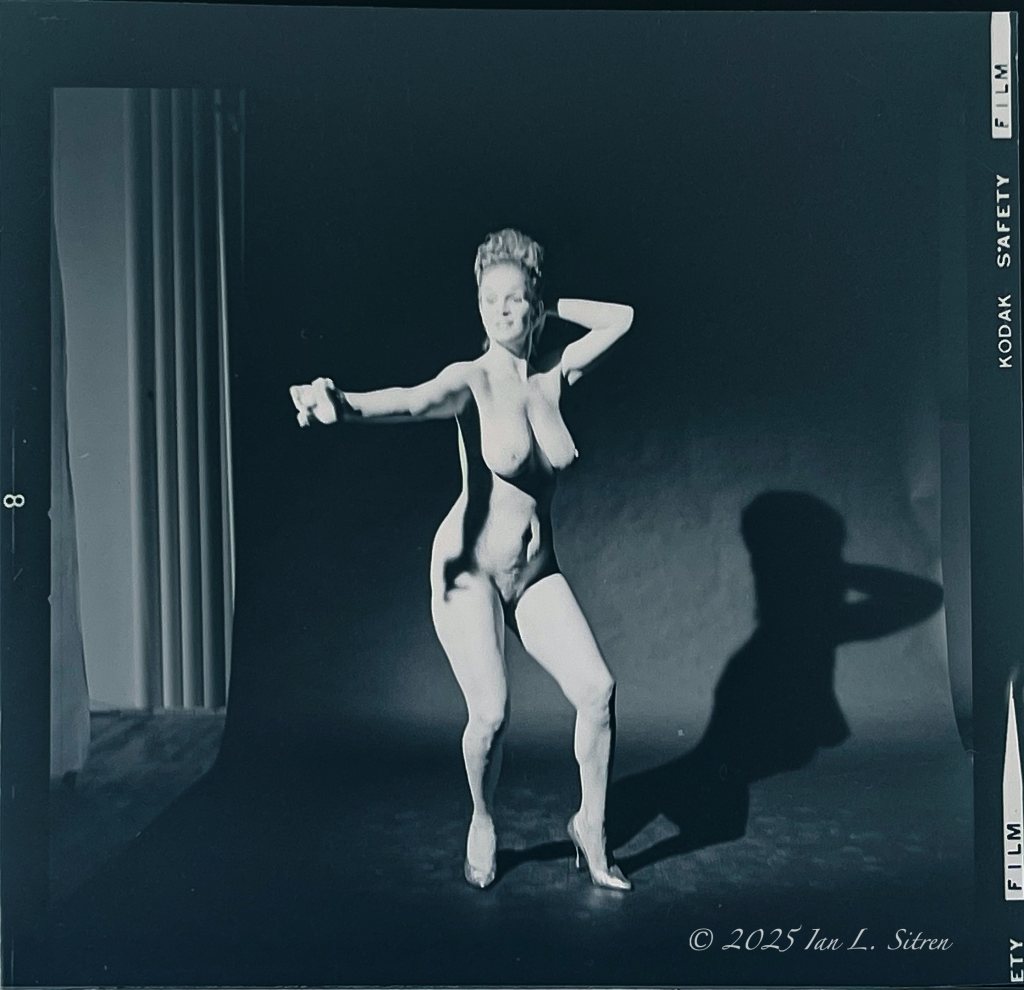
This original medium-format negative, shot sometime between 1960 and 1964, captures a nude model posed in a studio. The setup is simple: a seamless backdrop, a strong key light from the left casting a sharp shadow, and the model in stiletto heels holding a pose as she is dancing. The frame number in the rebate and the imprint from a Hasselblad 120 back place it firmly in the working methods of the era.
What stands out most is the difference in aesthetic between then and now. In the early 1960s, the “ideal” nude model was shaped as much by stage and dance influences as by fashion—often lean but not overly muscular, with a natural body and a poise drawn from performance. Hair was styled, makeup applied, and the presentation carried a certain theatrical quality. Today, the visual language of nude photography spans a far wider spectrum—from unretouched realism to heavily stylized, digitally polished work—and the concept of the “ideal” is far less fixed.
This negative is part of a much larger archive I’ve been building, preserving examples of cultural and erotic photography from different decades. You can view more pieces like this in my gallery From My Collections (Cultural & Erotic) here:
https://www.secondfocus.com/gallery/From-My-Collections-Cultural-Erotic/G0000h1LWkCCepcc/

