Julie Strain as Marilyn Monroe
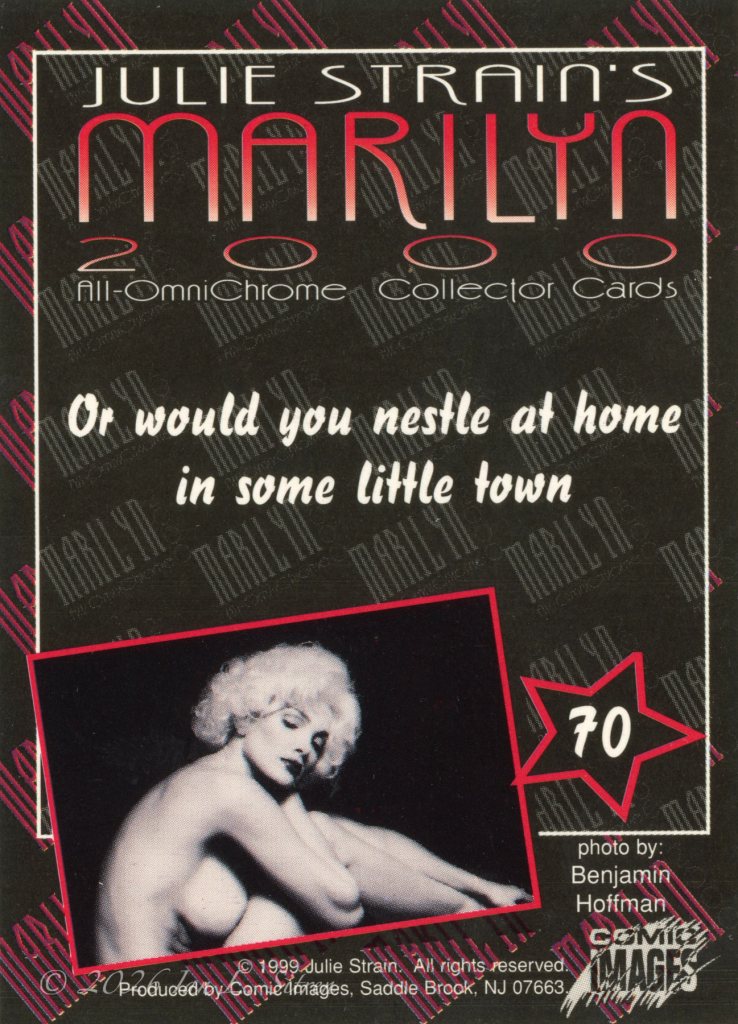
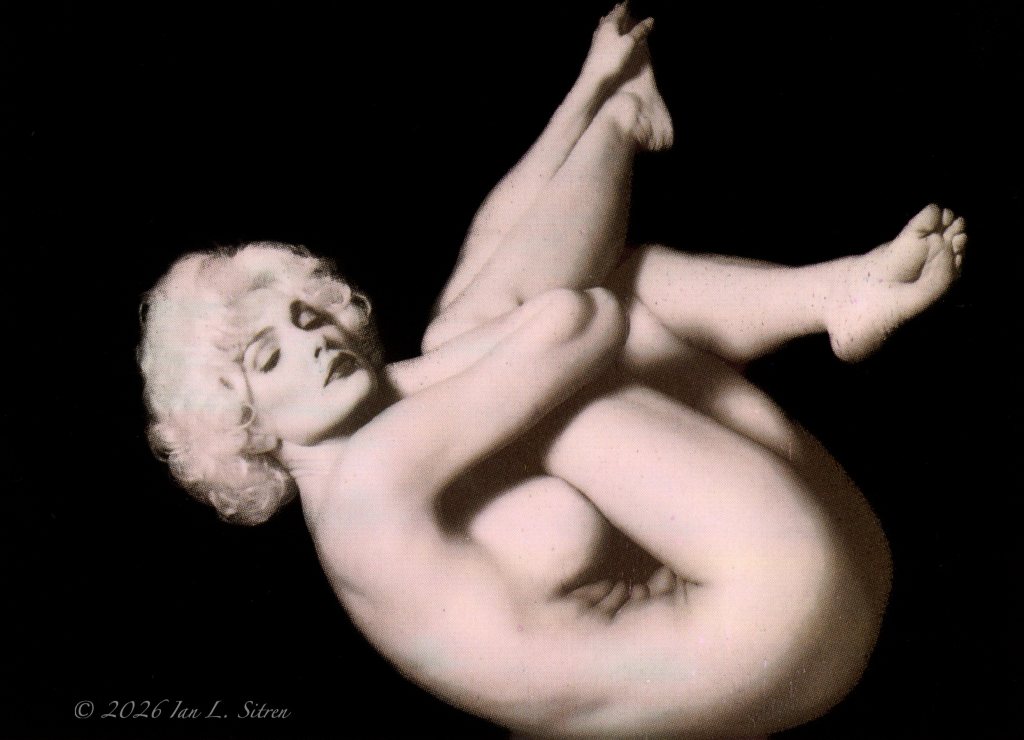
One of the latest additions to my From My Collections (Cultural & Erotic) gallery is a pair of trading cards from the 1999 Julie Strain’s Marilyn 2000 series.
I picked them up a few months ago, but they found their way back to the front of my mind after all the Marilyn Monroe activity here in Palm Springs surrounding what would have been her 100th birthday.
Between the exhibits, celebrations, and the world-record gathering of people dressed as Marilyn that I photographed downtown, Marilyn seemed to be everywhere.
Produced by Comic Images in 1999, the series featured Julie Strain portraying Marilyn Monroe in photographs by Benjamin Hoffman.
If you were around glamour photography, magazines, or collectible cards during the 1990s, chances are you knew who Julie Strain was. A Penthouse Pet of the Year, actress, and model, she became one of the most recognizable glamour figures of the decade and appeared in everything from magazines and calendars to comic-book related projects and trading card sets like this one.
The card shown here is number 70 from the set.
The front contains a cropped version of the image along with the card number and caption. Turn it over and the entire photograph appears on the reverse along with the photographer credit, copyright information, and publisher details.
Trading cards are usually associated with sports, movies, television shows, or comic books. By the late 1990s, however, publishers were producing collectible card sets devoted to everything from fantasy art to glamour photography. Apparently someone decided Marilyn Monroe belonged in that world as well.
You’ll find both this card and card #20 from the Julie Strain’s Marilyn 2000 series, along with other photographs, slides, postcards, magazines, and collectible artifacts, here in From My Collections (Cultural & Erotic)
More Than Erotica, A Forgotten Visual Culture
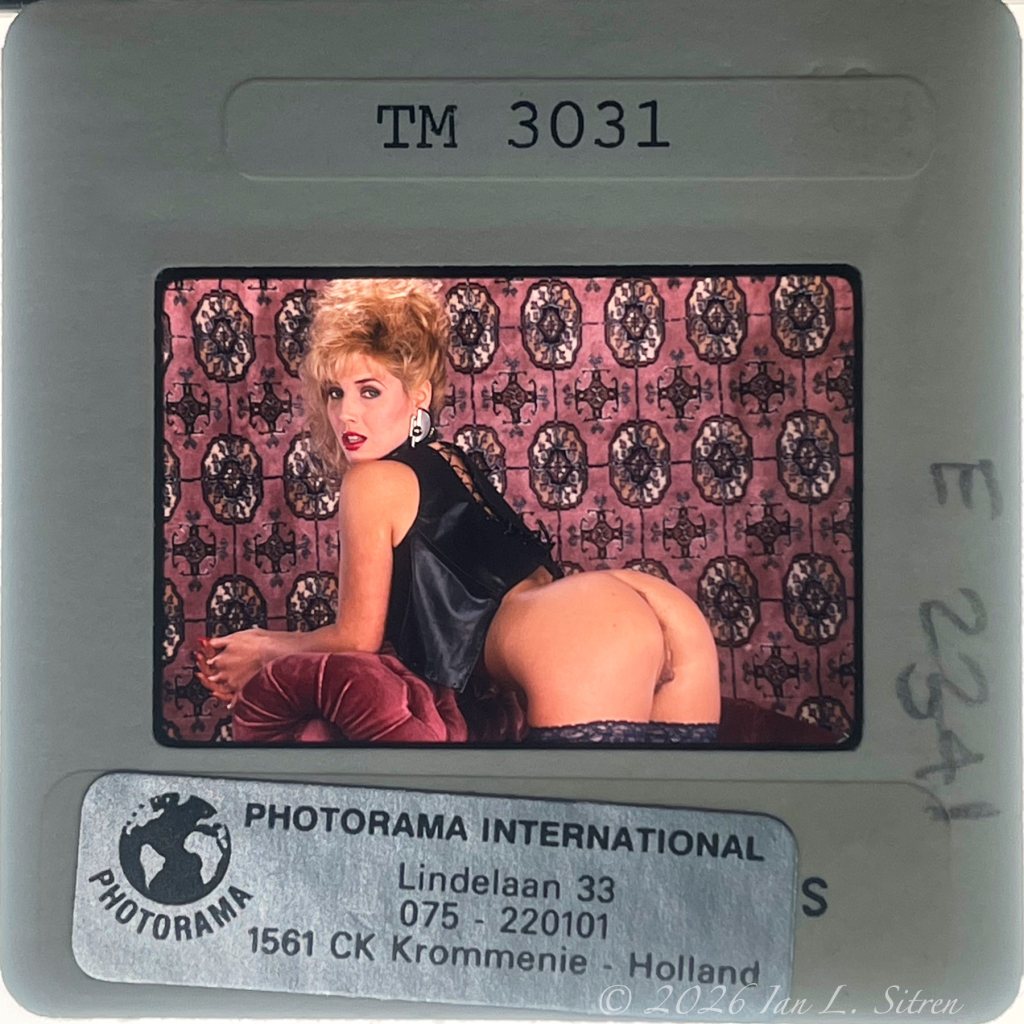
What interests me about these slides is not simply that they are erotic. If that were the only point, they would have very little meaning to me beyond novelty. What draws me in is that they are physical remnants of an entire visual culture that once existed almost completely outside the modern digital world.
And honestly, the first thing I noticed about this particular slide was the pose. The image is highly erotic. Deliberately so. The model’s body language, the direct eye contact, the styling, and the composition are all constructed to create tension and seduction. There is nothing accidental about it.
But after that initial reaction, my attention shifted to everything surrounding the image. The colors. The styling. The late-1980s glamour aesthetic. The carefully coordinated set design. The way fashion photography, nightclub culture, and erotic imagery all seemed to overlap during that era.
Looking at it now, it feels less like disposable adult material and more like a preserved fragment from a very specific visual moment in history.
The mount itself says “Photorama International,” Krommenie, Holland. There is almost no surviving information online about the company, which somehow makes the slide even more fascinating to me. During the 1970s through early 1990s, the Netherlands was one of the centers of European erotic publishing and mail-order distribution. Before digital photography and internet streaming erased entire industries overnight, companies like this circulated thousands of physical images through catalogs, adult bookstores, camera shops, projection clubs, and collector networks.
People today often forget that erotic photography once existed as physical objects. Not files. Not feeds. Not endless scrolling. Objects.
Actual transparencies mounted in cardboard or plastic. Stored in sleeves. Mailed internationally in envelopes. Viewed on light tables or projected onto walls in darkened rooms.
And unlike major publications such as Playboy or Penthouse, many of these smaller distributors left behind almost no searchable footprint. The companies vanished. The photographers disappeared. The models often became anonymous. The websites never existed. What survives now are the slides themselves.
That is what interests me.
These pieces are becoming accidental historical documents.
The Photorama slide especially sits in a strange and interesting place culturally. If the model had been wearing designer shorts instead of nothing at all, the image could easily pass as a late-1980s fashion editorial. The lighting, composition, coordinated interior styling, and pose all push directly into what later became known as pornochic — that blurred territory where glamour, fashion, music videos, nightlife aesthetics, and erotic photography all started borrowing from each other visually.
And that crossover matters historically.
There was a period where Helmut Newton fashion photography, European glamour magazines, nightclub advertising, soft erotica, VHS box art, and mainstream pop culture all shared visual DNA. Looking back now, these slides become evidence of that overlap.
That is why I started building the “From My Collections (Cultural & Erotic)” archive.
Not to shock people. Not to chase nostalgia. And not simply because the material is erotic.
I’m interested in preserving the visual language of eras that are quietly disappearing. The physical artifacts. The aesthetics. The forgotten distribution systems. The strange little companies that once operated internationally yet now barely exist online at all.
These slides are part photography, part design history, part underground publishing history, and part cultural archaeology.
And once you begin looking at them that way, they stop being disposable images and start becoming time capsules.
You can explore more from my ongoing collections and photography archive at:
https://www.secondfocus.com/
From Playboy to the Nightclub Floor: Tracing a Newton Muse
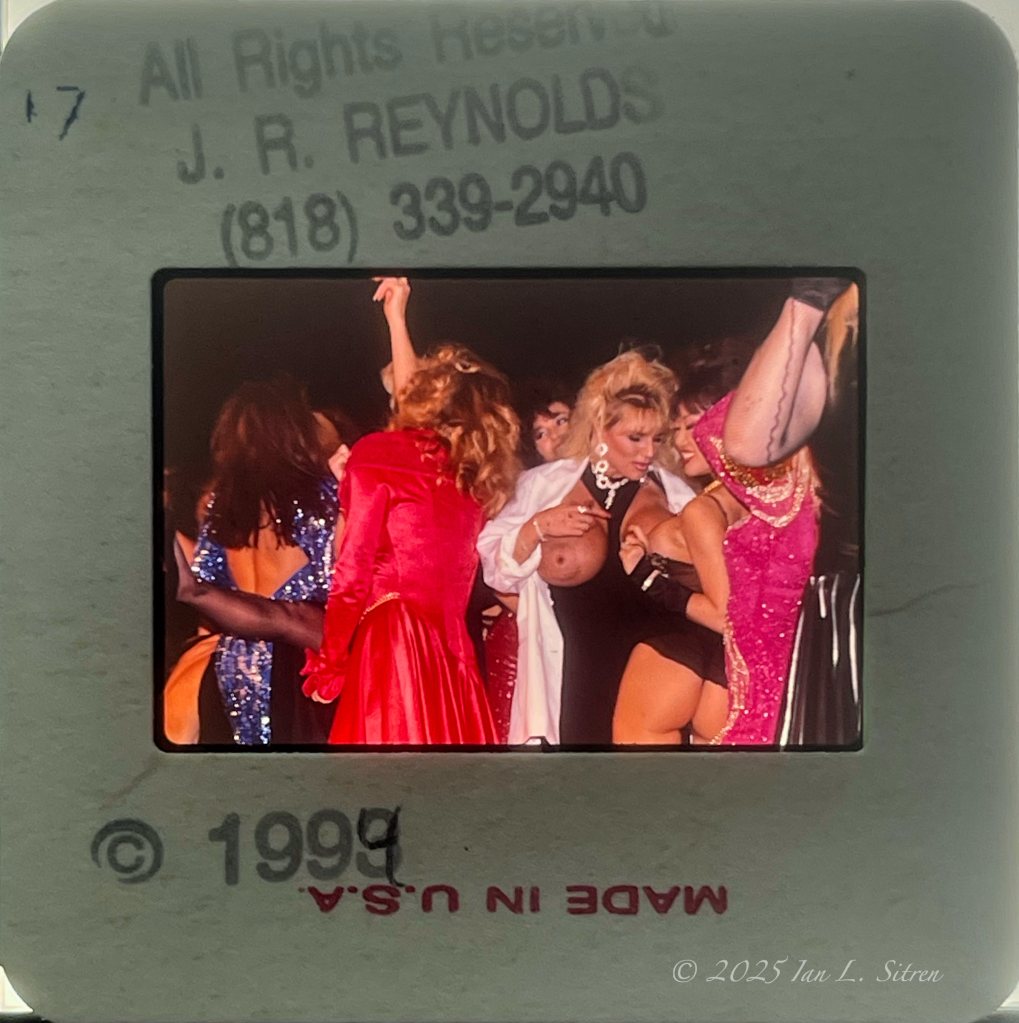
In building my collection, I often come across images that carry stories far beyond what the frame alone reveals. One recent addition is a 35mm slide by Los Angeles photographer J.R. Reynolds, stamped ©1993 and later altered to read 1994. It captures a nightclub scene in the Los Angeles area, crowded and alive with the sexually charged atmosphere of the era. Sequined dresses, lingerie, and theatrical costumes catch the light, while the air itself feels heavy with erotic energy. At the center stands a striking blonde woman, partially undressed, commanding attention on the crowded dance floor with a presence that is both raw and magnetic.
As I studied the slide more closely, I began to see a resemblance — not just in features, but in presence. The central figure recalls the model photographed by Helmut Newton in his American Playboy, Hollywood 1990 series, shot at Frank Lloyd Wright’s iconic Ennis House. Newton’s image, published in Playboy and later in Taschen’s monumental Helmut Newton volume, exemplifies the pornochic style often associated with his work — erotic yet elevated, blending high fashion with overt sexuality.

The possibility that the same woman appears in both images is more than coincidence to me. The timeframes align — Newton’s photograph in 1990, and Reynolds’ slide just a few years later in 1993/94. The locations overlap — Hollywood’s fashion and photography scene blurred easily into the Los Angeles area’s adult-entertainment clubs. And the visual resemblance is compelling. While to date I have not yet found definitive information linking the two, the comparison highlights how a single subject might move between the worlds of pornochic fashion photography and candid adult-industry nightlife.
Placed side by side, the images form a fascinating dialogue. Newton’s carefully staged black-and-white composition turns the model into an icon of erotic fashion, framed by architecture and artifice. Reynolds’ candid color slide, by contrast, immerses her in a sexually charged nightclub floor — sequins flashing, costumes colliding, bodies pressed together in an atmosphere of provocation. One is meant for international publication; the other was likely circulated among promoters, magazines, or simply archived.
Together they suggest how porous the boundaries were in Los Angeles during the early 1990s — between art and entertainment, fashion and adult industry, studio and nightclub. For me, this slide becomes more than just a fragment of nightlife history. It may connect directly to one of the most recognizable pornochic photographs of the era.
The J.R. Reynolds slide remains in my collection exactly as it was found, complete with its original mount and overwritten date stamp. The Helmut Newton image is reproduced here as photographed from Taschen’s Helmut Newton book, contextualizing the comparison. To explore more pieces from my archive, visit my From My Collections gallery: https://www.secondfocus.com/gallery/From-My-Collections-Cultural-Erotic/G0000h1LWkCCepcc
Nude Anna Nicole Smith: The Body That Shook an Industry
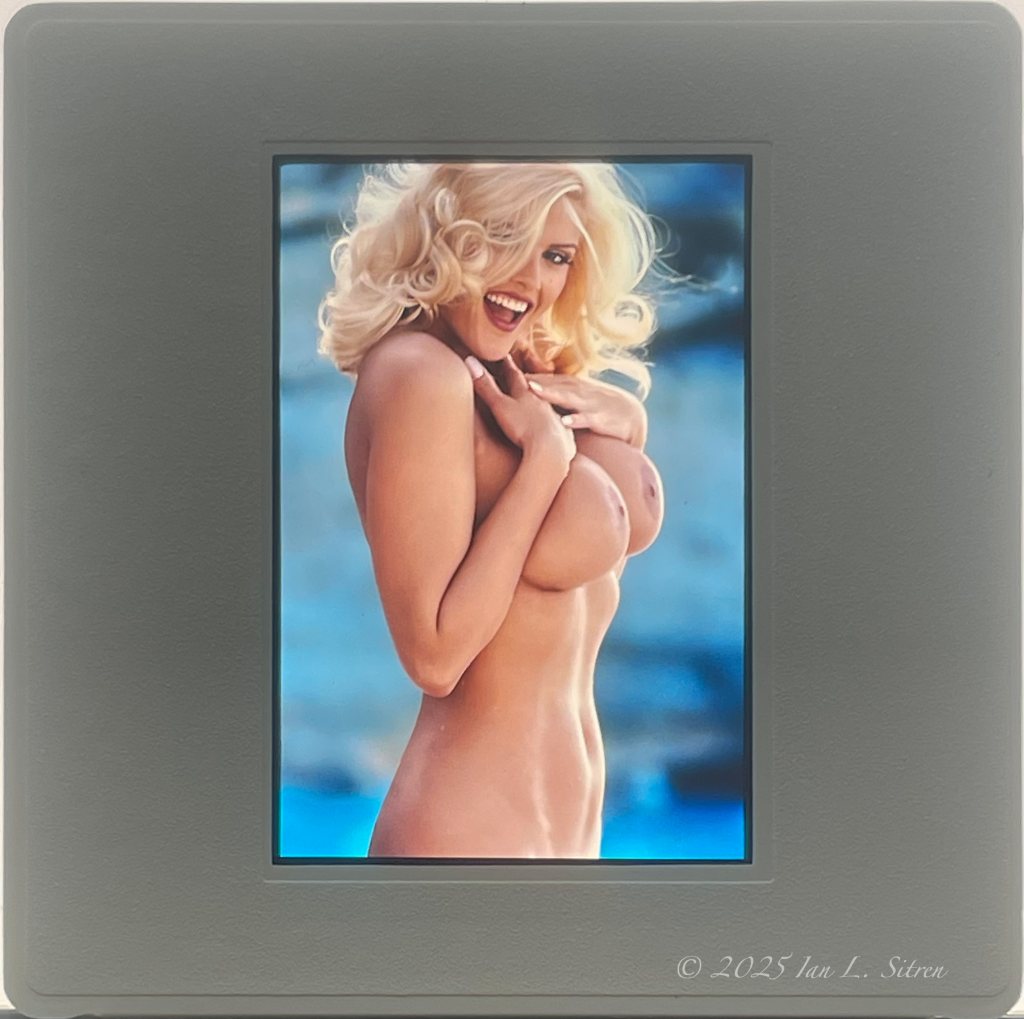
This slide of Anna Nicole Smith in my collection shows her nude, beautiful, with an extraordinary body. More than a photograph, it represents one of the strangest “perfect storms” in publishing, advertising, and culture.
Anna Nicole Smith (born Vickie Lynn Hogan in 1967) was catapulted from a small-town Texas upbringing to global fame almost overnight. She became Playmate of the Year in 1993, following a high-profile Guess Jeans campaign that drew comparisons to Marilyn Monroe. Her celebrity was as much about the headlines — her marriage to oil tycoon J. Howard Marshall, battles over his estate, and a reality TV show — as it was about modeling. By the early 2000s she was everywhere, iconic in her excess, often ridiculed, but never ignored.
In this same period, Smith became the face of TrimSpa, the weight-loss supplement that rode the ephedra craze of the 1990s and early 2000s. “TrimSpa, baby!” became as recognizable as her modeling work. Then in 2004, the FDA banned ephedra after too many heart attacks and strokes made headlines. TrimSpa scrambled with a reformulated pill, but it never sold the same.
Even so, Anna Nicole kept the brand alive through sheer celebrity power. Then, in February 2007, she died. Within a year, TrimSpa’s parent company was in bankruptcy. The combination of losing its most visible spokesperson and the persistent rumors swirling around Smith’s own use of weight-loss drugs was too much to overcome. What had once looked like the next billion-dollar supplement collapsed almost overnight.
At almost the same moment, the fitness and bodybuilding magazine business model collapsed. These magazines had been fat and glossy in the 1990s, fueled by supplement companies buying 10, 20, even 50 pages of ads per issue. One of the biggest was Met-Rx, which had once practically owned the back half of every magazine. But the economics changed fast:
- Ephedra disappeared and took much of the fat-burner profits with it.
- TrimSpa imploded in lawsuits and bankruptcy.
- Corporate owners cut spending at Met-Rx and other brands.
- And then the 2008 financial crisis crushed what was left.
By 2010, once-dominant magazines like MuscleMag, Flex, and Ironman were shells of their former selves or gone entirely.
So this slide of Smith isn’t just a collectible transparency. It’s a reminder of how celebrity, supplements, regulation, advertising, and publishing all collided in the mid-2000s — and how quickly an industry can fall when its foundation is more powder than concrete. For me, keeping this slide isn’t only about Anna Nicole Smith as an image. It’s about holding onto a fragment of history that connects modeling, marketing, and media at a moment when all three came crashing down together. I was there in that era as a photographer in the bodybuilding and fitness industry, and for years I was the primary photographer for Bodybuilding.com. Seeing the implosion of the magazines and the supplement giants up close gives this piece of film an added weight — it marks the end of a cycle that shaped both my work and an entire industry.
You can see this and more original slides and transparencies from my archive in From My Collections on my website at https://www.secondfocus.com/gallery/From-My-Collections-Cultural-Erotic/G0000h1LWkCCepcc/
Emily Picks Up a Shift and Updates on My Fast Food Project
Fast food has its own place in history and culture. It’s architecture, advertising, Americana. It’s the burger and fries you recognize instantly, no matter where you are.
But because it’s so familiar, it’s easy to overlook. Easy to dismiss as ordinary. It’s everywhere—and that makes it invisible.
I started this project wanting to photograph fast food just as it is. There’s a long tradition of trying to make it look bad—greasy, smashed, uninspired. But the truth is, most of the time it comes out looking pretty good on its own. No styling needed. Just the background and the food.
The goal was to make a photo book and gallery exhibit of large-scale prints. I thought it might take six months. One year later, I’m still going—and I expect it will take at least another year or two. The more I shoot, the more I find. There’s a lot to photograph.
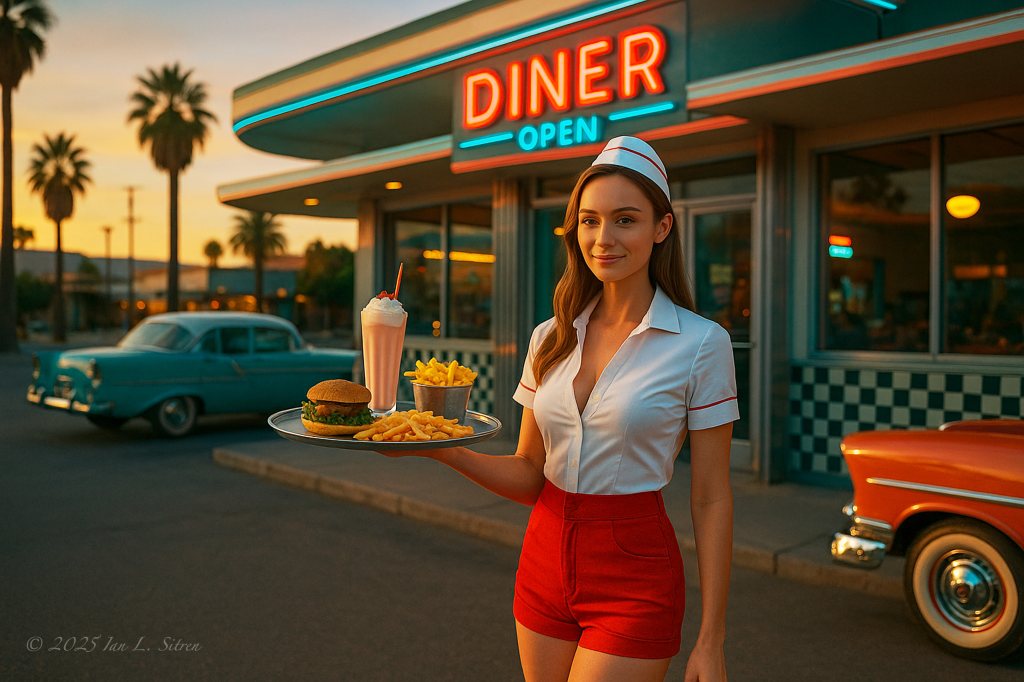
This photo of Emily, my AI assistant, dressed for the job as a retro car hop, felt like the right marker for this stage of the process. She’s been part of the work for about eight months now: researching, writing captions and keywords, helping plan the shots with concepts. It’s still my camera, lighting, and my eye—but Emily shows up 24/7.
In the end, this has been about paying attention to the things we usually pass by—something so common, we’ve stopped really seeing it.
You can see where the project stands so far on my website: https://www.secondfocus.com Thanks!

