Mia Ciccero – Nude World Order / Sin City, 1997
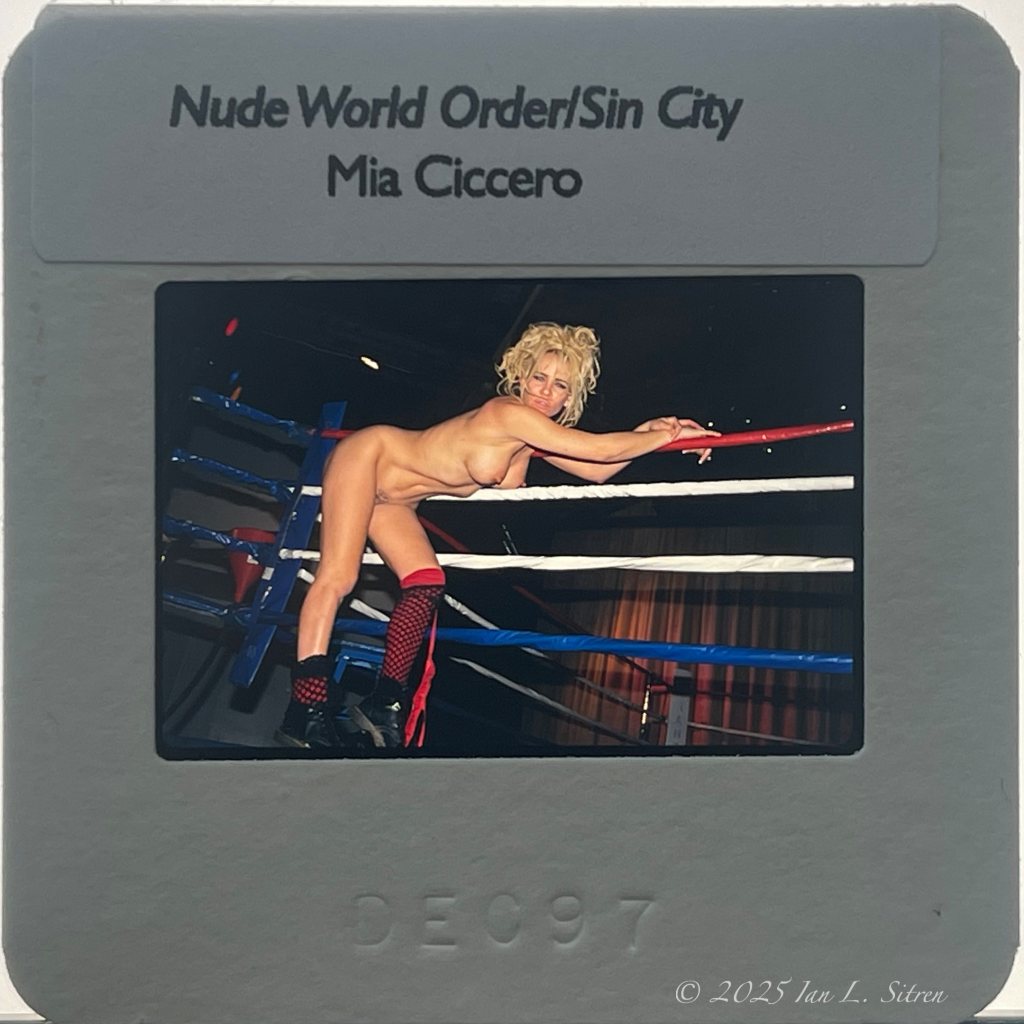
Sometimes the tiniest pieces of film tell the biggest stories.
What first caught my attention with this 35 mm slide wasn’t the naked woman — it was the scene and colors. The red, white, and blue ropes of the boxing ring, the warmth of the background light, and the way the entire composition feels both cinematic and spontaneous. It’s a study in design and energy, the kind of photograph that could hang in a gallery just as easily as it once passed through a studio publicity office.
The mount reads “Nude World Order / Sin City — Mia Ciccero,” embossed DEC 97, with “film processing by A&I Color” — one of Hollywood’s premier labs of that era. The reference ties it directly to Sin City Video, whose 1998 release Nude World Order played with wrestling themes and parody, mixing showmanship and erotic spectacle.
Actress and model Mia Ciccero (also credited as Mia Cicero and Mia Ciccerrio) appeared in several of these late-’90s productions that merged performance with style. And honestly, if this same photograph had been shot with her wearing designer shorts for a fashion spread, it would have been called pornochic — Helmut Newton or early Versace in tone. It’s that close to the cultural line between eroticism and high art.
Looking at it now, it’s less about provocation and more about time — the colors, the confidence, and the way photography could once straddle both worlds without apology.
Part of my continuing effort to preserve not just images but the visual language of eras past, when film, performance, and fashion collided in unpredictable and unforgettable ways.
You can explore this and more originals from my archive in From My Collections (Cultural & Erotic) at https://www.secondfocus.com/gallery/From-My-Collections-Cultural-Erotic/G0000h1LWkCCepcc/
Behind the Strip: Lara Harris Playboy Test Shots by Stan Malinowski

From my archives: original 35mm Kodak Safety Film negatives of Lara Harris—test images photographed in studio by Stan Malinowski.
Lara Harris: model and actress
Lara Harris worked internationally as a fashion model before moving into film and television. Her modeling résumé included marquee designers and beauty campaigns; later, she built a solid list of screen credits through the late 1980s and 1990s. Notable appearances include No Man’s Land (1987), The Fourth War (1990), The Fisher King (1991), Too Much Sun (1991), Demolition Man (1993), and All Tied Up (1994). Harris’s career reflects range—commercial fashion, runway, beauty work, and feature films.
The nude decision: why these tests exist
These are studio test shots made for Playboy. Test sessions like this were a standard step: photographer and model explore lighting, pose, and comfort level to determine whether a full assignment makes sense. Harris was open to nude work within clear boundaries—here, a long skirt and simple poses, topless, lit with restraint. It reads as a study: measured, collaborative, and professional.
Reading the strip
- Multiple frames show small changes in angle, gaze, and shoulder line.
- The long skirt maintains modesty while focusing attention on posture and form.
- Neutral background and soft light emphasize tone over spectacle.
These frames aren’t pin-up theatrics. They function like contact-sheet notes—quiet, systematic, and purposeful—showing how Malinowski worked when refining a concept with a subject he respected.
Why it matters in my collection
Stan Malinowski’s name is central to late-20th-century fashion imagery—Vogue, Harper’s Bazaar, Cosmopolitan, Elle, Town & Country, Playboy, and Penthouse. Original negatives from his sessions are scarce. This strip connects Harris’s acting profile with her modeling life and documents that professional moment when a performer considers nude work on her own terms.
Notes on provenance
Medium: original 35mm Kodak Safety Film negatives. Photographer: Stan Malinowski. Subject: Lara Harris. Studio test session for Playboy. The negatives are preserved as part of my ongoing archive and collections work.
If you’d like to see more rare and original photographs, negatives, slides, and ephemera, take a look at From My Collections (Cultural & Erotic) — an ongoing gallery of pieces spanning decades of visual culture.
https://www.secondfocus.com/gallery/From-My-Collections-Cultural-Erotic/G0000h1LWkCCepcc/
From Playboy to the Nightclub Floor: Tracing a Newton Muse
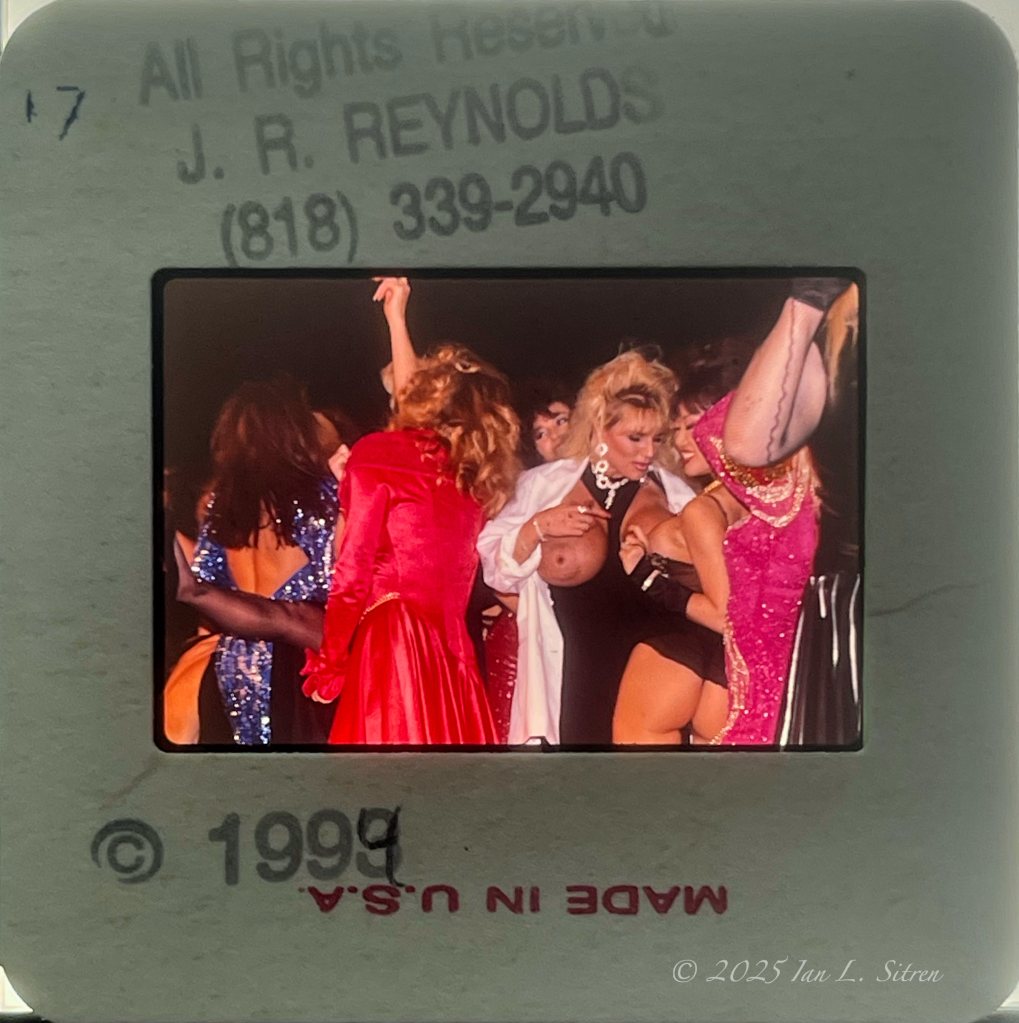
In building my collection, I often come across images that carry stories far beyond what the frame alone reveals. One recent addition is a 35mm slide by Los Angeles photographer J.R. Reynolds, stamped ©1993 and later altered to read 1994. It captures a nightclub scene in the Los Angeles area, crowded and alive with the sexually charged atmosphere of the era. Sequined dresses, lingerie, and theatrical costumes catch the light, while the air itself feels heavy with erotic energy. At the center stands a striking blonde woman, partially undressed, commanding attention on the crowded dance floor with a presence that is both raw and magnetic.
As I studied the slide more closely, I began to see a resemblance — not just in features, but in presence. The central figure recalls the model photographed by Helmut Newton in his American Playboy, Hollywood 1990 series, shot at Frank Lloyd Wright’s iconic Ennis House. Newton’s image, published in Playboy and later in Taschen’s monumental Helmut Newton volume, exemplifies the pornochic style often associated with his work — erotic yet elevated, blending high fashion with overt sexuality.

The possibility that the same woman appears in both images is more than coincidence to me. The timeframes align — Newton’s photograph in 1990, and Reynolds’ slide just a few years later in 1993/94. The locations overlap — Hollywood’s fashion and photography scene blurred easily into the Los Angeles area’s adult-entertainment clubs. And the visual resemblance is compelling. While to date I have not yet found definitive information linking the two, the comparison highlights how a single subject might move between the worlds of pornochic fashion photography and candid adult-industry nightlife.
Placed side by side, the images form a fascinating dialogue. Newton’s carefully staged black-and-white composition turns the model into an icon of erotic fashion, framed by architecture and artifice. Reynolds’ candid color slide, by contrast, immerses her in a sexually charged nightclub floor — sequins flashing, costumes colliding, bodies pressed together in an atmosphere of provocation. One is meant for international publication; the other was likely circulated among promoters, magazines, or simply archived.
Together they suggest how porous the boundaries were in Los Angeles during the early 1990s — between art and entertainment, fashion and adult industry, studio and nightclub. For me, this slide becomes more than just a fragment of nightlife history. It may connect directly to one of the most recognizable pornochic photographs of the era.
The J.R. Reynolds slide remains in my collection exactly as it was found, complete with its original mount and overwritten date stamp. The Helmut Newton image is reproduced here as photographed from Taschen’s Helmut Newton book, contextualizing the comparison. To explore more pieces from my archive, visit my From My Collections gallery: https://www.secondfocus.com/gallery/From-My-Collections-Cultural-Erotic/G0000h1LWkCCepcc
Nude Anna Nicole Smith: The Body That Shook an Industry
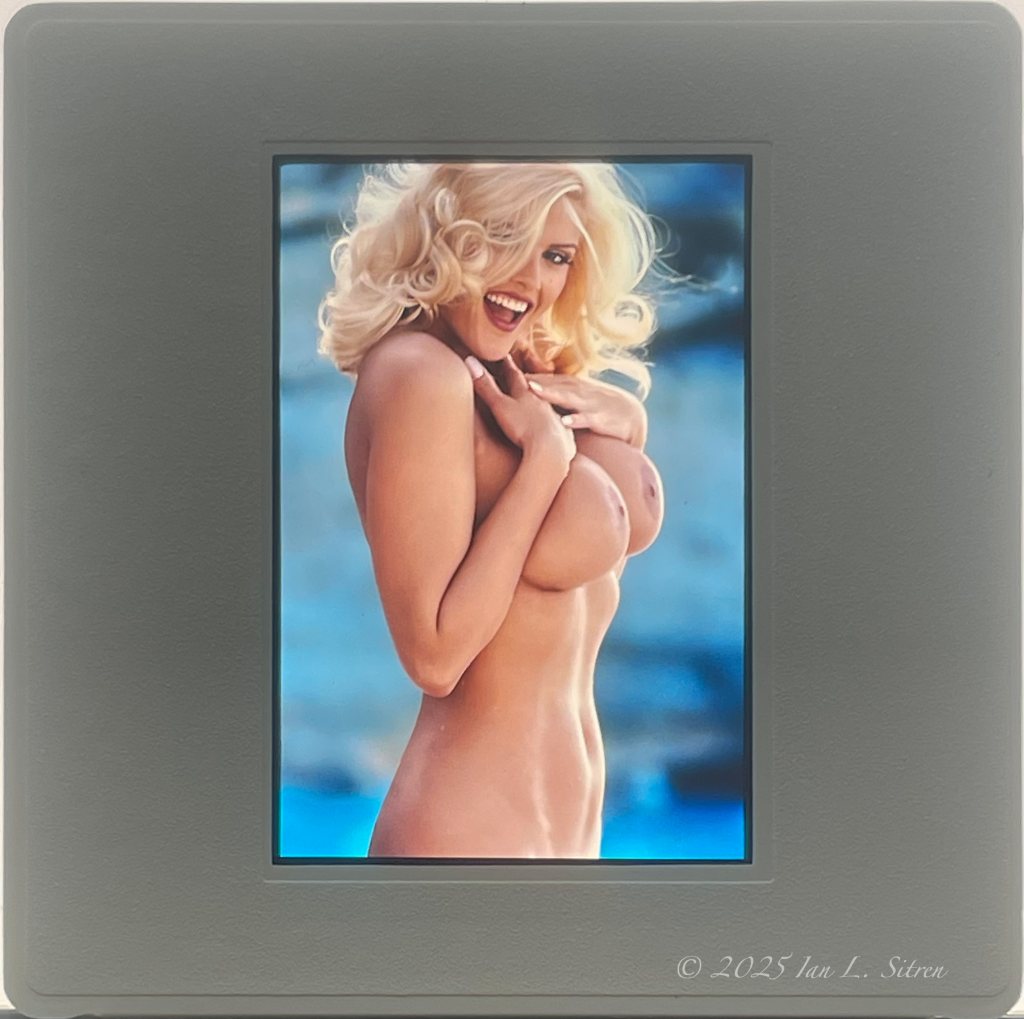
This slide of Anna Nicole Smith in my collection shows her nude, beautiful, with an extraordinary body. More than a photograph, it represents one of the strangest “perfect storms” in publishing, advertising, and culture.
Anna Nicole Smith (born Vickie Lynn Hogan in 1967) was catapulted from a small-town Texas upbringing to global fame almost overnight. She became Playmate of the Year in 1993, following a high-profile Guess Jeans campaign that drew comparisons to Marilyn Monroe. Her celebrity was as much about the headlines — her marriage to oil tycoon J. Howard Marshall, battles over his estate, and a reality TV show — as it was about modeling. By the early 2000s she was everywhere, iconic in her excess, often ridiculed, but never ignored.
In this same period, Smith became the face of TrimSpa, the weight-loss supplement that rode the ephedra craze of the 1990s and early 2000s. “TrimSpa, baby!” became as recognizable as her modeling work. Then in 2004, the FDA banned ephedra after too many heart attacks and strokes made headlines. TrimSpa scrambled with a reformulated pill, but it never sold the same.
Even so, Anna Nicole kept the brand alive through sheer celebrity power. Then, in February 2007, she died. Within a year, TrimSpa’s parent company was in bankruptcy. The combination of losing its most visible spokesperson and the persistent rumors swirling around Smith’s own use of weight-loss drugs was too much to overcome. What had once looked like the next billion-dollar supplement collapsed almost overnight.
At almost the same moment, the fitness and bodybuilding magazine business model collapsed. These magazines had been fat and glossy in the 1990s, fueled by supplement companies buying 10, 20, even 50 pages of ads per issue. One of the biggest was Met-Rx, which had once practically owned the back half of every magazine. But the economics changed fast:
- Ephedra disappeared and took much of the fat-burner profits with it.
- TrimSpa imploded in lawsuits and bankruptcy.
- Corporate owners cut spending at Met-Rx and other brands.
- And then the 2008 financial crisis crushed what was left.
By 2010, once-dominant magazines like MuscleMag, Flex, and Ironman were shells of their former selves or gone entirely.
So this slide of Smith isn’t just a collectible transparency. It’s a reminder of how celebrity, supplements, regulation, advertising, and publishing all collided in the mid-2000s — and how quickly an industry can fall when its foundation is more powder than concrete. For me, keeping this slide isn’t only about Anna Nicole Smith as an image. It’s about holding onto a fragment of history that connects modeling, marketing, and media at a moment when all three came crashing down together. I was there in that era as a photographer in the bodybuilding and fitness industry, and for years I was the primary photographer for Bodybuilding.com. Seeing the implosion of the magazines and the supplement giants up close gives this piece of film an added weight — it marks the end of a cycle that shaped both my work and an entire industry.
You can see this and more original slides and transparencies from my archive in From My Collections on my website at https://www.secondfocus.com/gallery/From-My-Collections-Cultural-Erotic/G0000h1LWkCCepcc/
Lt. Leslie Scorch MASH* – A 1970s Negative of Linda Meiklejohn
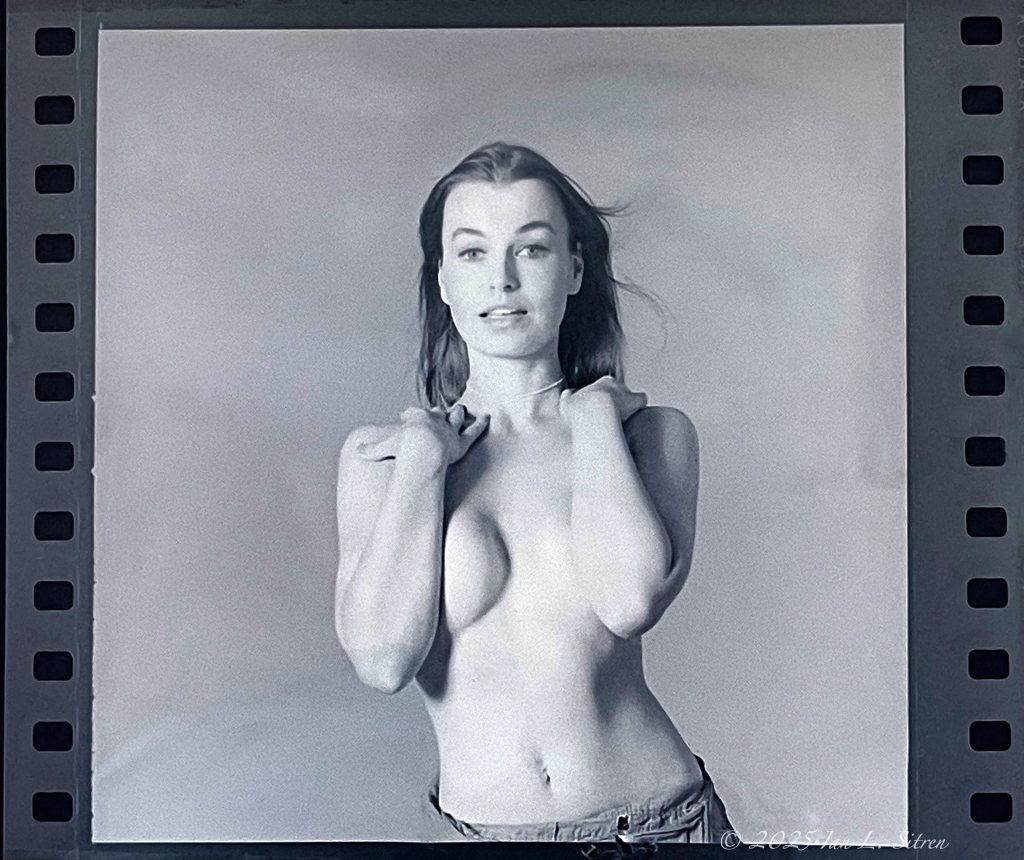
Now in my collection—a striking black-and-white negative of actress Linda Meiklejohn, shown here in a rare and intimate pose not often seen in her career.
Meiklejohn appeared in eight early episodes of MASH*, including the pilot episode in 1972, as Lt. Leslie Scorch. Though the role was brief, it placed her in one of television’s most enduring and influential series. She also guest-starred in *Mod Squad*, *Love American Style*, and *Police Woman*—each emblematic of the era’s changing culture and network television’s shift toward more modern, youth-driven storytelling.
Beyond acting, she came from Hollywood lineage. Her father, William Meiklejohn, was one of the industry’s most powerful casting directors and talent agents during the studio era. He is widely credited with discovering Ronald Reagan and introducing him to Warner Brothers, launching a career that spanned from film to the White House.
This image is out of the ordinary for Meiklejohn, who was not widely known for risqué or revealing photographs. While some promotional photos exist, this negative—photographed by Harry Langdon—presents a more candid and sensual portrayal than what audiences typically saw of her on screen.
Langdon was one of the most prolific photographers in Los Angeles from the 1970s through the 1990s. Known for his clean lighting and high-glamour portraits, he captured hundreds of Hollywood figures in moments that now serve as a visual time capsule of the era.
The original negative is now part of my growing archive of vintage imagery.
View it in the “From My Collections (Cultural & Erotic)” gallery on my website:
👉 https://www.secondfocus.com/gallery/From-My-Collections-Cultural-Erotic/G0000h1LWkCCepcc/
 SecondFocus Blog