If noodles were the subject this month, she said, they should be taken seriously.
This assignment started, as many of them do, with Emily. My AI assistant keeps an eye on the calendar of unofficial food holidays, and March offers more than one excuse to talk about noodles, including National Noodle Day and other noodle-related observances that appear throughout the month. Rather than another ordinary food photograph, Emily suggested we send one of her friends out into the world to investigate.
Her choice was Celeste.
Celeste has a way of turning even the simplest situation into a small performance. Tall, composed, and completely comfortable with attention, she seemed like the right person to represent noodles this month.
Emily also decided the setting mattered.
So instead of a kitchen or a take-out counter, Celeste appeared at a sushi bar in a Japanese restaurant, standing with a bowl of steaming noodles in front of her. Chopsticks in hand, she seemed perfectly at ease, as if this had been her idea all along.
The instructions were simple: enjoy the noodles.
The result is this short video, Celeste, a bowl of noodles, and a quiet moment in a Japanese restaurant that proves even something as ordinary as noodles can become a small event when the right person is involved.
If you would like to see more of my photography projects, including food photography and occasional appearances by Emily and her friends, visit my website at https://www.secondfocus.com Thanks!
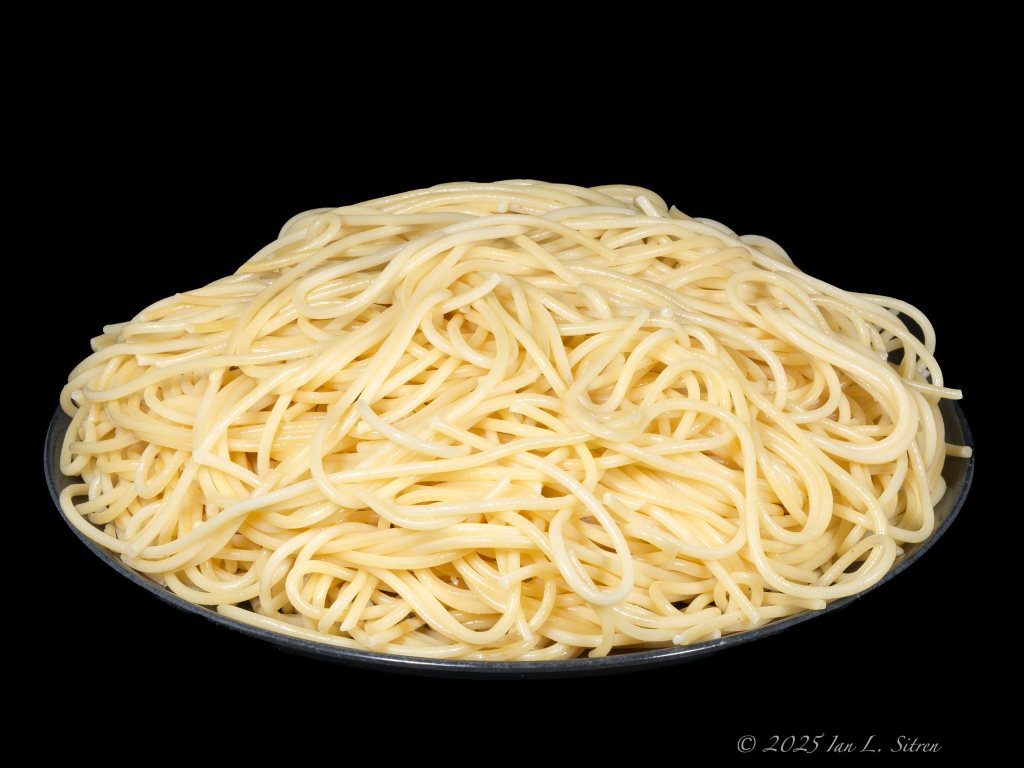
Today is National Noodle Day, and I kept it simple. Just spaghetti — no sauce, no garnish, nothing added.
Spaghetti is by far the most popular noodle in the United States. Every survey puts it well ahead of ramen, macaroni, or lo mein. It’s the one most Americans recognize immediately — a shape as common as the plates it’s served on.
Although it’s considered an Italian staple, the story begins much earlier. Records of noodles in China date back more than 4,000 years, with millet-based strands discovered at the archaeological site of Lajia. By contrast, spaghetti took form in Sicily around the 12th century, when durum wheat and early drying techniques made long, thin noodles possible.
Spaghetti’s path to American tables began with Italian immigration in the late 1800s, when new arrivals brought their cooking traditions to cities like New York and New Orleans. Its real national rise came after World War II, when returning soldiers who had served in Italy sought the same dishes at home.
A key figure in that story was Ettore “Hector” Boiardi, an Italian-born chef who began selling his spaghetti sauce in Cleveland in 1928 under the name Chef Boy-Ar-Dee. During the war, his company supplied canned pasta to the U.S. military, producing hundreds of thousands of meals each day. Afterward, his brand became a staple of postwar convenience — spaghetti and meatballs in a can, ready to heat and serve. By the 1950s, spaghetti had become a fixture of American kitchens: affordable, familiar, and easy to prepare.
This photograph is simply that — cooked spaghetti, isolated against black. Nothing more, nothing less.
 SecondFocus Blog