National Chicken Wing Day: 15 Original Hot Wings From Wingstop
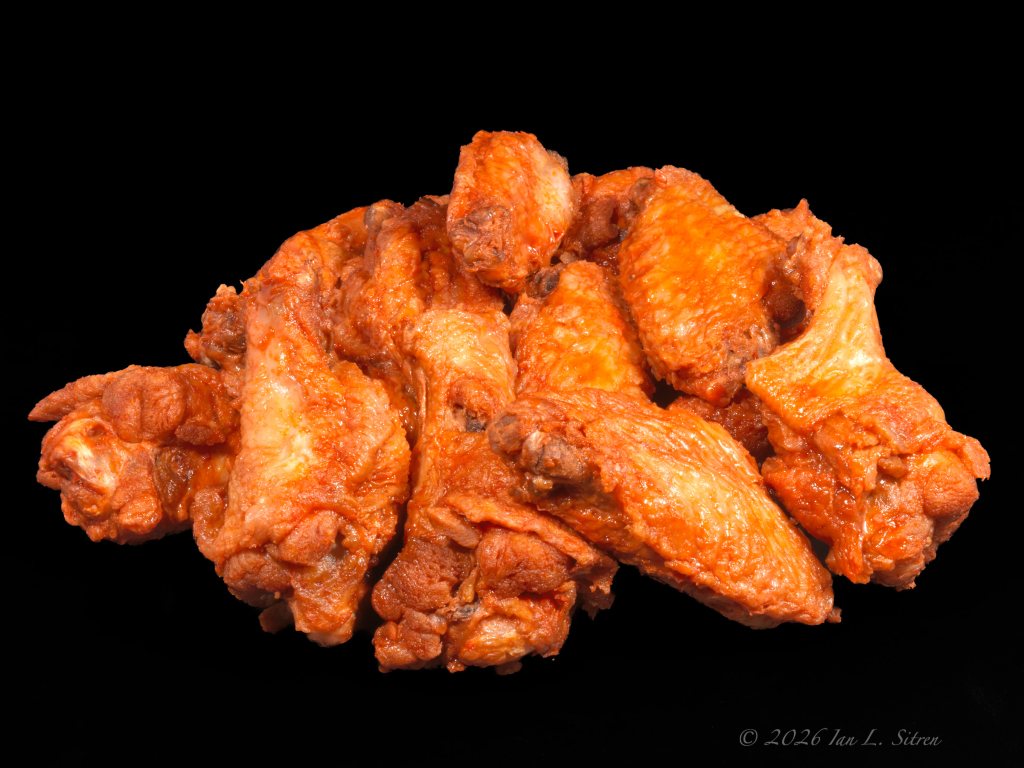
Today is National Chicken Wing Day, so this one seemed to require an actual pile of chicken wings.
The modern Buffalo wing story is generally traced to Buffalo, New York, in 1964, when Teressa Bellissimo at the Anchor Bar deep-fried chicken wings, tossed them in a peppery hot sauce and served them with blue cheese and celery. There are competing versions of exactly how that first plate came about, but the Anchor Bar story became the one most closely associated with what we now know as Buffalo wings.
By 1977, wings had become such a part of Buffalo that Mayor Stan Makowski proclaimed July 29 “Chicken Wing Day.” That local proclamation eventually became the National Chicken Wing Day we observe today.
For my photograph, I went to Wingstop. The company started in Garland, Texas, in 1994, began franchising in 1997, and has since grown to thousands of restaurants around the world. By 2002, Wingstop had already served its one-billionth wing.
I bought 15 pieces of Original Hot, which seemed like the appropriate choice for the day. Just the wings exactly as I wanted to photograph them, piled against my very black black background.
That seemed much more appropriate for my “Food From Bag To Background” fast food photography project.
Happy National Chicken Wing Day!
You can see more of my photography, projects, motion, and my Blog on my website at https://www.secondfocus.com
Thank You!
National Chicken Finger Day: Raising Cane’s Built an Empire on One Idea
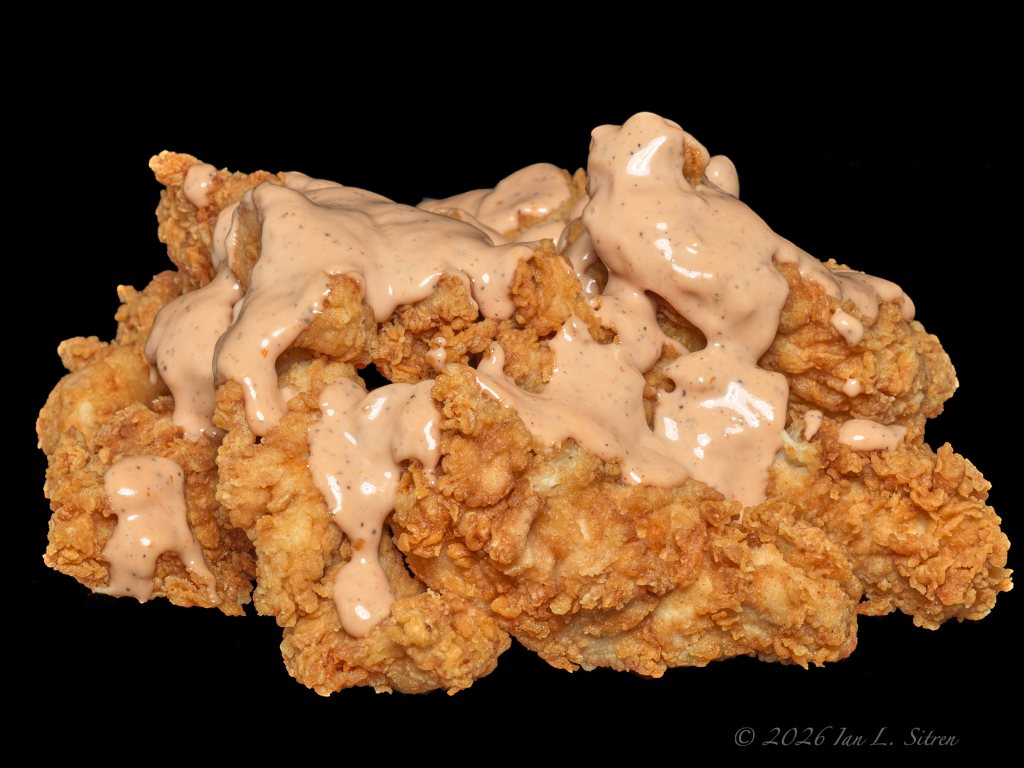
I didn’t realize that chickens had fingers, but apparently Todd Graves and Craig Silvey, the founders of Raising Cane’s, did.
And they took the idea very seriously.
The story of Raising Cane’s goes back to a college business plan for a restaurant built around one thing: chicken fingers. The idea was not exactly greeted with enthusiasm. Graves says the business plan received the lowest grade in his class, and banks weren’t interested in financing it either. He went to work at an oil refinery in Los Angeles and then commercial fishing in Alaska to earn money to pursue the idea. The first Raising Cane’s opened near Louisiana State University in Baton Rouge on August 28, 1996.
And chicken fingers weren’t just one item on a larger fast food menu. They were the entire concept. Raising Cane’s still describes chicken finger meals as its “ONE LOVE.”
Apparently that very simple idea worked.
Raising Cane’s has grown from that single restaurant near LSU into an international fast food chain. The company opened a record 118 new restaurants in 2024 alone, and in May 2025 announced that it had reached 800 restaurants worldwide. The expansion has continued since then, with new restaurants opening across the United States and internationally.
So it also makes sense that National Chicken Finger Day itself comes from Raising Cane’s. Todd Graves created the day in 2010, and it is observed every July 27. Raising Cane’s obtained full trademark status for National Chicken Finger Day in 2019, and says it has given away more than one million chicken fingers in connection with the day over the years.
Then there is Cane’s Sauce. The recipe is kept secret, the sauce is made fresh daily in each restaurant, and it has become almost as identified with Raising Cane’s as the chicken itself.
For my photograph, dipping seemed entirely too restrained. I bought the chicken fingers, piled them against my very black black background, and poured the Cane’s Sauce over the top.
That seemed much more appropriate for my “Food From Bag To Background” fast food photography project.
Happy National Chicken Finger Day!
You can see more of my photography, projects, motion, and my Blog on my website at SecondFocus.com
Thank You!
National Drive-Thru Day: Who Really Invented the Drive-Thru?
Yesterday was National Drive-Thru Day. And like so many things we now take for granted, the story of the drive-thru is a little more complicated than it might seem.
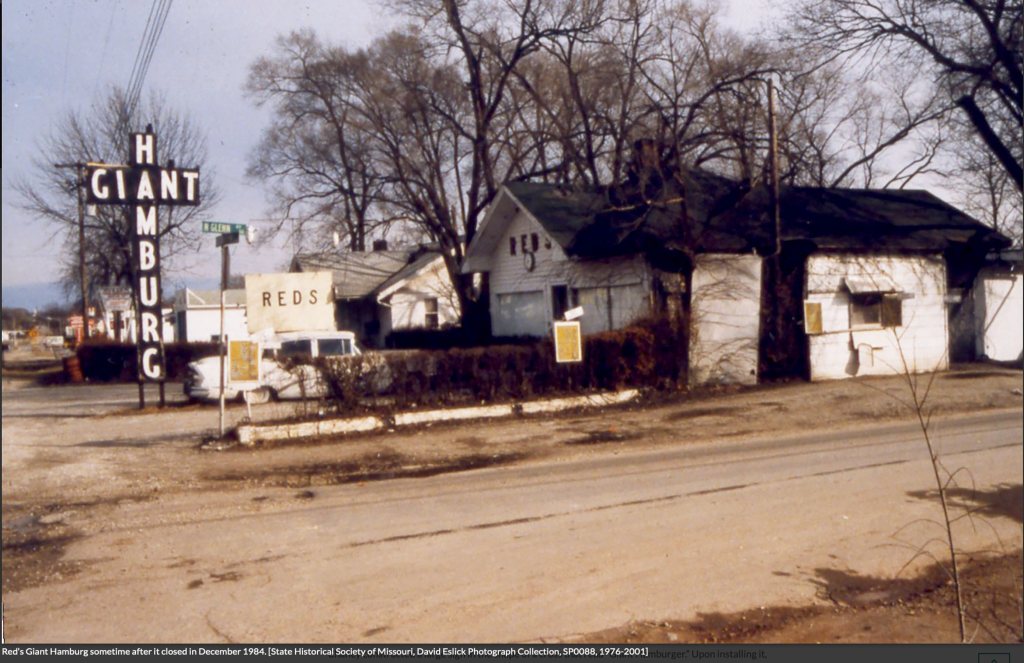
Red’s Giant Hamburg in Springfield, Missouri, is widely credited as the first drive-thru restaurant in the United States. Red’s opened along Route 66 in 1947, and by 1948 owner Sheldon “Red” Chaney had installed a drive-up window and speakers so customers could order from their cars and then pick up their food.
That is Red’s in this photograph, sometime after it had closed. The photograph is from the State Historical Society of Missouri, David Eslick Photograph Collection.
At almost exactly the same time, something similar was happening in California.
Harry and Esther Snyder opened the first In-N-Out Burger in Baldwin Park in 1948. Harry developed a two-way speaker system that allowed customers to place their orders without getting out of their cars and then drive forward to pick up their food. In-N-Out calls the original location California’s first drive-thru hamburger stand.
So Red’s gets the historical credit for the first drive-thru, while In-N-Out helped establish the ordering system that looks much more like the drive-thru we know today.
Then along came Jack in the Box.
Jack in the Box opened in San Diego in 1951 with drive-thru service built around ordering through a two-way intercom and picking up the food at a service window. Decades later, in 2002, Jack in the Box campaigned for a National Drive-Thru Day, originally proposing July 28. California Governor Gray Davis recognized the occasion statewide, and the observance later moved to July 24.
So Jack in the Box did not invent the drive-thru.
But they did give it its own day.
You can see more of my photography, projects, motion, and my Blog on my website at https://www.secondfocus.com
Thank You!
National Junk Food Day: Fast Food and Junk Food Are Not the Same Thing
Last Tuesday was National Junk Food Day, which got me thinking about something I see confused all the time.
Fast food and junk food are often talked about as if they are the same thing. They are not. Some fast food can certainly be junk food, but being fast food is not what makes it junk food. And much of what we call junk food is not fast food at all.
So what does junk food look like?
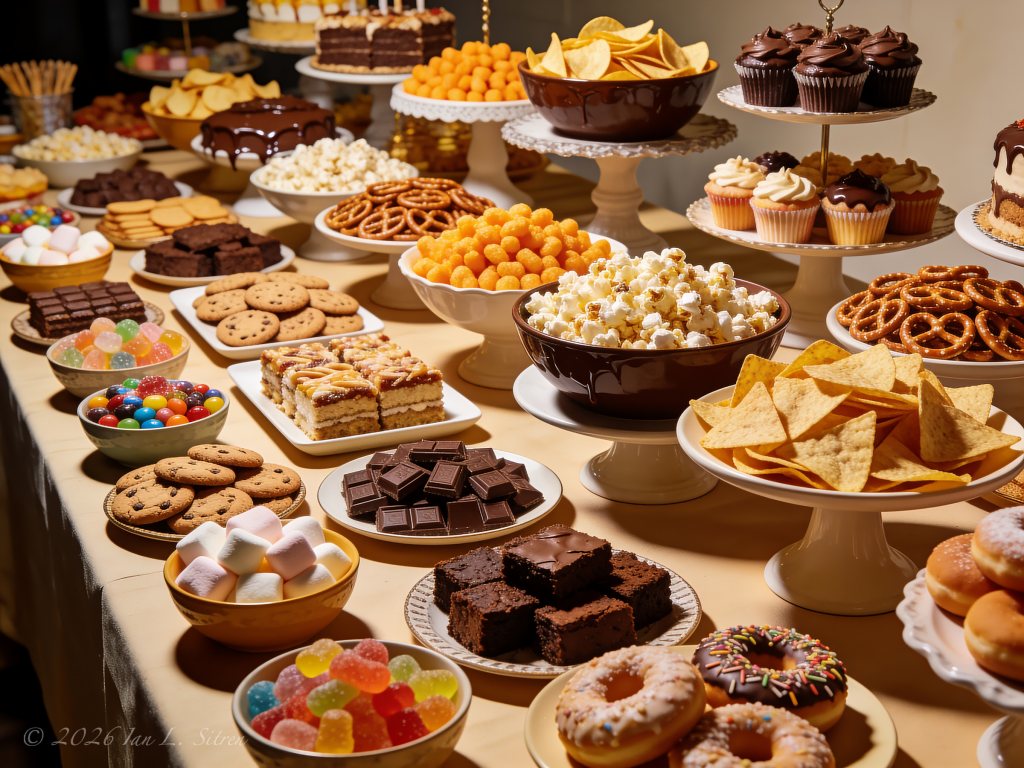
Potato chips, cheese puffs, candy, cookies, brownies, cupcakes, doughnuts, pretzels, snack cakes and all those other things we eat mostly because we like them. Lots of sugar, salt and fat, not much nutritional ambition, and very easy to keep eating long after you intended to stop.
That is what got me thinking about what a photograph of actual junk food should look like. Not just one bag of chips or a plate of cookies. I wanted all of it. A ridiculous abundance of junk food presented as though it deserved its own buffet.
So I created it with AI. Platters, bowls and cake stands piled with just about every kind of junk food I could think of, all together on one table.
Apparently, if you put enough junk food on serving platters and cake stands, it becomes a formal occasion.
You can see more of my photography, projects, motion, and my Blog on my website at https://www.secondfocus.com
Thank You!
National Biscuit Day and the Simplicity of FOOD FROM BAG TO BACKGROUND
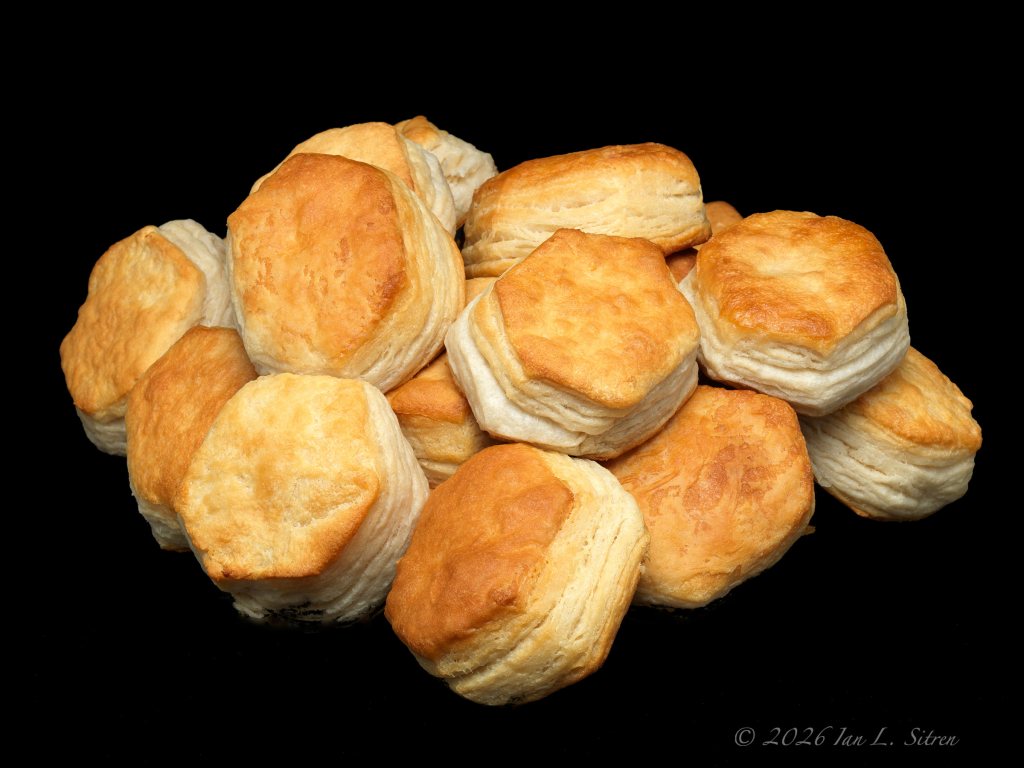
National Biscuit Day.
Some foods don’t really need marketing agencies, AI enhancement, stylists with tweezers, or fake steam drifting through the frame.
Biscuits are one of them.
These are just peel-apart biscuits photographed for my FOOD FROM BAG TO BACKGROUND series exactly the way they came out of the package and oven. No brushed butter, no artificial shine, no tricks to make them look taller, fresher, or more dramatic than they actually were.
And honestly, that was always part of the point of this project.
Fast food and convenience food advertising has trained people to expect food to look exaggerated, oversized, and almost synthetic. But when you isolate something simple against a black background and actually pay attention to it, the real texture starts doing the work by itself. The layers, the uneven browning, the soft edges, the imperfect shapes. Those details are usually hidden behind logos, wrappers, commercials, and speed.
Biscuits are also strangely tied into American fast food culture. Fried chicken chains, drive-thru breakfasts, gas station counters, roadside diners. They exist somewhere between comfort food and convenience food, which is probably why they fit this project so well.
So for National Biscuit Day, no AI animation experiments, no dramatic visual effects, just biscuits.
And when I was a kid, when my mom made these, I could have eaten every one of them, each with a pat of butter melting into the middle.
If this photograph brought back a memory, made you hungry, or simply made you look at something familiar a little differently, there are dozens more waiting in FOOD FROM BAG TO BACKGROUND. Burgers, tacos, pizza, donuts, fries, sandwiches, and other foods pulled straight from the bag and placed under the same black backdrop.
You can explore the entire series here on my website at https://www.secondfocus.com/index/G0000wQ3fbeEezF0
National Brisket Day and the Reality Behind FOOD FROM BAG TO BACKGROUND
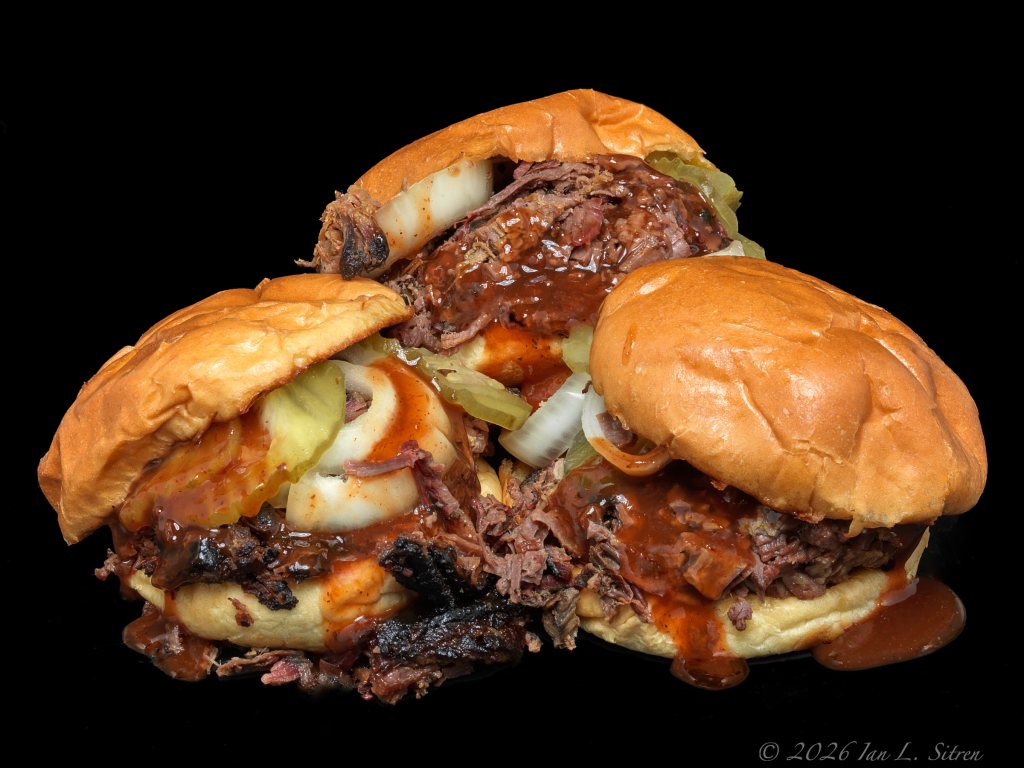
Today is National Brisket Day.
One of the things I wanted to challenge with my “FOOD FROM BAG TO BACKGROUND” project was the idea that food only becomes visually interesting after it passes through a marketing department, a food stylist, an art director, retouching, and increasingly now, AI image generation.
These brisket sandwiches from Dickey’s Barbecue Pit are none of that.
They were bought like any normal takeout order, carried home in a bag, opened, placed onto a black background, and photographed exactly as served. No rearranging. No fake steam. No hidden supports. No motor oil pretending to be sauce. No tweezers moving sesame seeds into place.
And yet they still work visually.
Actually, I would argue they work because they are real.
The overflowing chopped brisket, the uneven piles of smoked meat, the compressed buns, the dripping barbecue sauce, the onions and pickles sliding out of place, all of it feels far more appetizing and believable than the heavily over-engineered perfection seen in so much advertising imagery now.
That tension became one of the central ideas behind FOOD FROM BAG TO BACKGROUND. Fast food and takeout photographed seriously, exactly as it exists in the real world, isolated against black with no attempt to hide the messiness, excess, or reality of what arrived in the bag.
And sometimes the real version ends up looking better than the manufactured one.
More from FOOD FROM BAG TO BACKGROUND:
https://www.secondfocus.com/index/G0000wQ3fbeEezF0
National Hamburger Month, The Whopper Strikes Back in the BIG ARCH Authenticity War
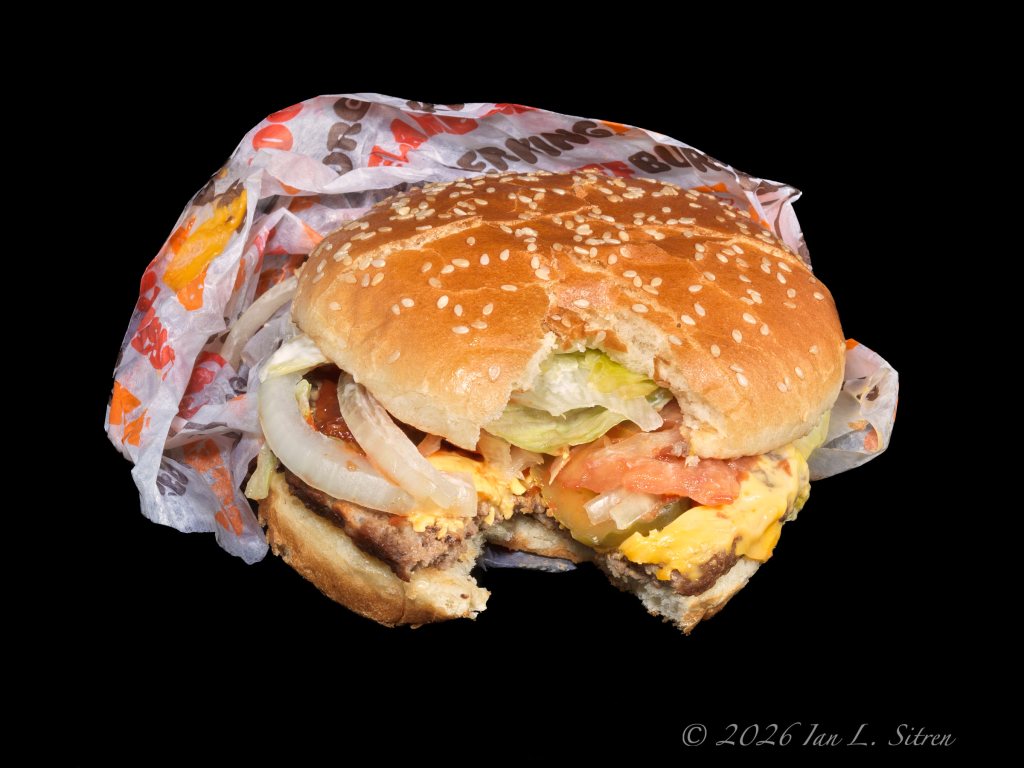
Yesterday I wrote about the introduction of the BIG ARCH from McDonald’s and the strange corporate authenticity debate that unexpectedly formed around it. That post ended up becoming less about hamburgers themselves and more about how massive fast food companies now perform for the public in real time, with every detail immediately analyzed, mocked, defended, or turned into marketing.
If you missed it, the first part is here:
But the story really did not stop with McDonald’s.
Burger King quickly responded using the Whopper as its counterargument. Not a new burger. Not a limited-time release. Just the Whopper itself, the company essentially arguing that authenticity did not need to be engineered because they already had it.
That became the fascinating part of this entire fast food moment.
McDonald’s presented the BIG ARCH almost like a flagship corporate object, oversized, stacked, carefully engineered, heavily promoted. Burger King responded with flame-grilled familiarity and a deliberately less controlled image. The companies were no longer simply competing on taste or price. They were competing on who appeared more believable.
And honestly, that may be the most modern form of advertising possible.
The Whopper itself has a long history. Introduced in 1957, it actually predates the Big Mac and became Burger King’s defining product for decades. Larger, messier, harder to eat cleanly, more physically uneven than the carefully stacked advertising versions most companies prefer to show.
Which is why this photograph interested me.
Unlike the BIG ARCH image I photographed earlier, this one already has a good sized bite taken out of it. The wrapper is still there. The burger is compressed from the bite. Sauce and onions are shifting out of place. It looks handled because it was handled.
That changes the photograph completely.
The image stops being about idealized presentation and becomes more about evidence, consumption, and the strange reality of how people actually interact with fast food. The burger becomes less like advertising and more like an object moving through someone’s life for a few minutes before disappearing.
That tension has become part of what I am exploring with the Food From Bag To Background project.
Fast food companies spend billions trying to construct images around products like this. Commercials, slogans, campaigns, celebrity promotions, social media teams, engineered branding language. But once the wrapper opens and someone takes a bite, the entire performance starts collapsing back into something very physical and very ordinary.
And somehow that may be the most authentic part of the entire thing.
More from the Food From Bag To Background project at https://www.secondfocus.com
National Walnut Day
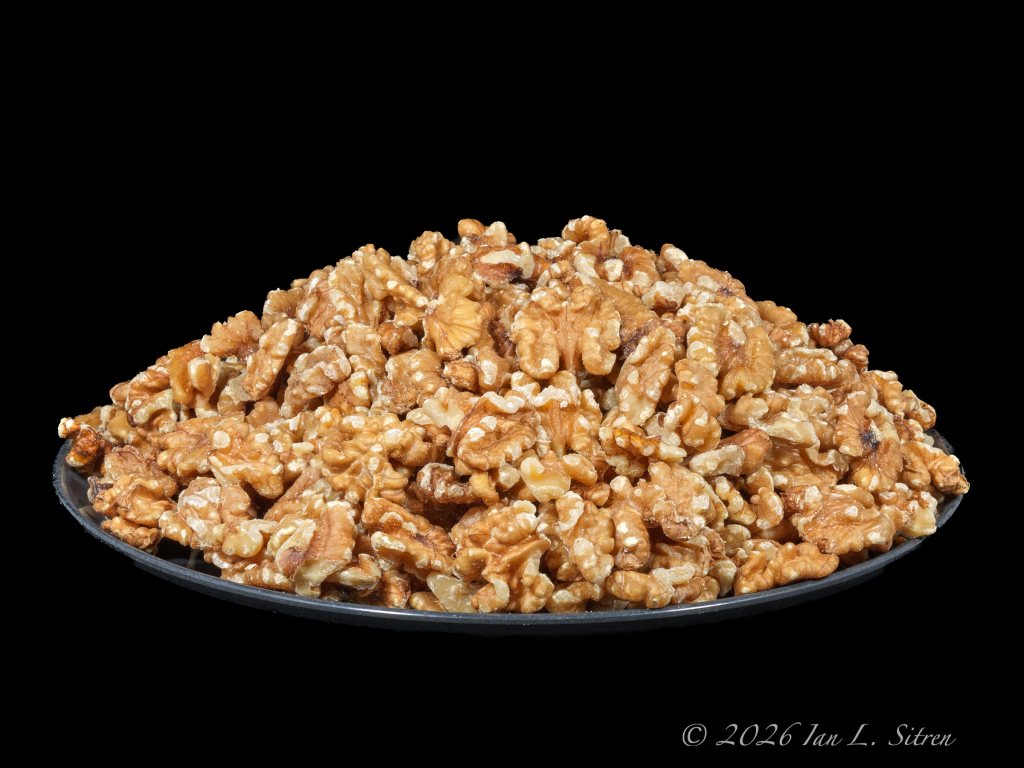
Today is National Walnut Day.
And unlike a lot of modern food holidays that seem to appear because somebody on social media decided tacos or donuts needed another excuse for hashtags, this one actually became official through the United States government.
National Walnut Day was originally established in 1949 by the Walnut Marketing Board. Then in 1958, the U.S. Senate passed a resolution officially recognizing May 17 as National Walnut Day, signed by President Dwight D. Eisenhower.
So walnuts have had an officially recognized day on the calendar for nearly 70 years.
And walnuts carry more weight than people probably realize. California now produces about 99% of all walnuts grown in the United States and roughly a third of the world’s walnut supply. They’ve become tied to everything from baking and salads to snack foods, health food culture, and holiday desserts.
This photograph keeps the idea simple. Just walnut halves piled onto a black plate against a black background. No styling tricks, no added elements, no attempt to turn them into something else. The texture, shapes, and warm tones do the work on their own.
Sometimes that’s enough.
More at https://www.secondfocus.com
Pickle Day, The International Version
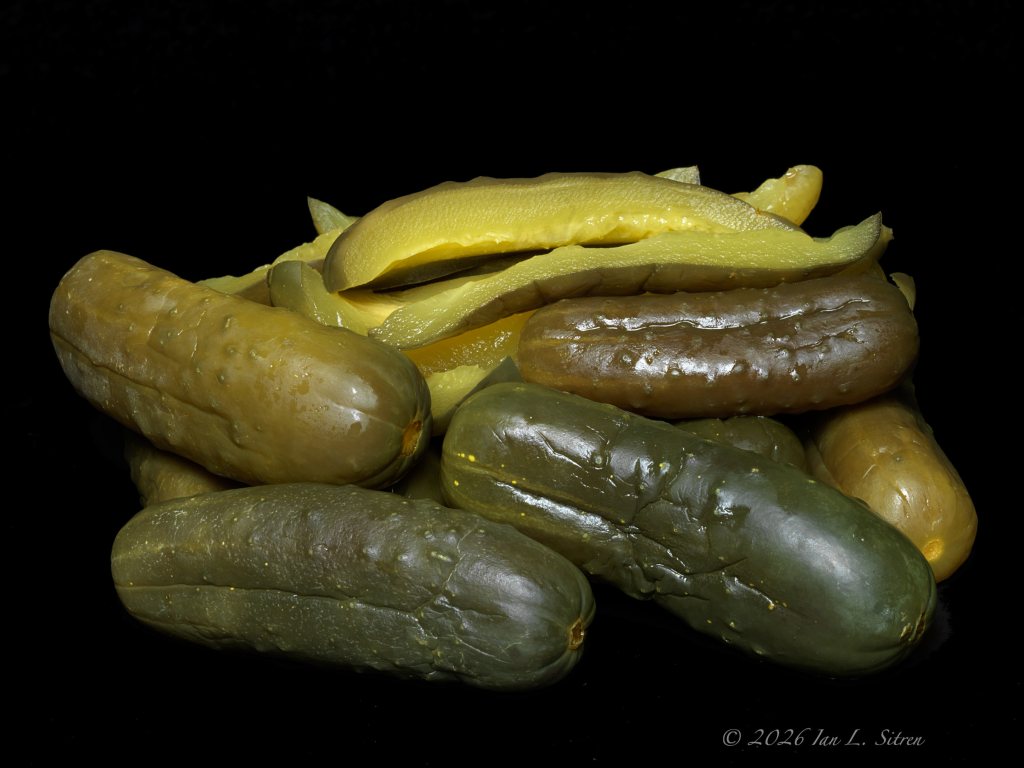
Today is International Pickle Day.
Because at some point, we decided pickles deserved a global platform.
And honestly, that tracks. Pickles show up everywhere. Not always the same, not always even close, but the idea holds. Take something fresh, preserve it, transform it, and give it time.
In the U.S., it usually lands here, cucumbers, brine, salt, sometimes vinegar, sometimes garlic, sometimes a little bite. The kind you get stacked next to sandwiches, burgers, or just eaten straight out of the container when no one’s paying attention.
But step outside that and it shifts quickly. Europe leans into sharper, more acidic versions. The Middle East brings in spices and different vegetables entirely. Asia pushes into fermented territory that’s deeper and more complex. Same concept, different outcomes.
That’s what makes it “international.”
This photograph keeps it simple. Whole pickles and slices, nothing styled, nothing adjusted, just taken as they are and placed onto a black background. The texture, the surface, the variation in color, that’s the entire point.
No garnish needed.
More at https://www.secondfocus.com
Yesterday was National Eat What You Want Day
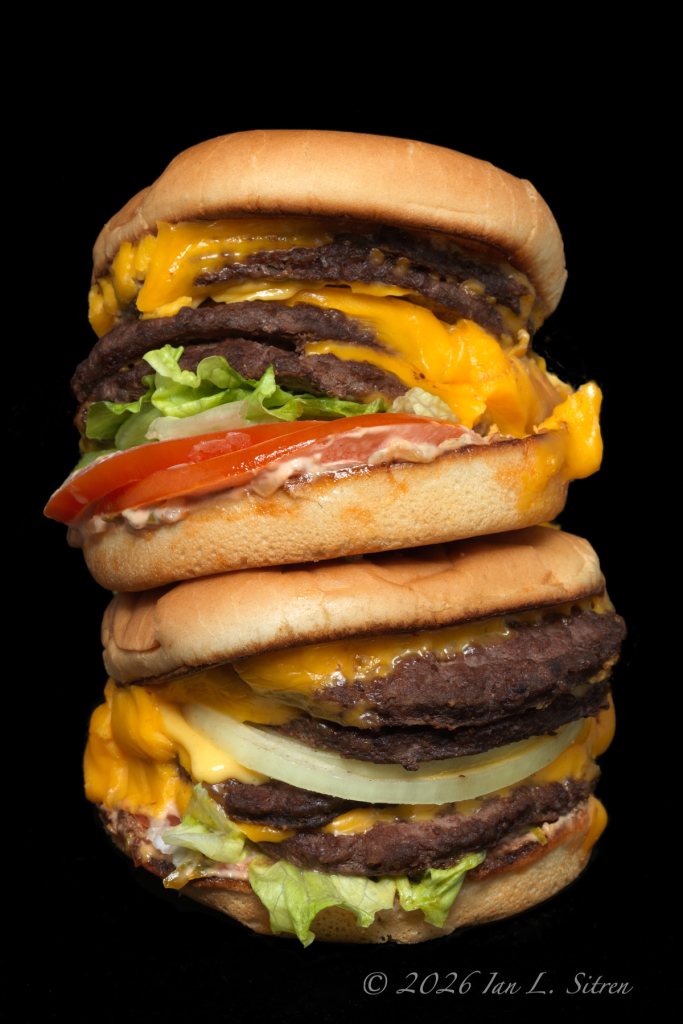
Yesterday was National Eat What You Want Day.
I actually spent some time going through all of the food photographs on my website trying to decide what I would use. First realization was just how much is there now. Second was that there were many choices.
That slowed me down enough that the day passed without a post.
So this is late, but the choice is clear.
If it’s really about eating what you want, then for me it comes down to a cheeseburger. Not a small one. Something stacked, excessive, and a little out of proportion.
No explanation needed.
Just the object, isolated on a black background, exactly as it is.
More of my food photography, from fast food to everything in between, is on my website at https://www.secondfocus.com
National Hostess CupCake Day
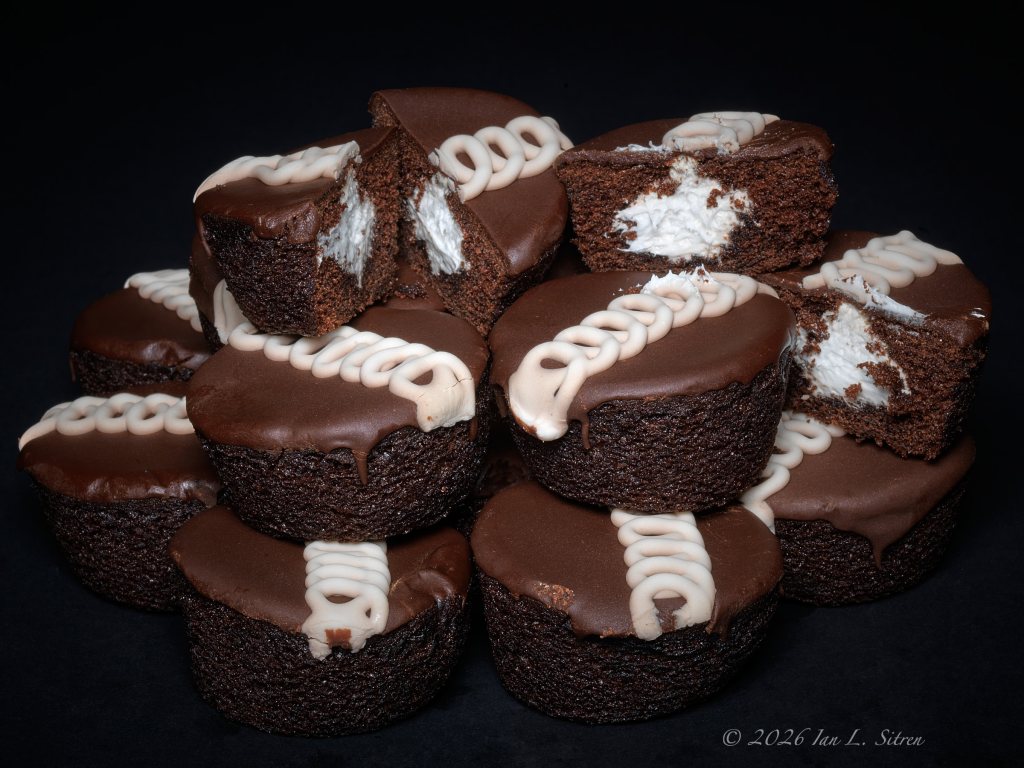
Today is National Hostess CupCake Day.
Which means we’re supposed to pause and appreciate one of the most engineered snack foods ever made.
The Hostess CupCake goes back to 1919, but the version most people recognize chocolate cake, white cream center, and that signature squiggle showed up in 1947. The swirl itself didn’t arrive until the 1950s, when a baker figured out he could pipe it on in one continuous motion.
Simple idea. Instantly recognizable.
At one point, hundreds of millions of these were being produced every year. Same shape, same filling, same swirl. Consistency as a business model.
And that’s really the point.
This isn’t about a chef, or a kitchen, or even baking. It’s about repetition. A product designed to look exactly the same every single time, whether you’re buying one or a million.
So naturally, I stacked a dozen of them on a black background.
No packaging. No branding. No context.
Just the object itself.
Which is probably not how Hostess intended you to look at it.
More of my food photography, from fast food to everything in between, is on my website at https://www.secondfocus.com
National Raisin Day
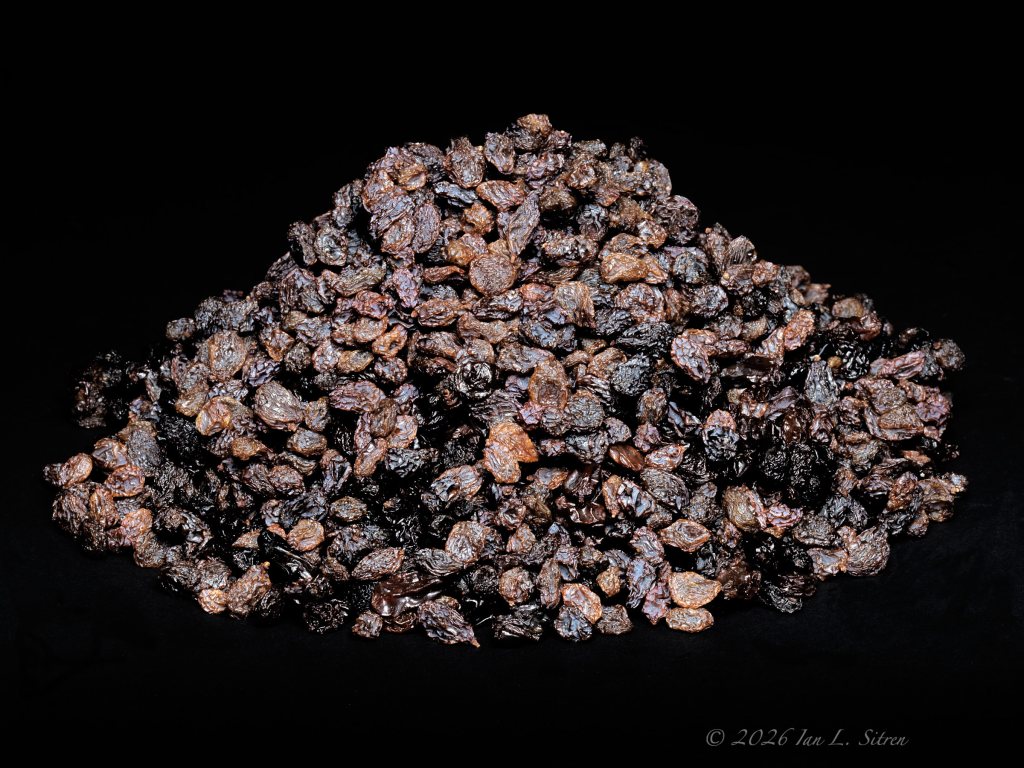
A pile of raisins. No styling tricks, no reinvention. Just grapes that didn’t make it.
Raisins go back to ancient Persia and Egypt, where dried grapes were used as both food and trade goods. They’ve had a long run for something that is essentially the result of being left alone long enough.
Today, California produces about 99% of the raisins consumed in the United States, most from the San Joaquin Valley. Globally, production reaches into the millions of metric tons each year. A lot of grapes end up here.
They are efficient. Portable. Shelf-stable. Packed with sugar, fiber, and minerals. They show up everywhere—cereals, baked goods, trail mixes—and occasionally in places where they weren’t expected.
Few foods manage to divide opinion as reliably as raisins. The cookie that looks like chocolate chip but isn’t. The dish that didn’t need them, but got them anyway. It’s a quiet kind of controversy, but it holds.
My photograph keeps it direct. A pile, isolated against black. No distractions. Just texture and density. What was once full and bright, reduced and concentrated.
More of my food photography, conceptual work, and everything in between can be found on my website at https://www.secondfocus.com
National Grilled Cheese Sandwich Day
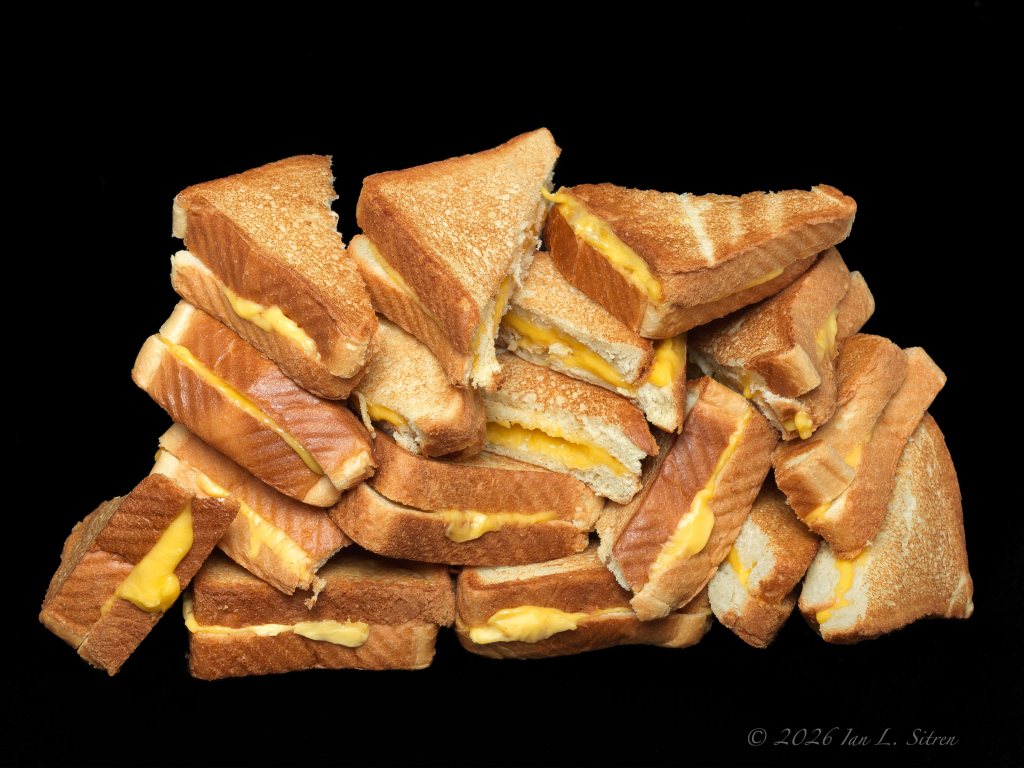
National Grilled Cheese Sandwich Day showed up again, and this one already had a place in my archive.
Last year I photographed these grilled cheese sandwiches from Sonic, stacked and set against a black background, exactly as they came. No styling, no reconstruction, no attempt to turn them into something else. Just what they are.
Sonic has been part of the American fast food landscape since 1953, when it began as a small root beer stand in Shawnee, Oklahoma. Built around the drive-in model, it became known for a menu that leaned into simplicity and consistency. The grilled cheese sandwich fits directly into that tradition. White bread, American cheese, buttered and toasted on a flat top. It is not trying to compete with anything elevated or reimagined. It is built to be recognizable, affordable, and the same every time.
That idea sits at the center of my “From Bag to Background” series. Fast food is not just something we eat quickly and forget. It is part of everyday life, routine, memory, and culture. These sandwiches, simple as they are, carry that weight. They are familiar, consistent, and widely recognized without needing explanation.
Photographing them this way isolates that idea. Removed from the packaging and the setting, they become something to look at more closely. Texture, repetition, structure, even excess. It shifts the way the subject is seen without changing what it is.
There is no attempt to elevate it into something it is not. The point is that it already matters.
More of my food photography, including the “From Bag to Background” series, along with everything else I am working on, can be found at https://www.secondfocus.com
National Corn Dog Day – 4 of Them
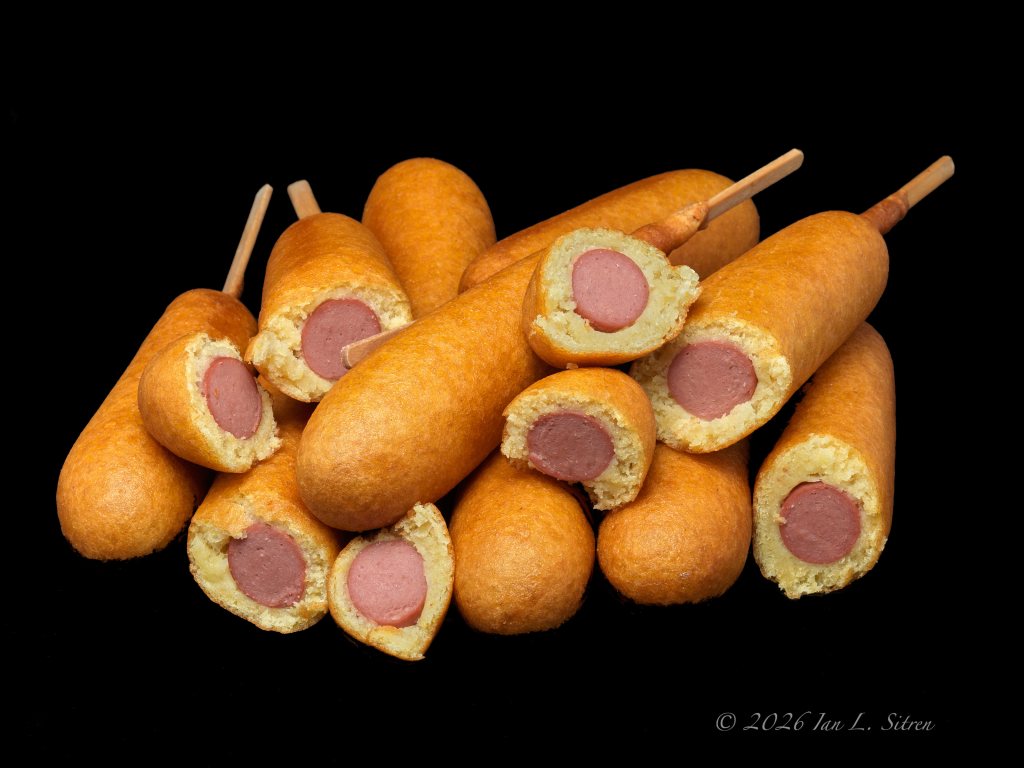
A corn dog, it turns out, has a schedule.
March 16 — often cited as the original or earliest claimed date, though no one seems certain why.
March 17 — sometimes folded into St. Patrick’s Day because it’s already a crowded calendar.
March 21 — another claimed “official” date, appearing in national day listings without clear origin.
NCAA Tournament Opening Weekend — widely accepted in practice, as National Corn Dog Day is frequently tied to the start of March Madness and watch parties.
So much complexity for my “National Days of…” calendar and photography.
Meanwhile, the corn dog itself remains exactly what it is.
A hot dog, coated in cornmeal batter and deep fried on a stick. A practical invention tied back to German sausage makers who settled in Texas, adapting their product to American tastes by dipping it in cornbread batter and frying it. By 1927, the process was patented, describing food on a stick as a “clean, wholesome and tasty refreshment.” It went on to become standard fare at fairs, festivals, school lunches, and just about anywhere something could be eaten while walking.
Simple. Portable. No explanation needed.
Which makes it slightly surprising that something this simple now comes with multiple official dates and a tournament tie-in.
See more from From Bag to Background on my website at…
https://www.secondfocus.com/index/G0000wQ3fbeEezF0/I0000nUG8tfk8Gdc
National Pizza Day
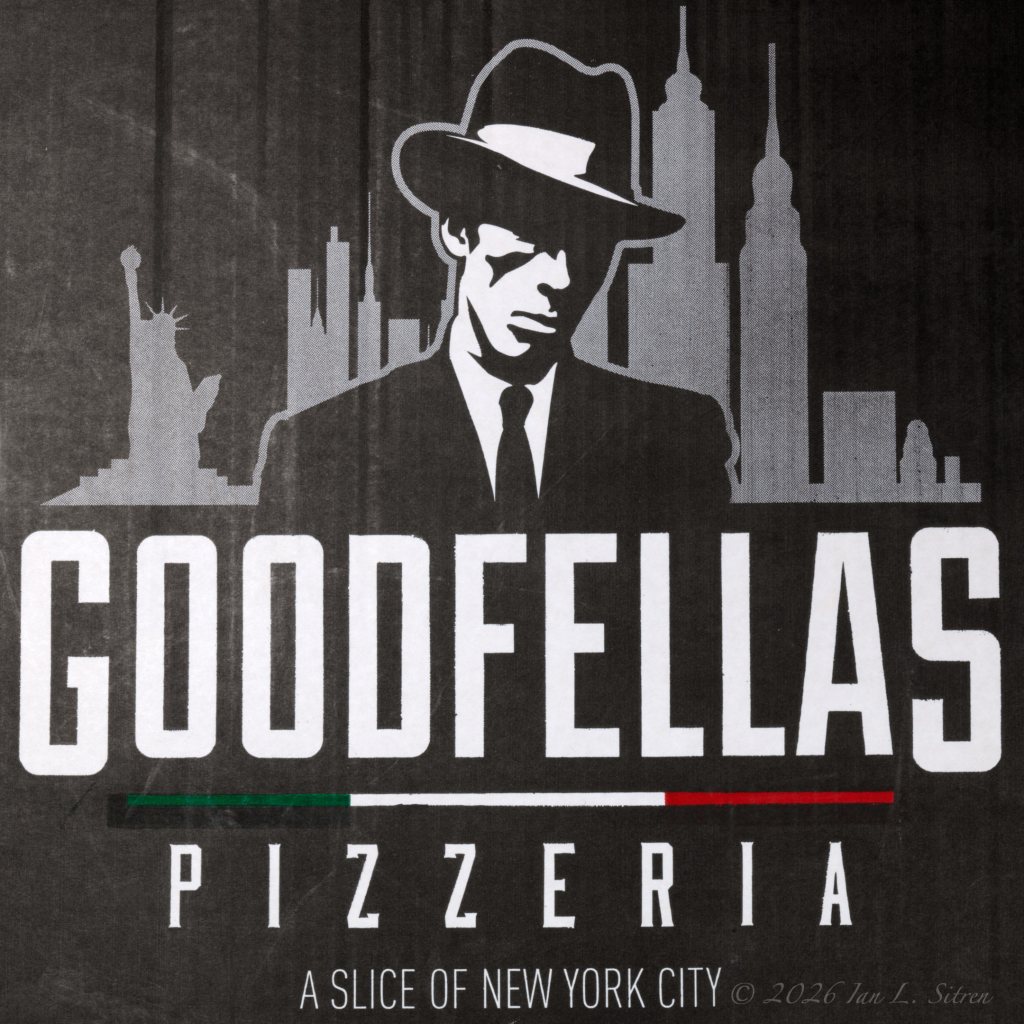
Today is National Pizza Day.
I did not have this pizza delivered all the way to Palm Springs.
In fact, I’ve never eaten at Goodfellas Pizzeria. I’ve never even seen one. Despite the box proudly declaring “A Slice of New York City,” their locations are in Kentucky, Ohio, Tennessee, and Indiana. New York itself appears to be excluded.
Still, the box made its way to me.
So I photographed it.
If you’re looking for actual pizza, not just the box it came in, you can see real pizzas and much more in my Food From Bag To Background series here:
https://www.secondfocus.com/index/G0000wQ3fbeEezF0
No delivery required.
The Fried Chicken Sandwich War

National Fried Chicken Sandwich Day — and the Sandwich That Started a Fast-Food Uprising
Today is National Fried Chicken Sandwich Day, and that seemed like the right reason to photograph a few of the most disruptive sandwiches in recent fast-food history. I stacked four Popeyes fried chicken sandwiches straight from the bag onto my usual black background. No styling, no tricks, nothing rearranged. Just the food as it arrived.
Before I even started shooting, I checked in with Emily, my AI muse and assistant. She told me something I did not realize at the time: in 2019, this simple Popeyes sandwich set off one of the most unusual moments the fast-food industry has ever seen. It wasn’t just popular. It became a cultural event. And that makes it worth photographing on a day like today.
How the Chicken Sandwich War Began
The story starts quietly.
In August 2019, Popeyes introduced its Classic Chicken Sandwich nationwide. A fried chicken breast on a bun with pickles and either mayo or spicy mayo. That’s it. But within days, reviewers began posting head-to-head comparisons with the long-established Chick-fil-A sandwich. Some declared Popeyes the new front-runner.
Then Chick-fil-A sent a tweet reminding everyone that “bun + chicken + pickles = the original.”
It wasn’t aggressive, but it was enough.
Popeyes replied with, “… y’all good?”
Those two words ignited something bigger than either company could have planned.
The Public Took Over
People across the country started doing their own taste tests.
Lines formed around buildings.
Drive-thru lanes spilled into traffic.
Police officers were directing cars at certain locations.
Some stores ran out of sandwiches by noon.
Others ran out completely.
Within two weeks, Popeyes announced a national shortage. They had underestimated demand to the point that the entire supply chain ran dry. That had never happened before with a fast-food menu item.
Resellers even appeared online trying to sell their leftover sandwiches for marked-up prices. One person tried to sell half of a sandwich. It didn’t matter that none of it made sense. People were buying into the moment.
A Sandwich That Changed the Industry
When Popeyes finally restocked in November, the lines returned.
This was no longer about a meal. It was about being part of a story.
Fast-food chains noticed.
Quietly at first, then very publicly.
Between late 2019 and 2021:
- McDonald’s reformulated and relaunched its chicken sandwich.
- KFC introduced a new version of theirs.
- Wendy’s updated their recipe.
- Burger King did the same.
- Smaller chains reworked their menus to catch up.
It wasn’t called the “Chicken Sandwich War” as a joke.
It was a real industry shift sparked by one product.
The timing also mattered. Chicken was already surpassing beef in U.S. consumption. Chains realized that a single chicken sandwich could define an entire brand. When the Popeyes sandwich went viral, it pushed the market faster than planned.
Why Photograph It
My ongoing Food From Bag To Background series has one theme: food as purchased, against a black backdrop, with no context except what the viewer brings to it. Photographs like this show everyday things stripped down to their basic form. No wrappers, no storefronts, nothing telling you what you should think.
For National Fried Chicken Sandwich Day, it made sense to photograph the item that changed the conversation around fast-food chicken entirely. Popeyes didn’t invent the fried chicken sandwich. They didn’t try to reinvent it. But they did launch the first fast-food moment that played out like a national event. And that alone earns it a place in this project.
A Small Reminder of What Food Culture Looks Like Now
Most food trends come and go quietly.
Most fast-food items disappear without being noticed.
But every so often, something cuts through — not because it’s elaborate, but because it hits the public at the right moment.
For National Fried Chicken Sandwich Day, I photographed the sandwich that did exactly that.
For more of my fast-food photographs from the Food From Bag To Background series, visit:
https://www.secondfocus.com/index/G0000wQ3fbeEezF0
International Nachos Day

It’s International Nachos Day—proof that even the most accidental snack can earn a global holiday. The humble pile of chips, cheese, and jalapeños that began as a quick improvisation now has its own calendar slot, official hashtags, and corporate menu boards. Somewhere, Ignacio “Nacho” Anaya might be amused.
Anaya first created nachos in 1943 in Piedras Negras, Mexico, when a group of diners arrived after hours. He fried tortilla chips, added melted cheese and sliced jalapeños, and served what became a timeless Tex-Mex invention. After his death in 1975, October 21st was declared the day to honor both the man and the moment—celebrated each year with cheese, crunch, and excess.
Fast-forward a few decades, and fast food turned the once-local recipe into a mass-market standard. Taco Bell brought nachos into the drive-thru era, eventually landing on the Nachos BellGrande—an instantly recognizable mix of seasoned beef, cheese sauce, sour cream, tomatoes, beans, and all the optional extras that marketing could justify.
My photograph of two Nachos BellGrande orders combined on a black background captures exactly that—fast food in its purest, most unapologetic form. No plating, no garnish, just the commercial version of a 1943 invention, elevated by light and isolation.
See more of my ongoing series Food From Bag to Background at https://www.secondfocus.com/index/G0000wQ3fbeEezF0
National Noodle Day
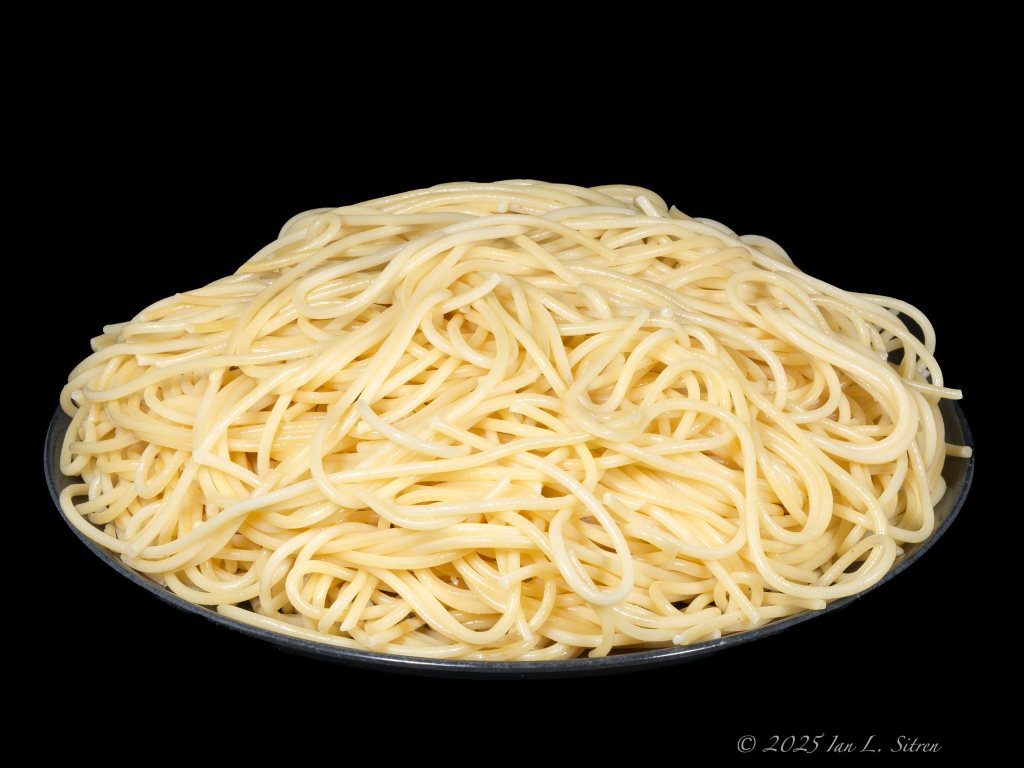
Today is National Noodle Day, and I kept it simple. Just spaghetti — no sauce, no garnish, nothing added.
Spaghetti is by far the most popular noodle in the United States. Every survey puts it well ahead of ramen, macaroni, or lo mein. It’s the one most Americans recognize immediately — a shape as common as the plates it’s served on.
Although it’s considered an Italian staple, the story begins much earlier. Records of noodles in China date back more than 4,000 years, with millet-based strands discovered at the archaeological site of Lajia. By contrast, spaghetti took form in Sicily around the 12th century, when durum wheat and early drying techniques made long, thin noodles possible.
Spaghetti’s path to American tables began with Italian immigration in the late 1800s, when new arrivals brought their cooking traditions to cities like New York and New Orleans. Its real national rise came after World War II, when returning soldiers who had served in Italy sought the same dishes at home.
A key figure in that story was Ettore “Hector” Boiardi, an Italian-born chef who began selling his spaghetti sauce in Cleveland in 1928 under the name Chef Boy-Ar-Dee. During the war, his company supplied canned pasta to the U.S. military, producing hundreds of thousands of meals each day. Afterward, his brand became a staple of postwar convenience — spaghetti and meatballs in a can, ready to heat and serve. By the 1950s, spaghetti had become a fixture of American kitchens: affordable, familiar, and easy to prepare.
This photograph is simply that — cooked spaghetti, isolated against black. Nothing more, nothing less.
View more from my Commercial Food Photography collection here: https://www.secondfocus.com/index/G0000WFAqDJQOgKU
National Quesadilla Day, the Frozen Aisle Edition
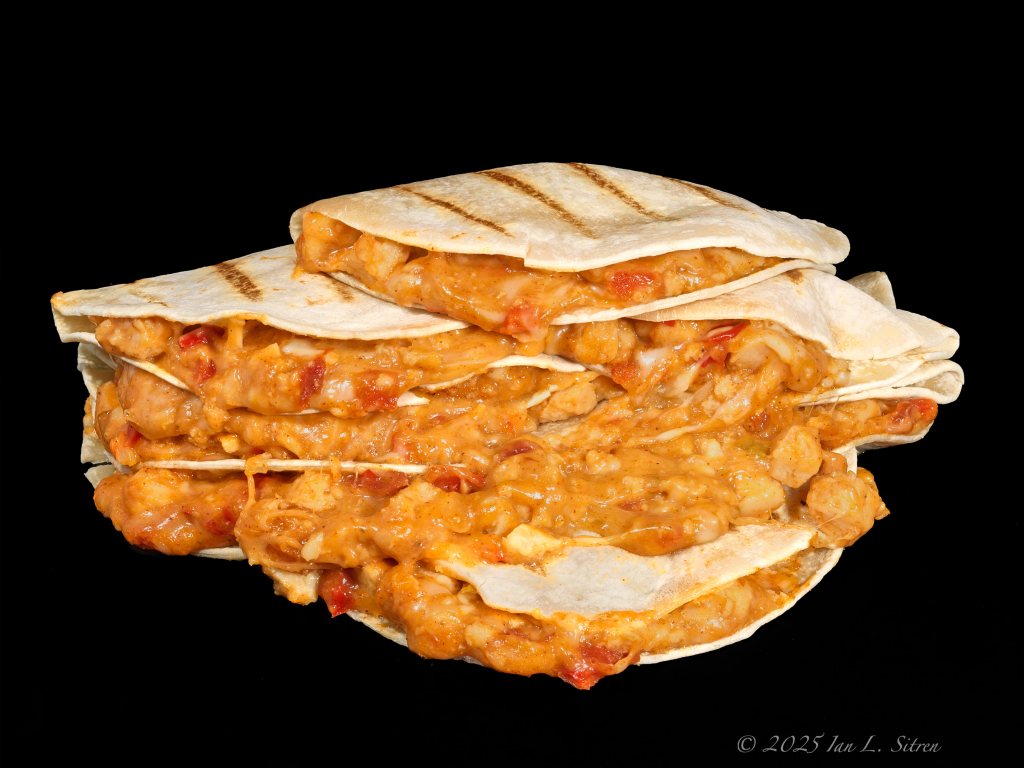
Today is National Quesadilla Day. I could’ve gone to Del Taco or Taco Bell — but that felt too expected. I wanted fast food, and this still qualifies.
The quesadilla began in 16th-century Mexico — tortillas and cheese on a hot griddle, simple and fresh. Over the centuries it spread, evolved, and crossed borders. And now, at last, it has reached its pinnacle: two entire boxes of El Monterey frozen chicken and Monterey Jack quesadillas, stacked straight from cardboard to black background. Ten quesadillas, no chef required. Just freezer, oven, and done.
Is it authentic Mexican food? No. It’s just another variation of fast food — not handmade on the street corner, not handed through a drive-thru window, but pulled from a box in the freezer aisle.
Five hundred years of history, now available in 15 minutes at 375 degrees — family pack times two.
📸 From my From Bag to Background series:
https://www.secondfocus.com/index/G0000wQ3fbeEezF0
🥪 National Eat A Hoagie Day

Forget politics, pandemics, and Wall Street — today it’s all about National Eat A Hoagie Day.
The celebration honors the long, layered sandwich that goes by many names: hoagie, sub, grinder, hero. The tradition traces back to Italian-American communities in Philadelphia in the early 20th century, where the combination of Italian cold cuts, cheese, lettuce, tomato, onion, and dressing was piled high into crusty rolls. The name “hoagie” is often credited to Philadelphia shipyard workers nicknamed “hoggies,” who carried these hearty sandwiches to work.
The day recognizes both the sandwich itself and its many regional variations across the United States. While “hoagie” is Philadelphia’s word of choice, most of the country knows them as subs, and in New England they’re just as likely to be called grinders. Whatever the name, the essence is the same: a long roll, stacked with meats, cheeses, vegetables, and that messy-but-perfect balance of oil, vinegar, and seasonings.
For this year’s National Eat A Hoagie Day, I photographed three Jersey Mike’s Original Italian hoagies, cut and stacked against my signature black background. Jersey Mike’s, which started as a single sub shop in Point Pleasant, New Jersey in 1956, has grown into a national chain with over 2,000 locations. They’ve built their reputation on freshly sliced meats and cheeses, rolls baked fresh daily, and sandwiches made to order “Mike’s Way” — onions, lettuce, tomato, oil, vinegar, and oregano.
The hoagie is both a cultural icon and a humble meal — straight from the bag, unstyled, layered with flavor and history.
And if you think hoagies look good, wait until you see what happens when tacos, burgers, and sushi get the same black-background treatment. Explore my ongoing series, “Food From Bag To Background,” here: https://www.secondfocus.com/index/G0000wQ3fbeEezF0 Just don’t click on an empty stomach.
National Waffle Day: Waffles and Whipped Cream
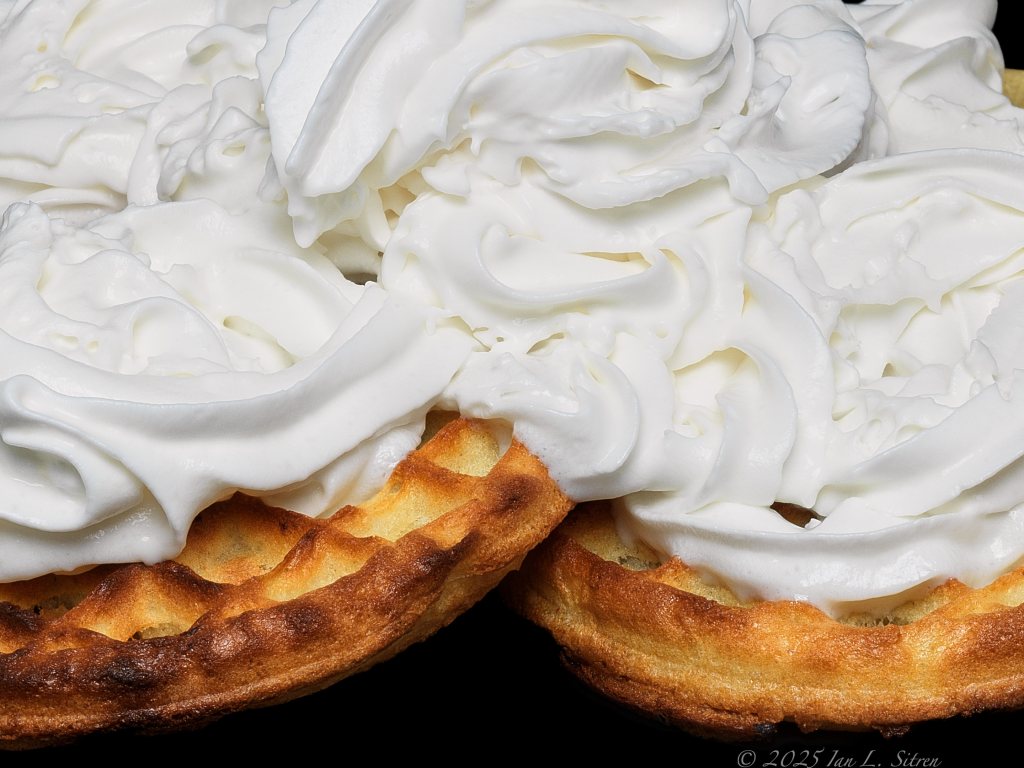
Waffles have traveled a long road in American culture — from colonial hearths to diners, hotel buffets, and even novelty cones for ice cream. They’ve been loaded with fried chicken, drenched in syrup, and adapted countless ways since Dutch settlers first brought them here in the 1600s.
August 24th marks National Waffle Day in the United States. The date commemorates the 1869 U.S. patent issued to Cornelius Swartwout for the waffle iron.
For this year’s occasion, I photographed waffles covered in generous swirls of Reddi Wip whipped cream. Mention whipped cream in American pop culture and you can’t ignore Herb Alpert & the Tijuana Brass — the 1965 album Whipped Cream & Other Delights, famous for its cover of model Dolores Erickson nude, wearing nothing but whipped cream, became an icon of its era. Here, the whipped cream might be less suggestive, but it remains just as central to the scene.
It’s a reminder that sometimes food doesn’t need embellishment or styling. Straight from the can, straight from the toaster oven, and straight to the camera.
See more from my commercial food photography gallery here:
👉 https://www.secondfocus.com/index/G0000WFAqDJQOgKU
National Cuban Sandwich Day

America has never quite decided what to do with Cuba. One decade it’s enemy, the next it’s exotic fantasy — a forbidden island of cigars, rum, bright cars, baseball players, exotic women and complicated politics. Yet in the middle of embargoes and obsessions, one export slipped through and became an icon: the Cuban sandwich. Roast pork, ham, cheese, and pickles pressed together until even rivals find common ground.
Today is “National Cuban Sandwich Day”, a moment to appreciate this classic of Cuban-American cuisine, rooted in Tampa and Miami and carried far beyond. Traditionally made with roast pork, sliced ham, Swiss cheese, pickles, and mustard on Cuban bread, the sandwich is pressed until the flavors meld into something greater than the sum of its parts.
My photograph shows two Cuban sandwiches plated with fried plantains, another staple of Cuban cuisine. The pulled pork and ham layers contrast with the tang of pickles and melted cheese, while the plantains add a caramelized richness to the plate. Presented against a dark background, the bold textures and colors stand out, highlighting the character of this dish.
Explore more of my commercial food photography gallery on my website at
https://www.secondfocus.com/index/G0000WFAqDJQOgKU
World Kebab Day, Americanized

Today is World Kebab Day, and yes, that’s a thing. While the kebab’s origins are skewered meats over open flames across the Middle East and South Asia, this is what it looks like when it passes through the American fast-food lens.
These are chicken kebab wraps from Wrap Houz here in Palm Springs, photographed exactly as they came, placed on my black background for my “From Bag to Background” series. No stylists, no plates, no garnish—just the food as it is served, textures and all.
I’ve been seeking out not just the big chains but also local fast-casual spots for this project, documenting how global foods are adapted, repackaged, and sold in convenient, handheld forms for quick lunches and late-night takeout.
World Kebab Day might make you think of skewers turning over coals, but here, it’s chicken chunks wrapped in flatbread, ready for a drive-thru or delivery bag. It’s a small glimpse of how food travels—and transforms—while staying familiar in a new context.
If you want to see more of these unstyled fast food photographs, visit my “From Bag to Background” gallery here:
https://www.secondfocus.com/index/G0000wQ3fbeEezF0/I0000nUG8tfk8Gdc


National Hamburger Month and the Billion Dollar Authenticity War Behind the BIG ARCH
May is National Hamburger Month.
Which sounds simple enough until you stop and realize how much of modern American culture quietly revolves around hamburgers.
This year, the biggest burger story has probably been the introduction of the BIG ARCH from McDonald’s. Not just because it was another fast food launch, but because the entire thing unexpectedly turned into a strange cultural event involving corporate marketing, social media authenticity, public reaction, and billions of dollars sitting underneath all of it.
The burger itself was designed to be bigger, heavier, and more excessive than the traditional McDonald’s lineup. Two large beef patties, layered cheese, onions, lettuce, pickles, special sauce, and a large sesame and poppy seed bun. McDonald’s positioned it almost like a flagship object, the “most McDonald’s McDonald’s burger yet,” which is such a corporate sentence it almost becomes satire on its own.
Earlier this year, McDonald’s CEO Chris Kempczinski posted a promotional tasting video for the BIG ARCH. Instead of focusing on the burger, people focused on him. The small bite. The awkward delivery. The careful corporate language. Whether he looked comfortable eating it at all.
The clips spread everywhere. TikTok, YouTube reactions, business media, late-night commentary, memes, marketing discussions. Burger King even took shots at the situation publicly. Business writers started describing the entire thing as an “authenticity war” between fast food companies trying to appear relatable in an era where consumers instantly dissect every detail.
Which is fascinating when you step back and look at the scale of what we are talking about.
McDonald’s serves roughly 69 million customers every day around the world. Annual revenue exceeds 25 billion dollars. The global burger market itself is estimated well over 100 billion dollars annually. Entire supply chains, agricultural systems, marketing departments, packaging systems, social media strategies, and public corporations revolve around products like this.
And after all of that planning, testing, engineering, and advertising, public discussion ended up collectively debating whether a CEO looked natural taking a bite out of a hamburger.
That may actually be the most 2026 thing imaginable.
This photograph became part of that larger observation for me. The image strips away the advertising language and isolates the object itself. No restaurant interior, no fries, no smiling family, no campaign graphics. Just the burgers against black.
That approach has become part of what I’m doing with the Food From Bag To Background project. Taking fast food out of its marketing environment and presenting it almost like an artifact. The layers, the excess, the construction, the familiarity of it all. Things people see constantly but rarely stop and actually look at.
And whether people love it, criticize it, joke about it, or eat it in their car without thinking twice, the hamburger remains one of the defining products of modern American culture.
More at https://www.secondfocus.com
May 18, 2026 | Categories: Uncategorized | Tags: American culture, BIG ARCH burger, black background food photography, burger history, burger industry, Burger King, burger marketing, Burger Photography, burger wars, Chris Kempczinski, commercial food photography, cultural commentary, fast food culture, fast food history, fast food industry, fast food marketing, fast food photography, food blog, food culture, Food From Bag to Background, hamburger culture, McDonald’s, McDonald’s Big Arch, National Hamburger Month, restaurant industry, secondfocus, whopper | 1 Comment