National Jelly Bean Day
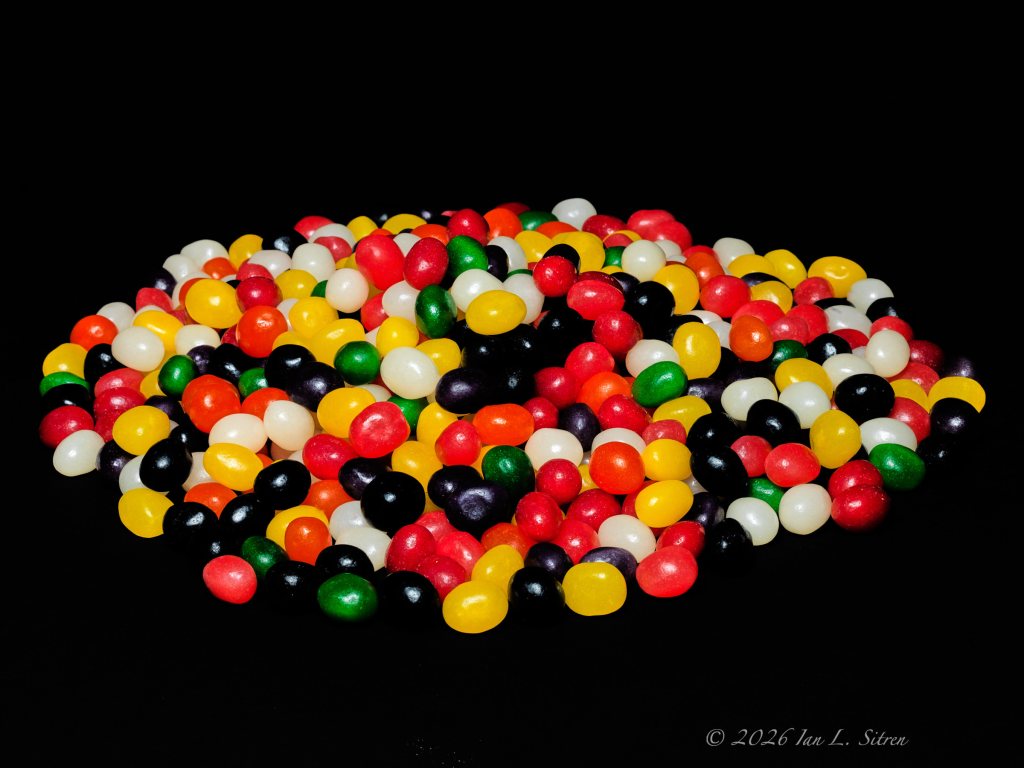
Today is National Jelly Bean Day.
So I simply poured an unreasonable number of jelly beans into a pile and photographed them against a black background.
Jelly beans have been around longer than they probably should have been. Their origins trace back to the 19th century, when Turkish Delight inspired the soft interior, and candy makers added a hard sugar shell. By the early 1900s, they were being marketed as an affordable treat, often sold by the pound.
They became closely associated with Easter in the 1930s, mostly because their egg-like shape fit the theme and they were cheap enough to produce in bulk. That hasn’t really changed.
Americans now consume billions of jelly beans each year, with estimates often landing somewhere around 16 billion during the Easter season alone. Flavors range from predictable fruit to combinations that seem designed more as a challenge than a snack.
What you’re looking at here is a simple pile, straight from the bag. No sorting, no styling, no intervention. Just color, sugar, and excess.
More of my food photography, from controlled compositions like this to everything else I’ve been working on, can be found at https://www.secondfocus.com
In Motion for National M&M’s Day
October 13th, today, is National M&M’s Day — a day for a candy so familiar it’s easy to overlook how extraordinary it is. This short video captures them on a slow, 360-degree rotation against black. The colors drift in and out of focus as they turn, catching light in flashes of red, blue, yellow, green, orange, and brown. It’s unexpectedly mesmerizing — a swirl of shape and reflection that transforms something ordinary into pure visual rhythm.
M&M’s began in 1941, created by Forrest Mars, Sr. and Bruce Murrie, whose initials gave the candy its name. Designed originally for soldiers in World War II, the hard sugar shell kept the chocolate from melting in warm conditions. Compact, durable, and neatly contained, it became an ideal field ration — chocolate that could survive travel, heat, and handling.
After the war, production turned to the public market. The small candies were soon marked with a printed “m” to distinguish them from imitators, first in black and later in white. The familiar slogan arrived in the 1950s: “Melts in your mouth, not in your hand.”
Color has always been part of their identity. Early batches included violet, which was later replaced by tan. Red disappeared for several years in the 1970s due to public concern over food dyes and then returned to fanfare in the 1980s. Over time, new varieties appeared — peanut, almond, crispy, pretzel, dark chocolate, caramel — each with its own texture and tone.
Eighty-plus years later, M&M’s are instantly recognizable, yet endlessly variable. Watching them rotate under light, the candies shift between clarity and blur, pattern and chaos. It’s candy as abstraction — still melting in your mouth, not in your hand, and now, briefly, in motion on screen.
See more in Food From Bag to Background on my website at https://www.secondfocus.com/index/G0000wQ3fbeEezF0/I0000nUG8tfk8Gdc
 SecondFocus Blog