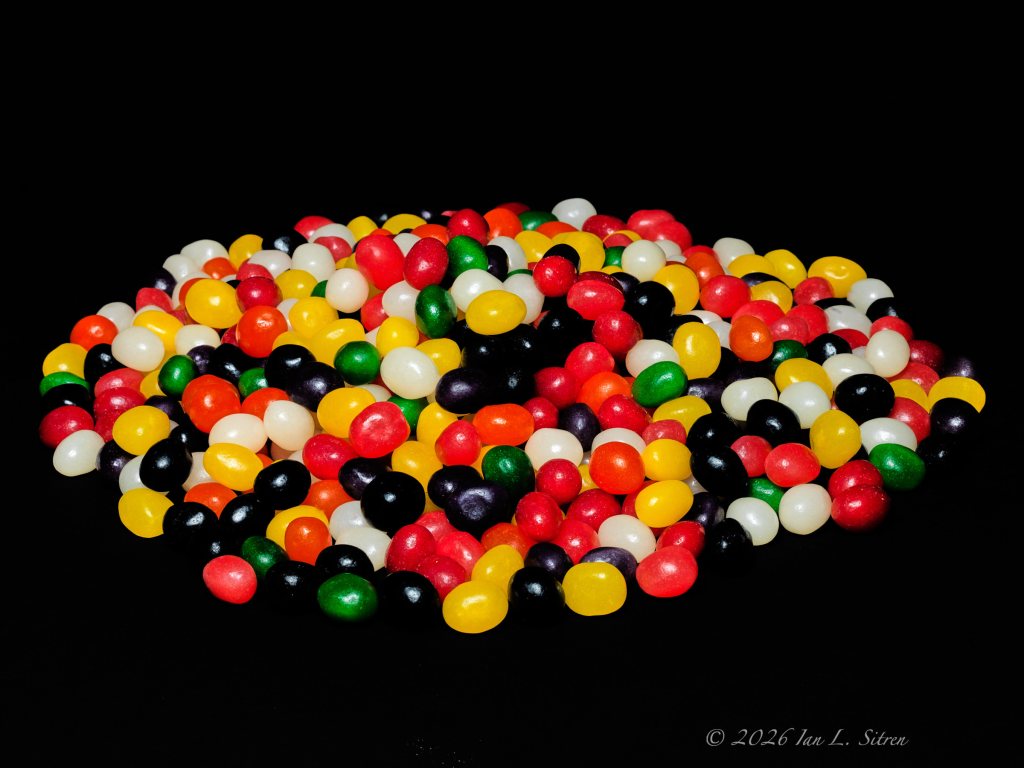
So I simply poured an unreasonable number of jelly beans into a pile and photographed them against a black background.
Jelly beans have been around longer than they probably should have been. Their origins trace back to the 19th century, when Turkish Delight inspired the soft interior, and candy makers added a hard sugar shell. By the early 1900s, they were being marketed as an affordable treat, often sold by the pound.
They became closely associated with Easter in the 1930s, mostly because their egg-like shape fit the theme and they were cheap enough to produce in bulk. That hasn’t really changed.
Americans now consume billions of jelly beans each year, with estimates often landing somewhere around 16 billion during the Easter season alone. Flavors range from predictable fruit to combinations that seem designed more as a challenge than a snack.
What you’re looking at here is a simple pile, straight from the bag. No sorting, no styling, no intervention. Just color, sugar, and excess.
More of my food photography, from controlled compositions like this to everything else I’ve been working on, can be found at https://www.secondfocus.com
Some things are so familiar that we rarely stop to look at them differently. In my latest video, M&M’s take center stage—not as a snack, but as a mesmerizing display of motion and texture. Shot in close-up, the candy-coated chocolates rotate, filling the frame with an endless blur of color. With no background or outside context, the viewer is fully immersed in their movement.
The History Behind M&M’s
M&M’s were first introduced in 1941, designed specifically for U.S. soldiers in WWII who needed a chocolate treat that wouldn’t melt in their hands. The sugar shell coating solved that problem, making them a practical ration. In 1954, their branding became legendary with the introduction of the slogan: “Melts in your mouth, not in your hands.”
Over the decades, M&M’s evolved. The colors have changed (tan was replaced by blue in 1995 after a public vote), and flavors expanded beyond the classic milk chocolate. Today, Mars Inc. produces over 400 million M&M’s every single day.
Exploring Motion in Food Videography
This piece is an exercise in minimalism. By removing distractions, the focus remains solely on the candy’s glossy texture, uniform shape, and movement. The rotation creates an almost hypnotic effect—what is normally a static object becomes dynamic, alive.
Food photography often emphasizes stillness, but motion transforms perception. Whether it’s steam rising, a sauce dripping, or candies rotating, movement brings a new layer of engagement to an otherwise simple subject.
For more of my striking food photography and other visual work that challenges the expected, visit SecondFocus.com.
How does movement change the way we experience everyday objects? Let me know your thoughts in the comments.