National Hostess CupCake Day
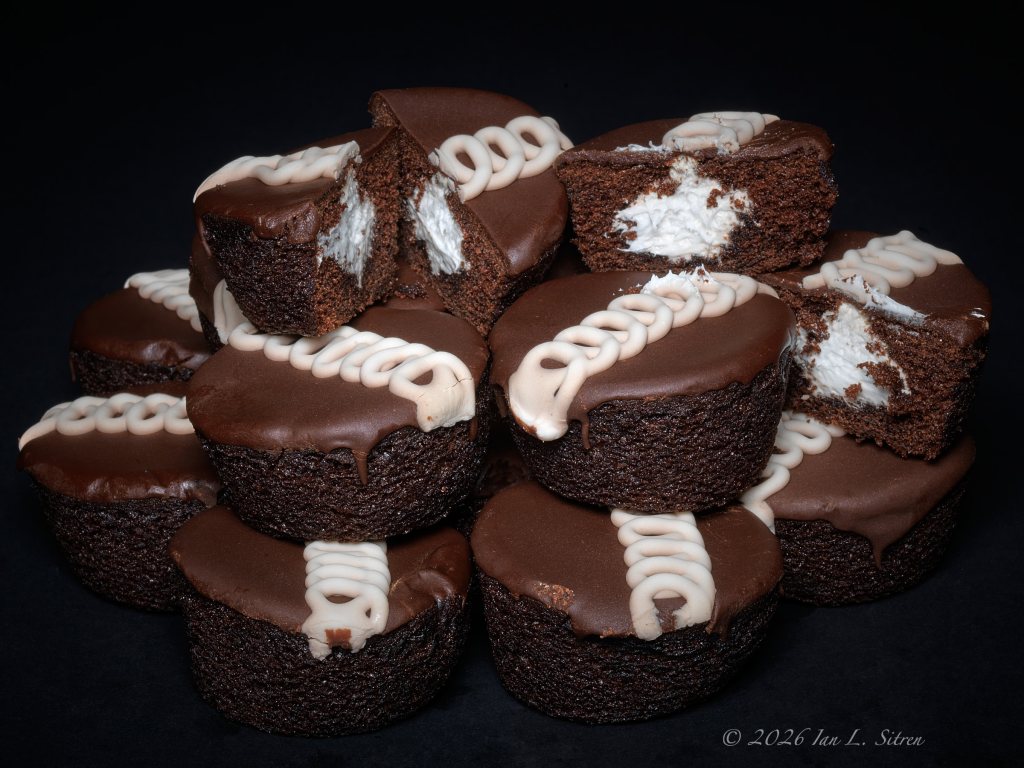
Today is National Hostess CupCake Day.
Which means we’re supposed to pause and appreciate one of the most engineered snack foods ever made.
The Hostess CupCake goes back to 1919, but the version most people recognize chocolate cake, white cream center, and that signature squiggle showed up in 1947. The swirl itself didn’t arrive until the 1950s, when a baker figured out he could pipe it on in one continuous motion.
Simple idea. Instantly recognizable.
At one point, hundreds of millions of these were being produced every year. Same shape, same filling, same swirl. Consistency as a business model.
And that’s really the point.
This isn’t about a chef, or a kitchen, or even baking. It’s about repetition. A product designed to look exactly the same every single time, whether you’re buying one or a million.
So naturally, I stacked a dozen of them on a black background.
No packaging. No branding. No context.
Just the object itself.
Which is probably not how Hostess intended you to look at it.
More of my food photography, from fast food to everything in between, is on my website at https://www.secondfocus.com
National Raisin Day
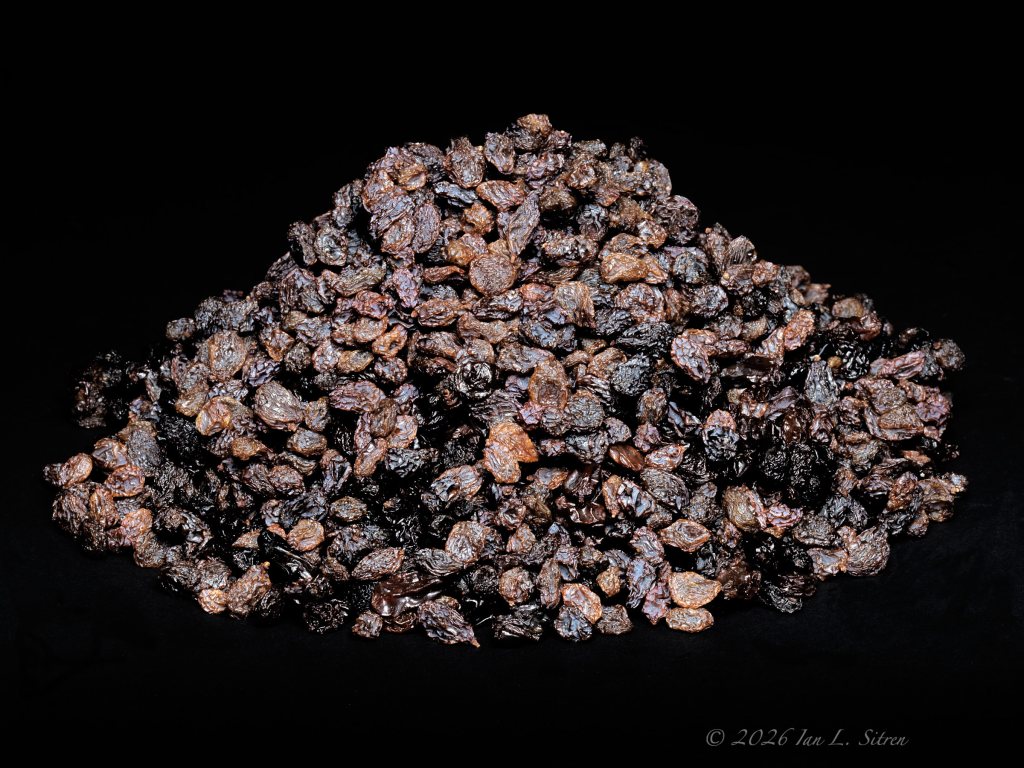
A pile of raisins. No styling tricks, no reinvention. Just grapes that didn’t make it.
Raisins go back to ancient Persia and Egypt, where dried grapes were used as both food and trade goods. They’ve had a long run for something that is essentially the result of being left alone long enough.
Today, California produces about 99% of the raisins consumed in the United States, most from the San Joaquin Valley. Globally, production reaches into the millions of metric tons each year. A lot of grapes end up here.
They are efficient. Portable. Shelf-stable. Packed with sugar, fiber, and minerals. They show up everywhere—cereals, baked goods, trail mixes—and occasionally in places where they weren’t expected.
Few foods manage to divide opinion as reliably as raisins. The cookie that looks like chocolate chip but isn’t. The dish that didn’t need them, but got them anyway. It’s a quiet kind of controversy, but it holds.
My photograph keeps it direct. A pile, isolated against black. No distractions. Just texture and density. What was once full and bright, reduced and concentrated.
More of my food photography, conceptual work, and everything in between can be found on my website at https://www.secondfocus.com
National Bacon Day!
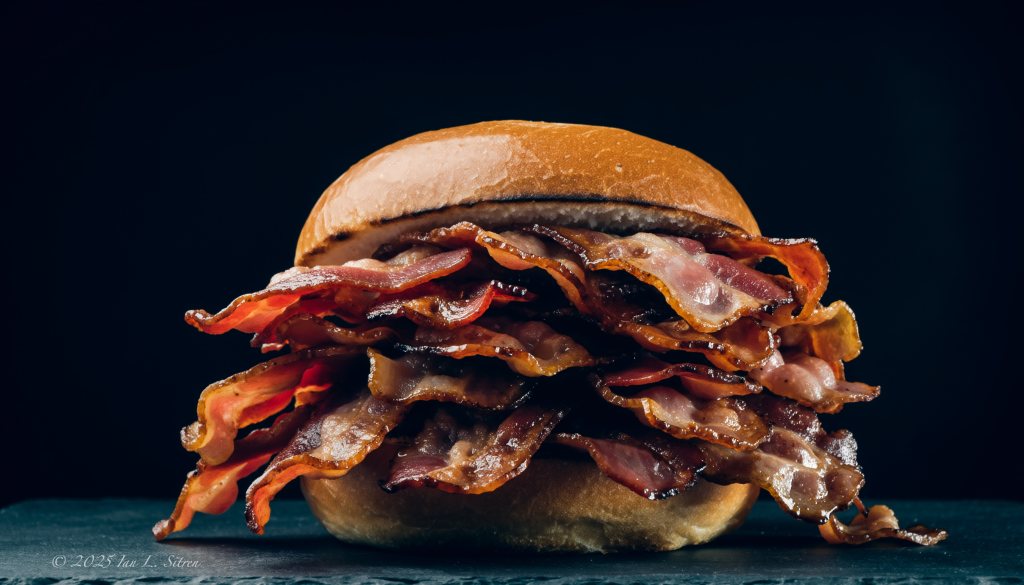
There are few foods people agree on as readily as bacon. Across generations and cultures, it holds a rare position as something almost universally liked, often described as the ingredient that makes everything better. If you asked people to name their ideal sandwich, many would quietly admit this would be it: bread, bacon, and nothing else getting in the way.
Bacon’s appeal is deeply rooted in history. Salt-cured pork dates back thousands of years, used as a practical method of preservation long before refrigeration. Variations appeared across Europe and Asia, but bacon as we recognize it today became firmly embedded in American food culture during the 20th century. By the mid-1900s, it had moved beyond breakfast and into sandwiches, burgers, and fast food, where its smoky, fatty richness became shorthand for indulgence.
Culturally, bacon has taken on a role larger than the ingredient itself. It represents abundance, comfort, and excess, often acknowledged without apology. Entire menus have been built around it, and marketing has leaned heavily into its reputation as something people crave even when they know they shouldn’t. It’s one of the few foods that can be both nostalgic and provocative at the same time.
This photograph leans into that idea by stripping the sandwich down to its core. No lettuce, no tomato, no attempt at balance. Just bacon, stacked high, presented without distraction. It’s easy to imagine this being wildly popular as a fast-food option, ordered impulsively and remembered vividly. Of course, it isn’t something you’ll actually find on a menu. And that absence is part of the point.
My fast food photography project can be found in “Food From Bag to Background” on my website at https://www.secondfocus.com/index/G0000wQ3fbeEezF0


National Foodies Day
Today is National Foodies Day.
Which got me thinking, what exactly is a “foodie” now?
There was a time when people argued over whether they were gourmets or gourmands. People who chased flavors, studied food, cared about where it came from.
Now it mostly means you took a photo of what you ordered.
So here’s my contribution to the conversation.
A stack of McDonald’s McRib sandwiches, straight out of the bag and onto a black background. No styling, no plating, no attempt to make it something it isn’t.
I photograph food, but not in the way that fits neatly into any of those categories. No chef, no restaurant, no experience attached to it. Just the object itself.
So does that make me a foodie?
Or something else entirely.
More of my food photography, from fast food to everything in between, is on my website at https://www.secondfocus.com
May 9, 2026 | Categories: Uncategorized | Tags: black background food, commercial food imagery, conceptual food photography, fast food photography, food art, food culture commentary, Food Photography, food styling vs reality, food trends, foodie definition, from bag to background, gourmet vs foodie, isolated food photography, McDonalds McRib, McRib, minimalist food photography, modern food culture, National Foodies Day, provocative food imagery, secondfocus photography, what is a foodie | Leave a comment