SPAM Meets the Big Mac
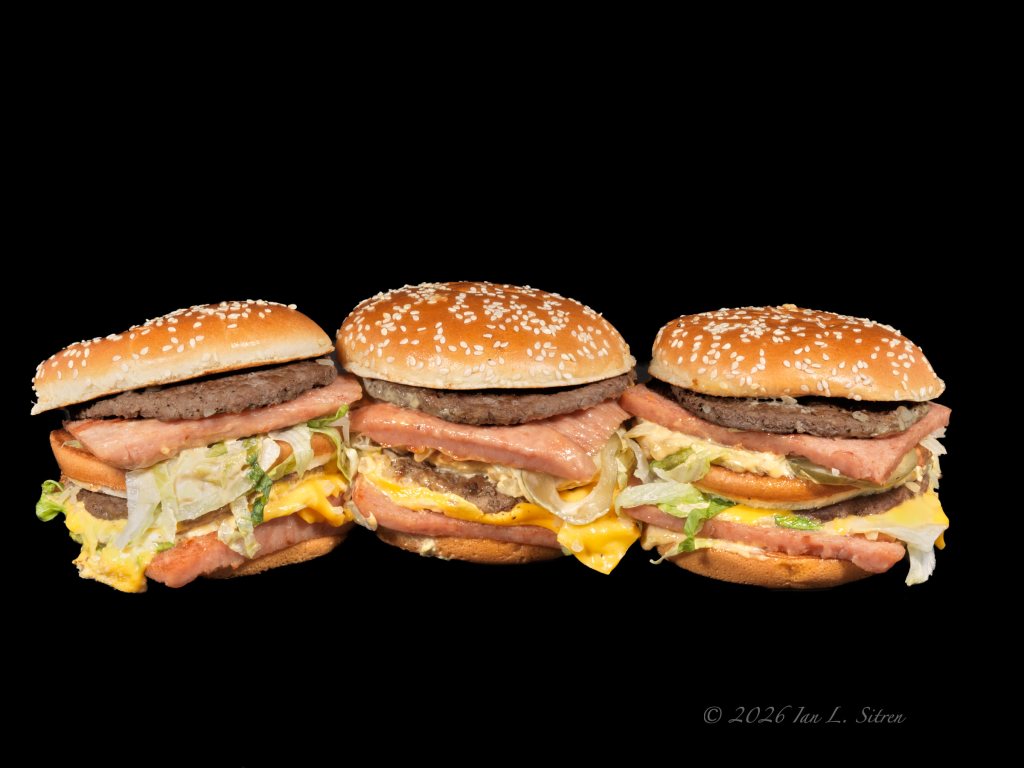
Last week gave us National SPAM Day. Then, just a couple of days later, came National Big Mac Day.
While thinking about National Big Mac Day, I remembered something that people on the mainland may not know.
SPAM is a huge part of the food culture in Hawaii, and McDonald’s restaurants throughout the Islands have embraced it for years. You’ll find SPAM on breakfast platters with eggs and rice, and at many locations it can also be substituted on selected breakfast sandwiches. So while McDonald’s has never offered a SPAM Big Mac, SPAM has had a place on the McDonald’s menu in Hawaii for many years.
Flying to Hawaii just to pick up breakfast from McDonald’s didn’t seem especially practical.
So I decided to bring a little Hawaii into my own kitchen.
Instead of changing the Big Mac, I wondered what would happen if I simply added SPAM to it. Not replacing the famous beef patties. Just adding two slices of pan-fried SPAM to each burger.
I started with three regular Big Macs. Then I pan-fried six slices of SPAM and added two slices to each burger, leaving the original Big Mac exactly as McDonald’s intended while adding a little Hawaiian inspiration.
Then it was time for the part I know best.
The three burgers moved in front of my camera and became the latest addition to my Food From Bag To Backgroundfast food photography project. Against my very black black background, the sesame seed buns, melted cheese, lettuce, beef patties, and SPAM came together exactly as I had envisioned.
The SPAM story isn’t over yet. There is one more stop on this journey through Hawaii’s favorite canned meat.
Next… SPAM Musubi.
You can see more of my photography, projects, motion, and my Blog on my website at https://www.secondfocus.com
Thank You!
National Big Mac Day and a Hawaiian Question

Today is National Big Mac Day, a celebration of one of the most recognizable hamburgers ever created. Introduced by McDonald’s in 1968, the Big Mac has become far more than just another menu item. With its two all-beef patties, three-piece sesame seed bun, shredded lettuce, cheese, pickles, onions, and signature Big Mac Sauce, it has become an icon of American fast food.
For this photograph, I wanted to show what makes a Big Mac unique. Opening the top bun reveals the middle layer of bread and the familiar ingredients that have made the sandwich instantly recognizable for generations. Against my very black black background, the attention stays exactly where I wanted it, on one of the world’s most famous hamburgers.
While researching today’s post, I stumbled onto something I hadn’t expected. Hawaii has one of the highest rates of SPAM consumption in the world, and McDonald’s restaurants there even serve SPAM on their breakfast menu. That led me to an obvious question. If McDonald’s Hawaii serves SPAM, why has there never been an official SPAM Big Mac?
Tomorrow I’m going to find out what that might look like. I’ll be creating and photographing my own SPAM Big Mac. It won’t be an official McDonald’s product, but rather my own photographic interpretation inspired by Hawaii’s unique food culture. Then, a few days later, we’ll continue the journey with National SPAM Musubi Day.
You can see more of my photography, projects, motion, and my Blog on my website at https://www.secondfocus.com
Thank You!
National Chili Dog Day and a Stack of Ten from Wienerschnitzel
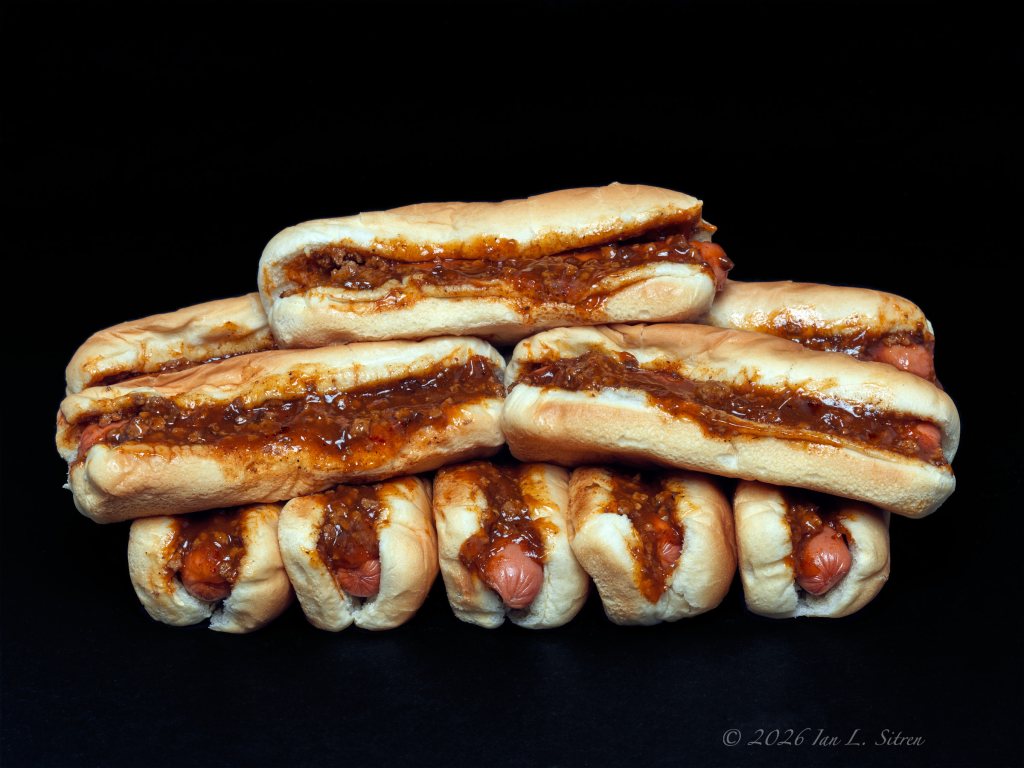
Today is National Chili Dog Day, and if there’s one fast food chain that’s almost synonymous with chili dogs, it’s Wienerschnitzel. Founded in 1961, the chain has built its reputation around hot dogs and has served hundreds of millions of them over the years. For a day dedicated to one of America’s classic fast food favorites, it seemed like the perfect place to stop.
The exact origin of the chili dog is still debated, with several restaurants and regions claiming to have created it during the early 1900s. However it began, the combination of a hot dog, a soft bun, and seasoned chili quickly became a favorite at drive-ins, roadside stands, and fast food restaurants across the country. More than a century later, it’s still one of the most recognizable items on a fast food menu.
For Food From Bag To Background, I picked up ten Wienerschnitzel chili dogs and stacked them against my very black black background. Instead of photographing a single chili dog, I wanted to emphasize the abundance, the texture of the chili, and the unmistakable look of a true fast food icon. Sometimes more really is more.
Whether you celebrate National Chili Dog Day with one chili dog or a stack of ten, today is a good reminder that some of America’s most enduring fast food favorites have earned their place by simply standing the test of time.
You can see more of my photography, projects, motion, and my Blog on my website at https://www.secondfocus.com
Thank You!
National Cheesecake Day With Krispy Kreme’s New Guava Cheesecake Doughnut
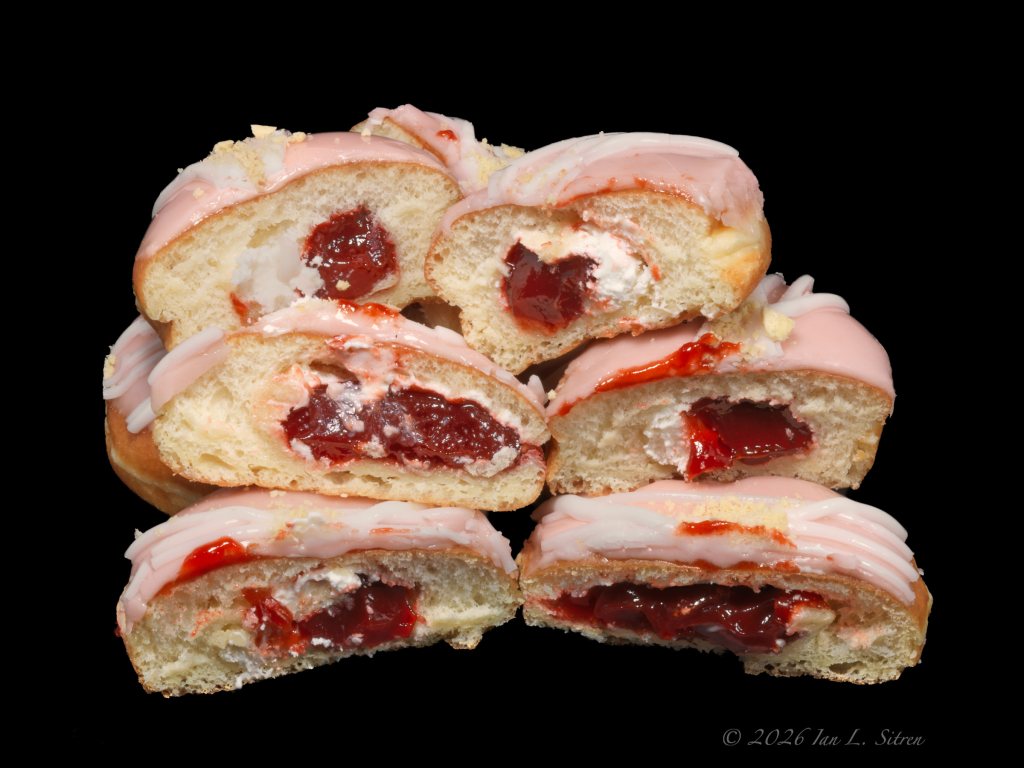
When National Cheesecake Day came around, I really wasn’t planning to photograph a cheesecake. As much as I enjoy the food holidays, a traditional cheesecake didn’t fit the direction of my Food From Bag To Background project. The project has always been about fast food, photographed exactly as it comes, with the food becoming the entire subject against a very black black background.
Then, almost by coincidence, Krispy Kreme introduced its new Guava Cheesecake Doughnut. Suddenly National Cheesecake Day had a fast-food connection that fit the project perfectly. I picked up six of them, cut them in half, and stacked them to show exactly what was inside. The bright guava filling, cheesecake Kreme, pink guava icing, icing drizzle, and crunchy crumbles made for a much more interesting photograph than I had expected.
Krispy Kreme says the Guava Cheesecake Doughnut is part of its new Destination Dessert Collection inspired by Latin American desserts. Along with the Guava Cheesecake Doughnut, the collection also includes a Tres Leches-Inspired Doughnut and a Choco Dulce Cookie Crunch Doughnut. It was an unexpected way to celebrate National Cheesecake Day while still staying true to a project devoted entirely to fast food.
Sometimes the best additions to Food From Bag To Background aren’t the ones I plan. They are the ones that unexpectedly appear at exactly the right time.
You can see more of my photography, projects, motion, and my Blog on my website at https://www.secondfocus.com
Thank You!
National Chicken Wing Day: 15 Original Hot Wings From Wingstop
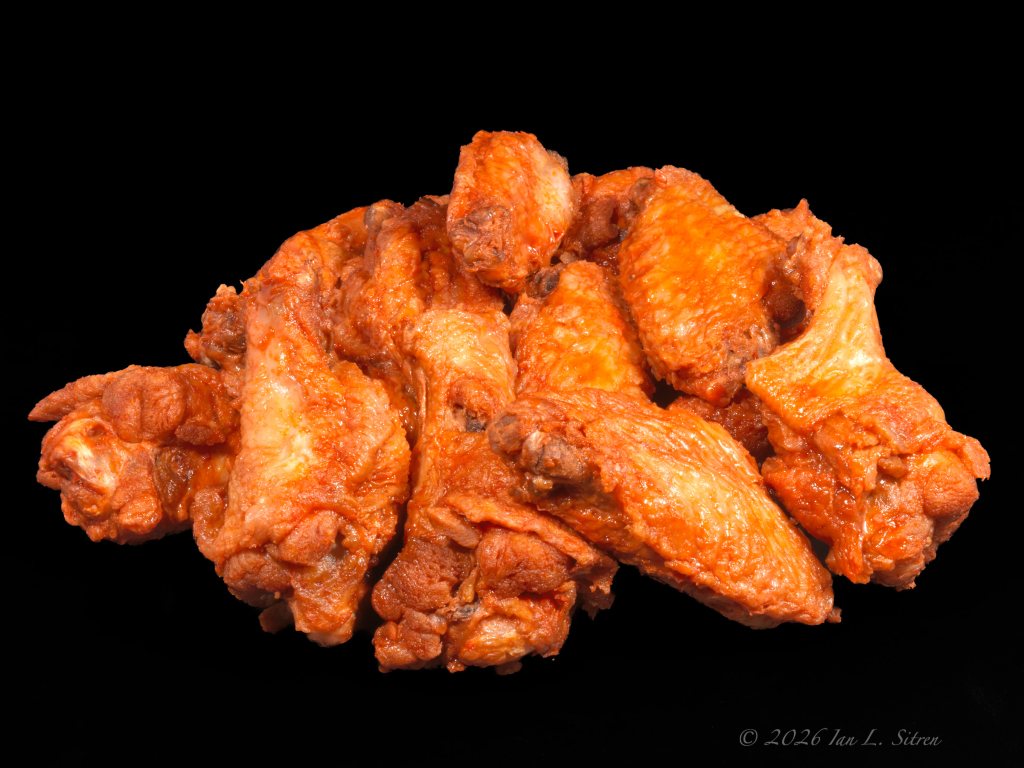
Today is National Chicken Wing Day, so this one seemed to require an actual pile of chicken wings.
The modern Buffalo wing story is generally traced to Buffalo, New York, in 1964, when Teressa Bellissimo at the Anchor Bar deep-fried chicken wings, tossed them in a peppery hot sauce and served them with blue cheese and celery. There are competing versions of exactly how that first plate came about, but the Anchor Bar story became the one most closely associated with what we now know as Buffalo wings.
By 1977, wings had become such a part of Buffalo that Mayor Stan Makowski proclaimed July 29 “Chicken Wing Day.” That local proclamation eventually became the National Chicken Wing Day we observe today.
For my photograph, I went to Wingstop. The company started in Garland, Texas, in 1994, began franchising in 1997, and has since grown to thousands of restaurants around the world. By 2002, Wingstop had already served its one-billionth wing.
I bought 15 pieces of Original Hot, which seemed like the appropriate choice for the day. Just the wings exactly as I wanted to photograph them, piled against my very black black background.
That seemed much more appropriate for my “Food From Bag To Background” fast food photography project.
Happy National Chicken Wing Day!
You can see more of my photography, projects, motion, and my Blog on my website at https://www.secondfocus.com
Thank You!
National Chicken Finger Day: Raising Cane’s Built an Empire on One Idea
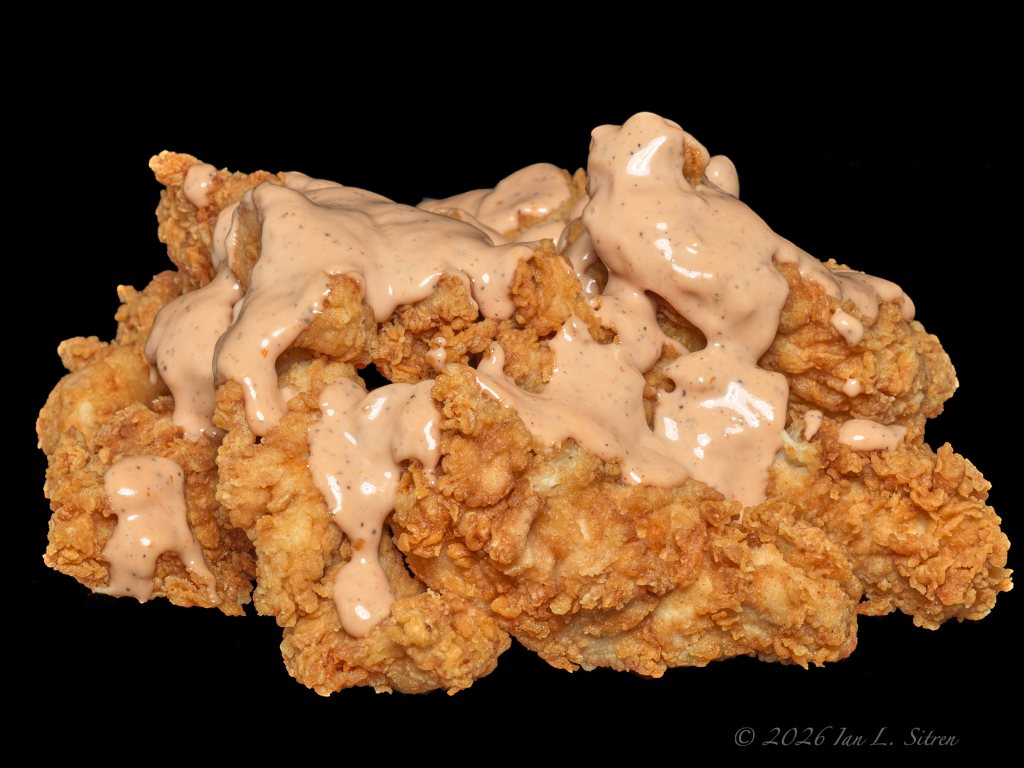
I didn’t realize that chickens had fingers, but apparently Todd Graves and Craig Silvey, the founders of Raising Cane’s, did.
And they took the idea very seriously.
The story of Raising Cane’s goes back to a college business plan for a restaurant built around one thing: chicken fingers. The idea was not exactly greeted with enthusiasm. Graves says the business plan received the lowest grade in his class, and banks weren’t interested in financing it either. He went to work at an oil refinery in Los Angeles and then commercial fishing in Alaska to earn money to pursue the idea. The first Raising Cane’s opened near Louisiana State University in Baton Rouge on August 28, 1996.
And chicken fingers weren’t just one item on a larger fast food menu. They were the entire concept. Raising Cane’s still describes chicken finger meals as its “ONE LOVE.”
Apparently that very simple idea worked.
Raising Cane’s has grown from that single restaurant near LSU into an international fast food chain. The company opened a record 118 new restaurants in 2024 alone, and in May 2025 announced that it had reached 800 restaurants worldwide. The expansion has continued since then, with new restaurants opening across the United States and internationally.
So it also makes sense that National Chicken Finger Day itself comes from Raising Cane’s. Todd Graves created the day in 2010, and it is observed every July 27. Raising Cane’s obtained full trademark status for National Chicken Finger Day in 2019, and says it has given away more than one million chicken fingers in connection with the day over the years.
Then there is Cane’s Sauce. The recipe is kept secret, the sauce is made fresh daily in each restaurant, and it has become almost as identified with Raising Cane’s as the chicken itself.
For my photograph, dipping seemed entirely too restrained. I bought the chicken fingers, piled them against my very black black background, and poured the Cane’s Sauce over the top.
That seemed much more appropriate for my “Food From Bag To Background” fast food photography project.
Happy National Chicken Finger Day!
You can see more of my photography, projects, motion, and my Blog on my website at SecondFocus.com
Thank You!
National Junk Food Day: Fast Food and Junk Food Are Not the Same Thing
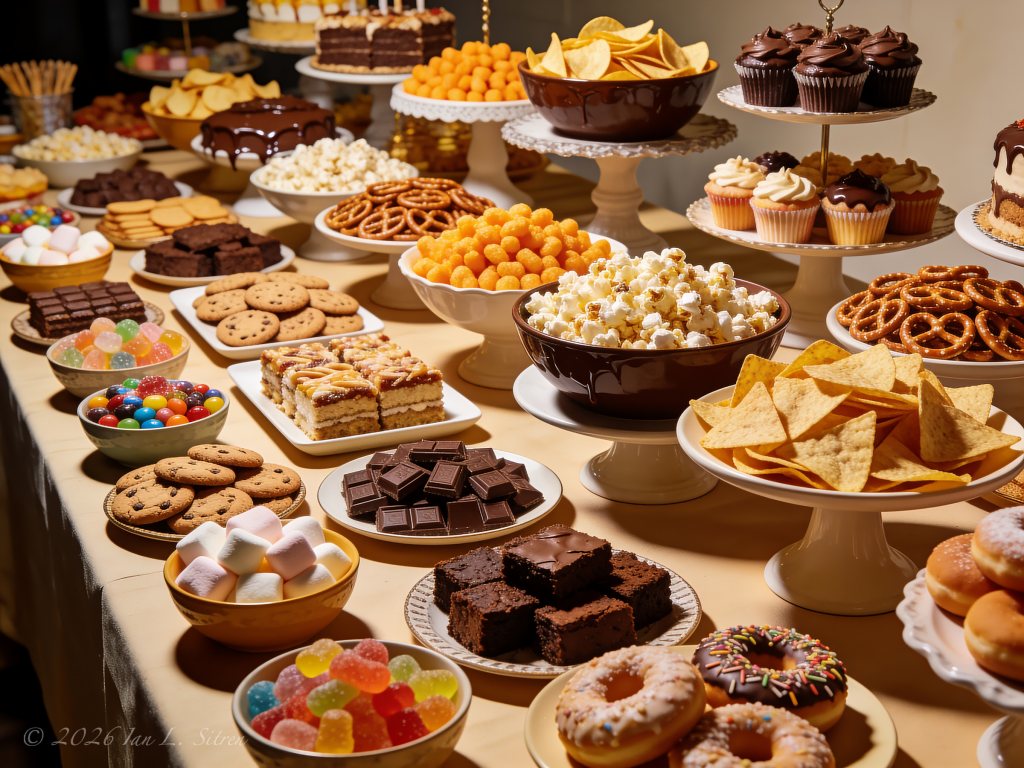
Last Tuesday was National Junk Food Day, which got me thinking about something I see confused all the time.
Fast food and junk food are often talked about as if they are the same thing. They are not. Some fast food can certainly be junk food, but being fast food is not what makes it junk food. And much of what we call junk food is not fast food at all.
So what does junk food look like?
Potato chips, cheese puffs, candy, cookies, brownies, cupcakes, doughnuts, pretzels, snack cakes and all those other things we eat mostly because we like them. Lots of sugar, salt and fat, not much nutritional ambition, and very easy to keep eating long after you intended to stop.
That is what got me thinking about what a photograph of actual junk food should look like. Not just one bag of chips or a plate of cookies. I wanted all of it. A ridiculous abundance of junk food presented as though it deserved its own buffet.
So I created it with AI. Platters, bowls and cake stands piled with just about every kind of junk food I could think of, all together on one table.
Apparently, if you put enough junk food on serving platters and cake stands, it becomes a formal occasion.
You can see more of my photography, projects, motion, and my Blog on my website at https://www.secondfocus.com
Thank You!
A Fast Food BLT for Food From Bag To Background
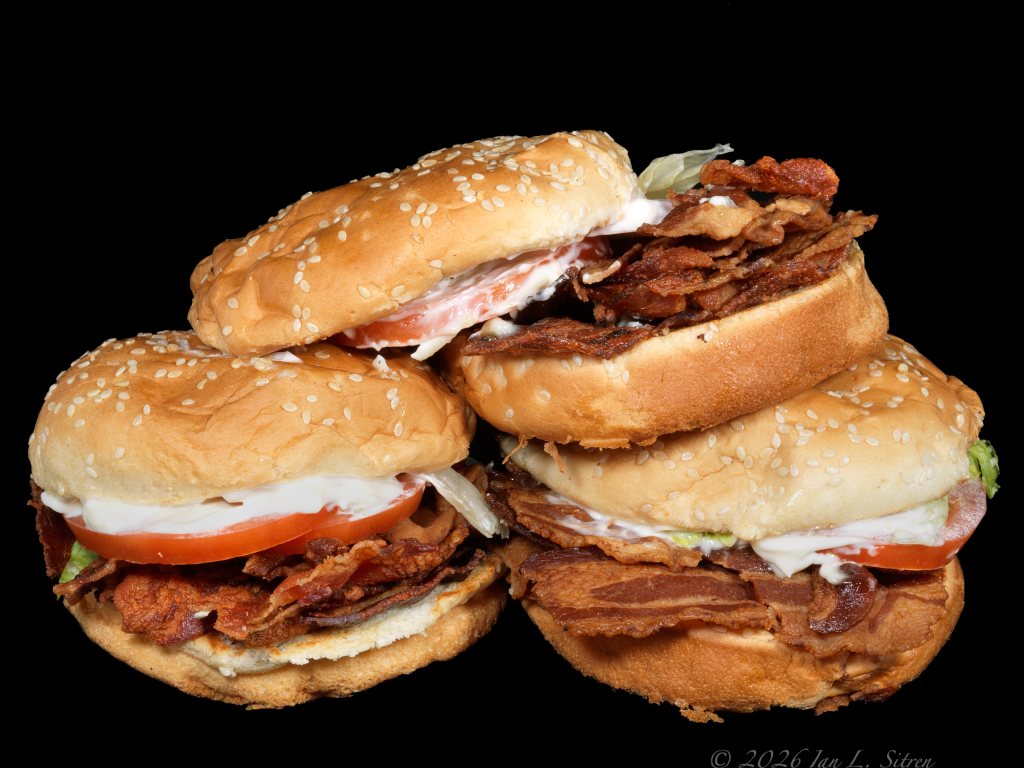
Wednesday was National BLT Day, and I did a post for it using an AI-created image. But I still wanted to photograph the real thing, especially after discovering what appears to be one of the very few BLTs offered by a major fast food chain.
So I went to Five Guys and purchased three of their BLT sandwiches.
The Five Guys version is pretty straightforward: bacon, lettuce, tomato and mayonnaise on their sesame seed bun. And there is plenty of bacon. Of course, Five Guys gives you the option of adding all kinds of other toppings, but for this photograph I stayed with the basic BLT. I wanted it to actually look like a BLT.
And stacked together against my very black black background, they became exactly what I wanted for my Food From Bag To Background project, where I photograph fast food exactly as it comes from the restaurant, straight from the bag and in front of my camera. Five Guys makes this a real fast food BLT and a perfect addition to the project.
You can see more of my photography, projects, motion, and my Blog on my website at https://www.secondfocus.com
Thank You!
Reese’s Peanut Butter Cups: The Real Thing Behind Peanut Butter and Chocolate Day
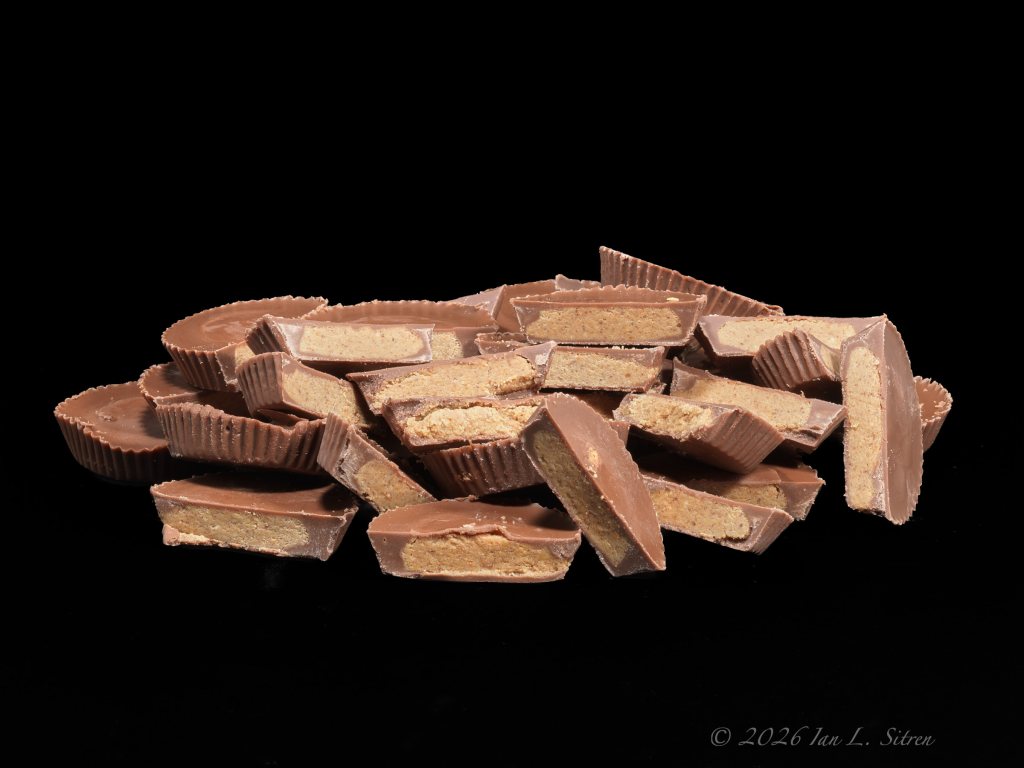
Yesterday was National Peanut Butter and Chocolate Day, and I used AI to explore what happens when you take that combination and push it a little further.
But I also wanted to photograph the real thing.
So I went to the store, purchased Reese’s Peanut Butter Cups, brought them into the studio, cut some of them open, piled them up on my very black black background, and photographed them.
Reese’s Peanut Butter Cups date back to 1928, when H.B. Reese created them in Hershey, Pennsylvania. And the combination obviously worked. By 2012, Reese’s was the best-selling candy brand in the United States, with more than $2.6 billion in annual sales. And it hasn’t exactly disappeared from the top of the candy pile. Reese’s Peanut Butter Cups ranked #1 in Instacart’s 2025 Halloween candy report.
It is easy to understand why. Chocolate and peanut butter is one of those combinations that just works. Reese’s took that combination and gave it a shape and identity that became instantly recognizable. Cut one open and there it is, milk chocolate surrounding that unmistakable peanut butter center.
You can see more of my photography, projects, motion, and my Blog on my website at https://www.secondfocus.com
Thank You!
National Peanut Butter and Chocolate Day: A Combination That Just Works
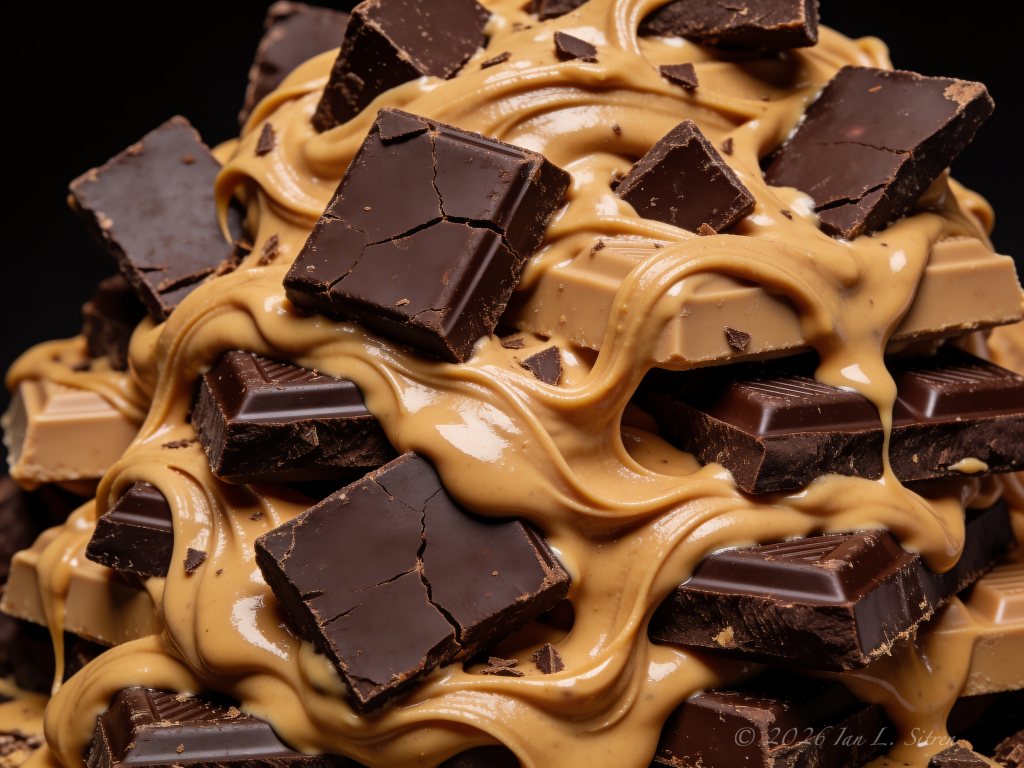
Today is National Peanut Butter and Chocolate Day, which seems less like a food holiday and more like an excuse to put two things together that were probably destined for each other anyway.
Chocolate and peanut butter just work. Sweet chocolate, salty peanut butter, smooth and creamy against something with a little snap. It is one of those combinations where each makes the other taste even better.
For today, I decided to explore the combination with AI. I created a series of images with chocolate bars, chocolate pieces, peanut butter, stacks, piles and some ideas that became increasingly excessive. This one seemed especially appropriate. A huge pile of chocolate pieces covered with thick, creamy peanut butter.
Looking at what AI created, I am willing to bet this would be a very popular dessert if restaurants actually served it. Just bring out a plate piled with pieces of chocolate and pour warm peanut butter all over it. Or better yet, put it in a to-go cup at a fast food place. Chocolate chunks, warm peanut butter, a spoon, and a lid.
I would order it.
Happy National Peanut Butter and Chocolate Day!
You can see more of my photography, projects, motion, and my Blog on my website at https://www.secondfocus.com
Thank You!
Happy Anniversary Burger King: From Insta-Burger King to the Whopper
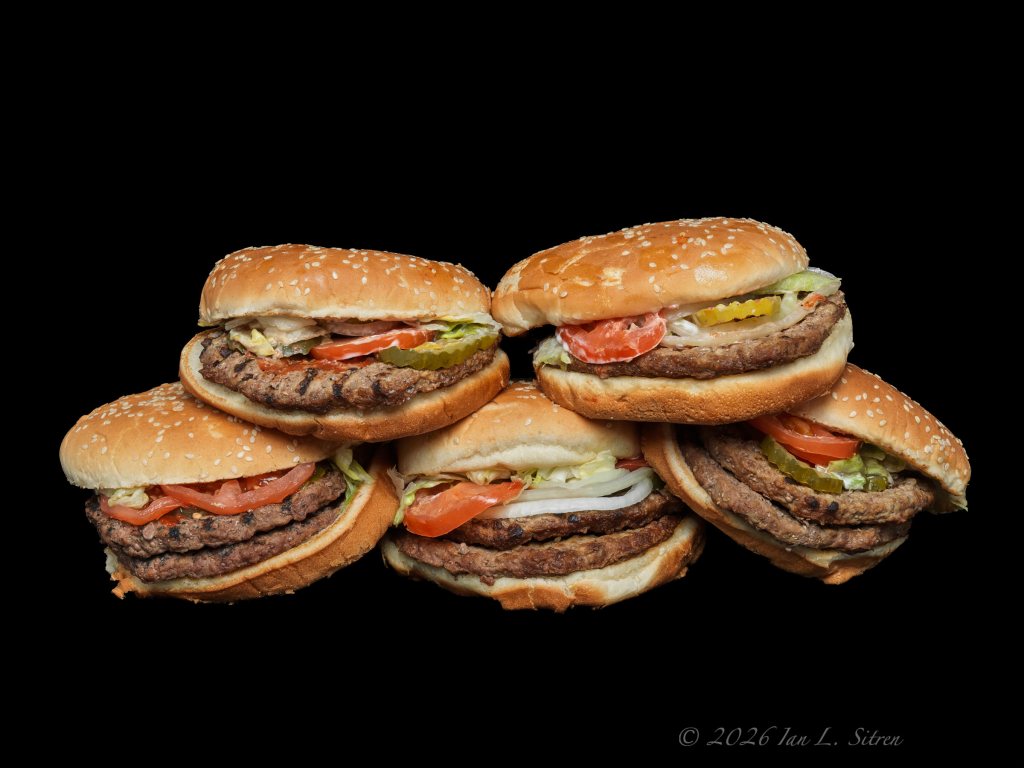
Today, July 23, marks the anniversary of the beginnings of Burger King, going back to 1953 and a restaurant in Jacksonville, Florida, called Insta-Burger King.
The story changed considerably from there. James McLamore and David Edgerton opened an Insta-Burger King franchise in Miami in 1954, eventually acquired the company, dropped the “Insta” from the name, and built Burger King into one of the biggest fast food chains in the world.
Then came the sandwich that would define the company.
The Whopper was introduced in 1957 and went on to become one of the most recognizable hamburgers in fast food. “Home of the Whopper” became part of the Burger King identity, and the Whopper itself has remained at the center of the menu for almost 70 years.
For my Food From Bag To Background photography project, I photographed both Whoppers and Double Whoppers, straight from Burger King, out of the wrappers and onto my very black black background.
And apparently one Whopper wasn’t enough for the photograph either.
Happy Anniversary Burger King!
You can see more of my photography, projects, motion, and my Blog on my website at https://www.secondfocus.com
Thank You!
National French Fry Day | The McDonald’s Fries Debate Never Ends

Today is National French Fry Day.
McDonald’s french fries may be the closest thing fast food has to a religion. Everyone has an opinion. Some insist they were better before 1990. Others swear no one has ever matched them. Entire internet debates have been devoted to trying to duplicate them.
I wasn’t trying to solve the mystery. I was just trying to buy enough of them.
Historians may debate the rise and fall of civilizations, but ask people when McDonald’s fries tasted best and everyone suddenly becomes an expert. Mention beef tallow, vegetable oil, or the “original recipe,” and you’re likely to start an argument that lasts longer than the fries themselves.
This photograph took several large orders of McDonald’s french fries for my Food From Bag To Background project. They went straight from the bags to a black background. No props, no styling, and, despite considerable temptation, none disappeared before the photograph was finished.
You can see more food photography, motion, projects, and my Blog on my website at https://www.secondfocus.com
National Fried Chicken Day | Kentucky Fried Chicken | Food From Bag To Background
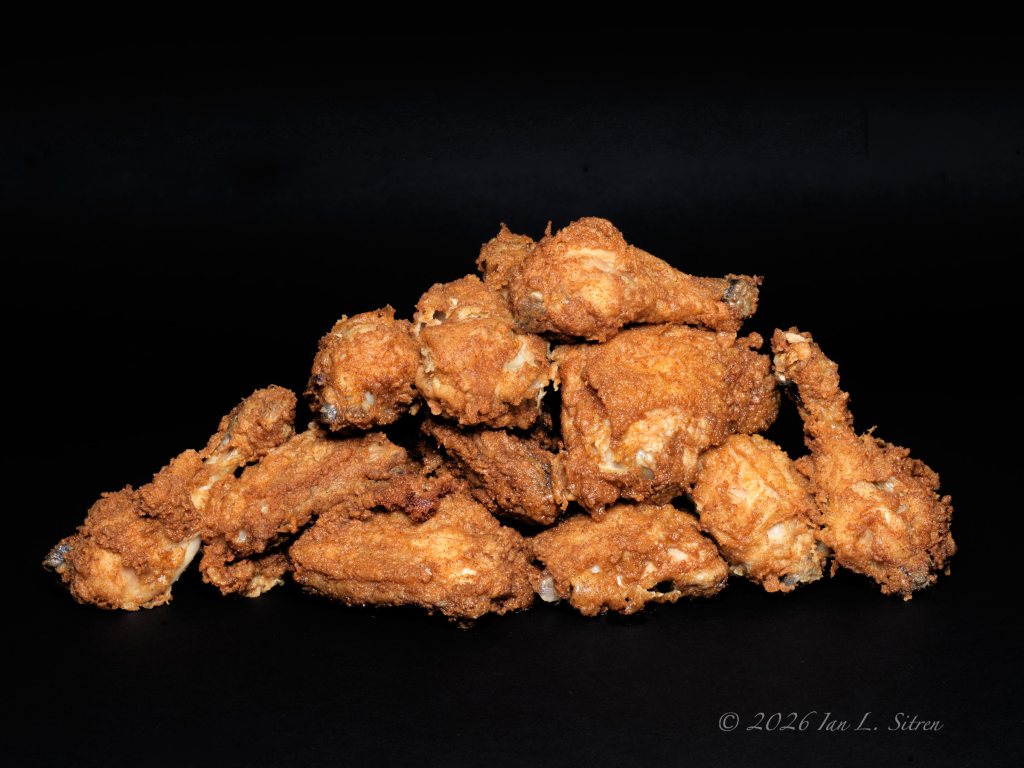
Yesterday was National Fried Chicken Day.
Fast food is the focus of my Food From Bag To Background project, so Kentucky Fried Chicken was an easy choice for today’s photograph. Every image in the project begins the same way. The food comes home from the restaurant, is removed from its packaging, and is photographed on a black background with no plates, props, or styling.
Kentucky Fried Chicken traces its roots to Colonel Harland Sanders, who began franchising his fried chicken recipe in 1952 after developing his pressure frying method. That technique reduced cooking time while helping the chicken stay moist inside and crispy outside, making it practical for restaurants to serve fried chicken much more quickly than traditional methods.
One thing I enjoy about this project is taking familiar fast food and presenting it in a way that people don’t normally see. Instead of a bucket on the dinner table, the chicken becomes the entire subject of the photograph. There is no branding competing for attention, just the shape, color, and texture of the food itself.
You can see more food photography, motion, projects, and my Blog on my website at https://www.secondfocus.com
Thank you!
National Cupcake Lovers Day and Six Birthday Cupcakes
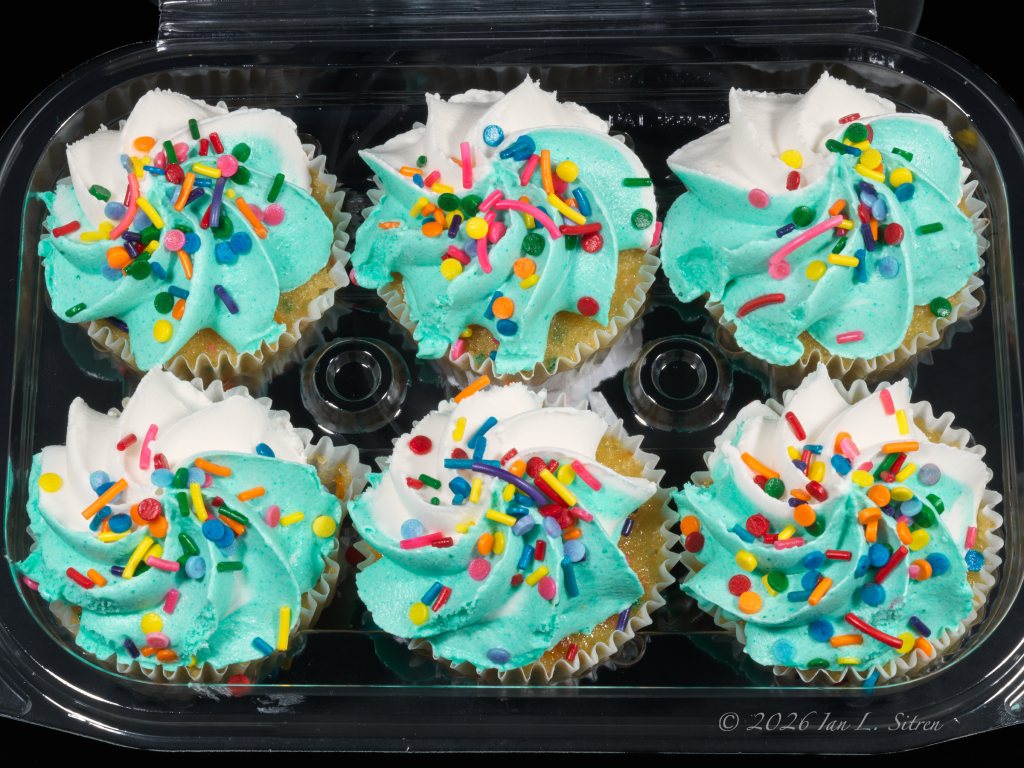
Today has been National Cupcake Lovers Day.
Notice it isn’t National Cupcake Day. It is National Cupcake Lovers Day, making it just as much about the people who enjoy cupcakes as the cupcakes themselves.
For this one, I made a slight departure from my usual Food From Bag To Background approach.
Instead of removing the cupcakes from their packaging, I photographed them exactly as they came from the grocery store in their clear plastic container. Sometimes the packaging is part of the story.
The cupcake has been around for more than 200 years. Early recipes appeared in American cookbooks in the late 1700s and early 1800s, and by the mid-19th century the name “cupcake” had become common. Some historians believe the name came from cakes baked in individual cups, while others point to recipes that measured ingredients by the cup rather than by weight.
These Birthday Cupcakes caught my attention because of their bright blue and white frosting and colorful sprinkles. I thought they would photograph really nicely.
To see more of my completed food photographs, along with my aviation, fitness, fashion, and other photography projects, please visit my website at https://www.secondfocus.com. Thanks!
National Roast Beef Day and Arby’s Original Idea
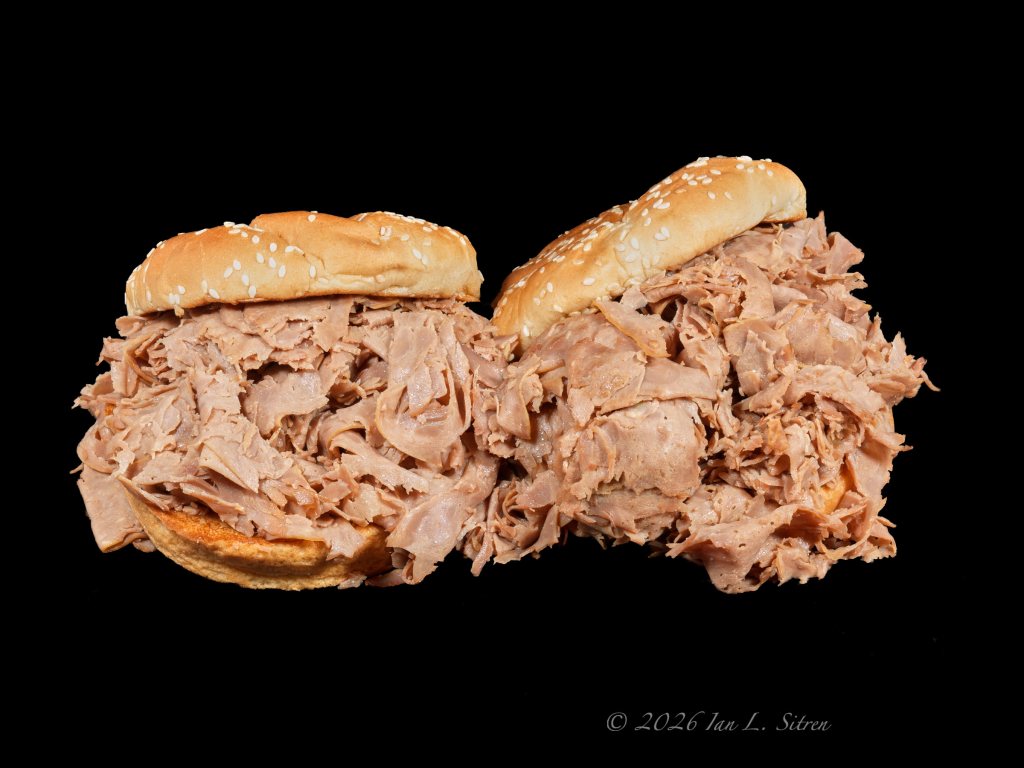
Today has been National Roast Beef Day.
I picked Arby’s for this one because my primary food project has focused on fast food.
Arby’s is somewhat unique in the fast-food world because the chain was built around the roast beef sandwich. While many major fast-food chains became known for hamburgers, fried chicken, tacos, or pizza, Arby’s made thinly sliced roast beef its signature item.
The chain was founded in 1964 by brothers Forrest and Leroy Raffel. At the time, most fast-food restaurants were competing in the hamburger business. The Raffel brothers decided to go in a different direction and built their restaurant around roast beef sandwiches instead.
For this photograph, I used two Arby’s Half Pound Roast Beef sandwiches. The reason there are two is simple. Arby’s was offering a buy one, get one free promotion for National Roast Beef Day.
Working on my fast food project has also made me pay attention to fast-food apps and promotions. Many chains offer discounts tied to food holidays and loyalty programs. If you use them regularly, the savings can be significant.
These two sandwiches were removed from their wrappers and photographed against a black background for my Food From Bag To Background series.
To see more of my completed food photographs along with my other photography projects, please visit my website at https://www.secondfocus.com. Thanks!
National Veggie Burger Day and the Impossible Whopper
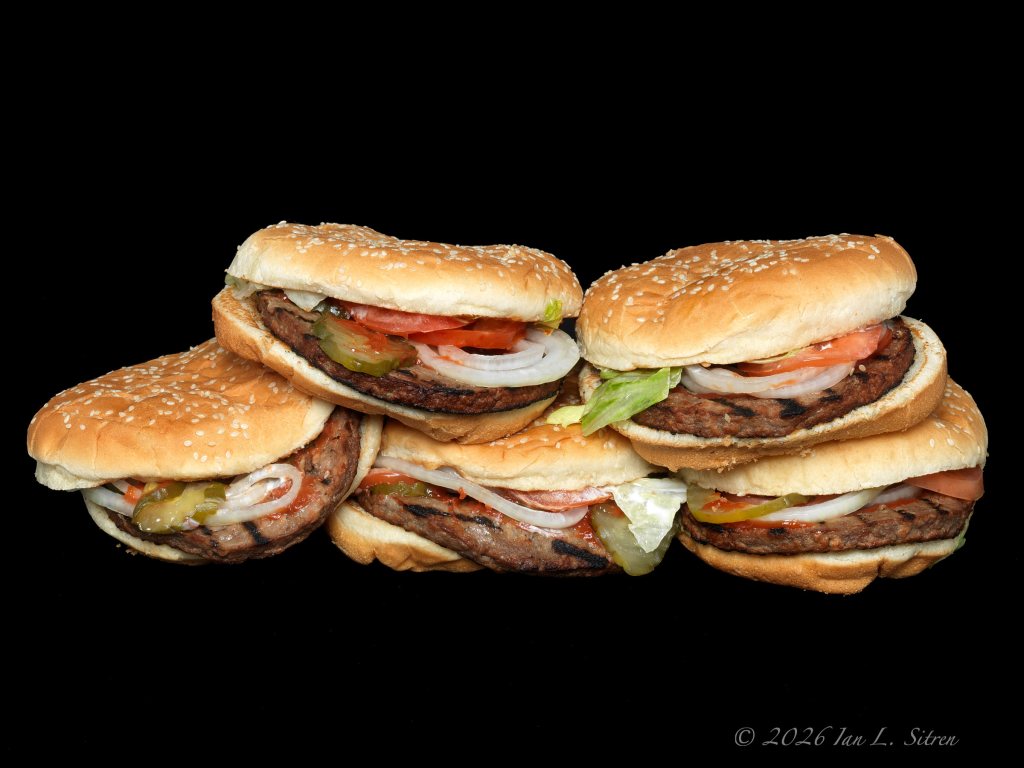
There was a time when the idea of a burger chain selling a plant-based Whopper would have sounded unlikely.
Burger King built its reputation on flame-grilled beef burgers. The Whopper has been the company’s signature sandwich since the 1950s and remains one of the most recognizable items in fast food.
Then came the Impossible Whopper.
Introduced nationally in 2019, the sandwich looked like a Whopper, was built like a Whopper, and was sold right alongside the traditional version. The difference was the patty, which was made from plant-based ingredients rather than beef.
Today’s photograph features a stack of Burger King Impossible Whoppers for my FOOD FROM BAG TO BACKGROUND series.
One of the reasons the Impossible Whopper attracted so much attention was that it wasn’t aimed exclusively at vegetarians. Burger King positioned it as an alternative that could appeal to anyone curious about plant-based burgers while still delivering a familiar fast-food experience.
Whether someone chooses it for environmental reasons, dietary preferences, curiosity, or simply to try something different, the Impossible Whopper marked a significant moment in fast-food history. One of the largest burger chains in the world had embraced a product that would have seemed out of place on its menu only a few decades earlier.
You can see more from my FOOD FROM BAG TO BACKGROUND series, along with collections and other projects at https://www.secondfocus.com
National Fish & Chips Day and the Legacy of Haddon Salt
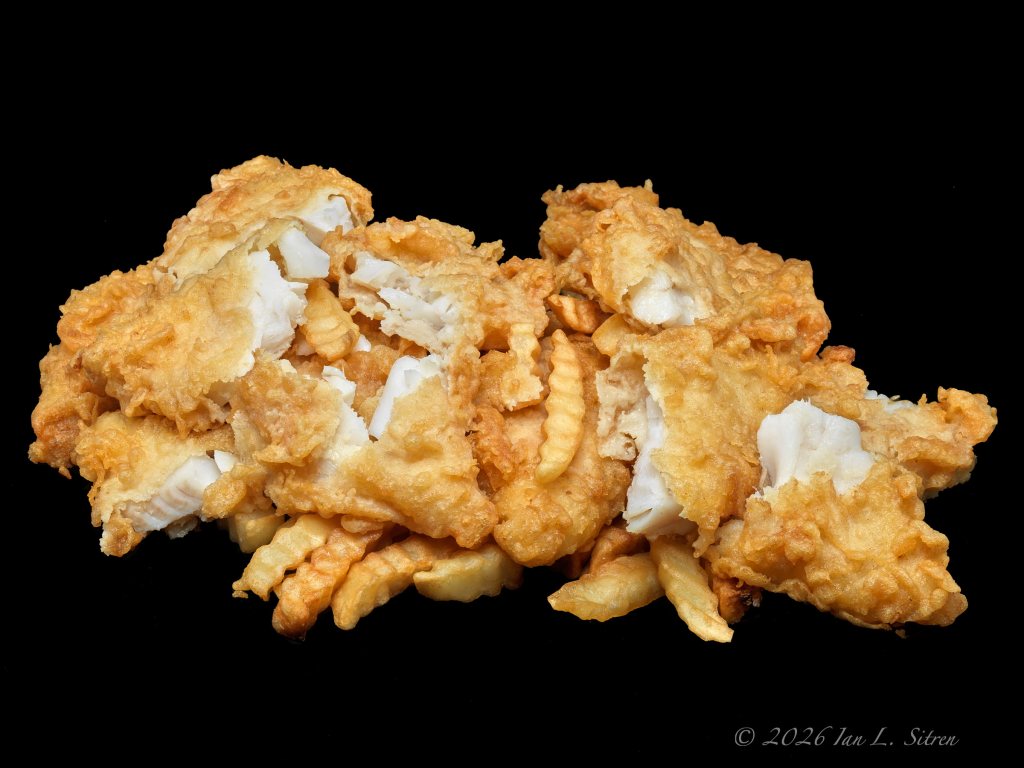
National Fish & Chips Day
Before there was H. Salt Fish & Chips, there was Haddon Salt.
In 1965, Salt opened the first H. Salt Esquire Fish & Chips in Sausalito, California, introducing a style of fish and chips inspired by the shops he had known in England. The idea proved popular, and what began as a single restaurant eventually grew into a chain that spread across the United States.
Today’s photograph features a serving of fish and chips from H. Salt for my FOOD FROM BAG TO BACKGROUND series.
Fish and chips has a history stretching back well over a century, with roots in England where fried fish and chipped potatoes became one of the country’s most recognizable meals. The combination eventually crossed the Atlantic and found a place in American fast-food culture as well.
For this photograph, the fish and chips were removed from their paper trays and photographed against a black background.
You can see more from my FOOD FROM BAG TO BACKGROUND series, along with collections and other projects at https://www.secondfocus.com
National Donut Day and the One You Would Pick First
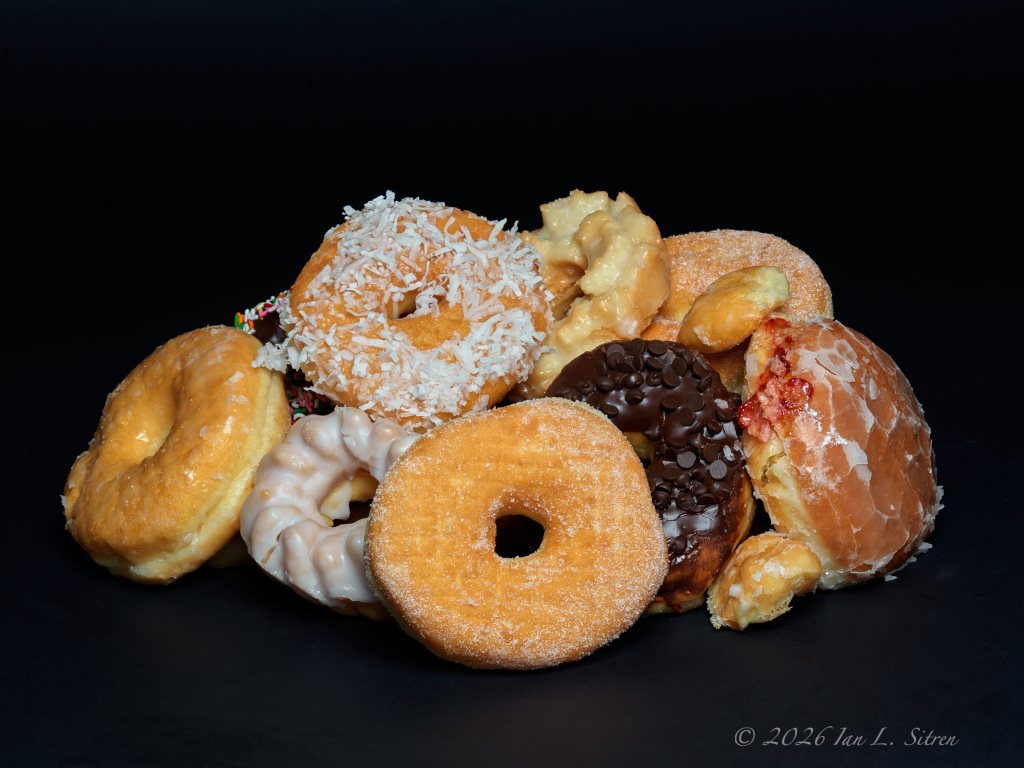
National Donut Day
Somewhere in this photograph is the donut you would pick first.
That’s usually the game people play when they see a box of donuts.
Some head straight for the chocolate. Others reach for the glazed donut. Someone inevitably grabs the jelly-filled one, while another person is convinced the coconut-covered donut is the best choice in the box.
Personally, I’ve never seen much agreement.
For National Donut Day, I pulled together a selection from a local donut shop for this photograph. Once they were arranged against a black background, the display stopped looking like breakfast and started looking more like a collection. Different shapes, colors, textures, toppings, fillings, and glazes all competing for attention.
Donuts have become so familiar that it’s easy to overlook just how many variations exist. A simple ring of fried dough can become almost anything depending on what happens after it leaves the fryer.
National Donut Day itself dates back to 1938 when the Salvation Army established the observance to honor the “Donut Lassies” who served donuts to American soldiers during World War I. Nearly ninety years later, the day has become one of the most widely recognized food celebrations on the calendar.
Looking at this photograph, I’m still not sure which donut I would choose first.
Fortunately, nobody says you can only pick one.
You can see more from my FOOD FROM BAG TO BACKGROUND series, along with collections and other projects at https://www.secondfocus.com
National Cheese Day and Taco Bell’s Cheesy Roll Up
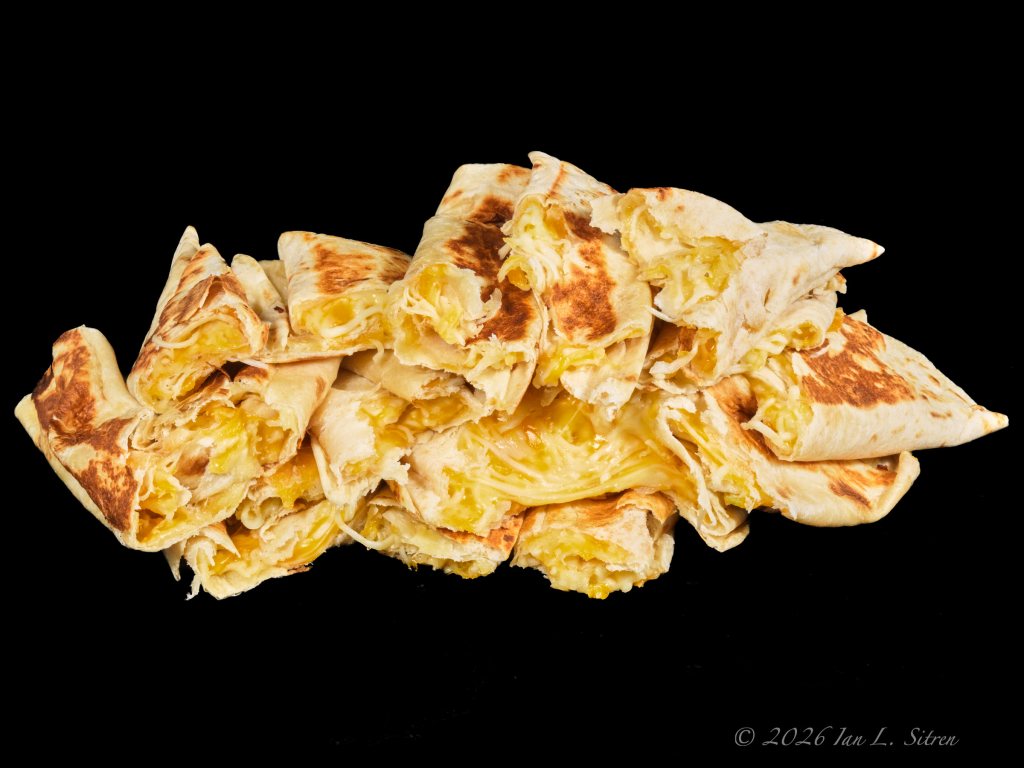
National Cheese Day
National Cheese Day presented a problem.
I could have photographed a block of cheddar cheese and called it a day. There are already millions of cheese photographs in the world, and probably enough stock photos of cheese to keep the internet supplied for several lifetimes.
That didn’t seem very interesting.
So I asked Emily, my AI partner and muse.
As often happens, Emily immediately found a different way to look at the problem. Rather than photograph cheese itself, why not photograph something where cheese fits one of my projects?
That led us to Taco Bell’s Cheesy Roll Up.
The Cheesy Roll Up is exactly what it sounds like. A tortilla wrapped around melted cheese. No complicated recipe. No attempt to disguise what you’re getting. Just cheese, rolled up and served as a menu item.
For National Cheese Day, that seemed like a perfectly appropriate subject.
This photograph features a pile of Taco Bell Grilled Cheesy Roll Ups for my FOOD FROM BAG TO BACKGROUND series. Rather than cutting them apart, I pulled them apart, revealing the melted cheese inside and creating a pile of toasted tortillas, cheese-filled interiors, and strands of melted cheese connecting one piece to another.
The Cheesy Roll Up isn’t one of Taco Bell’s most famous products. It doesn’t have the history of a taco or the size of a burrito. Yet on National Cheese Day it may be one of the most honest items on any fast-food menu. It makes no promises beyond its name and delivers exactly what it advertises.
You can see more from my FOOD FROM BAG TO BACKGROUND series, along with collections and other projects at https://www.secondfocus.com
National Carl Day and a Different Carl
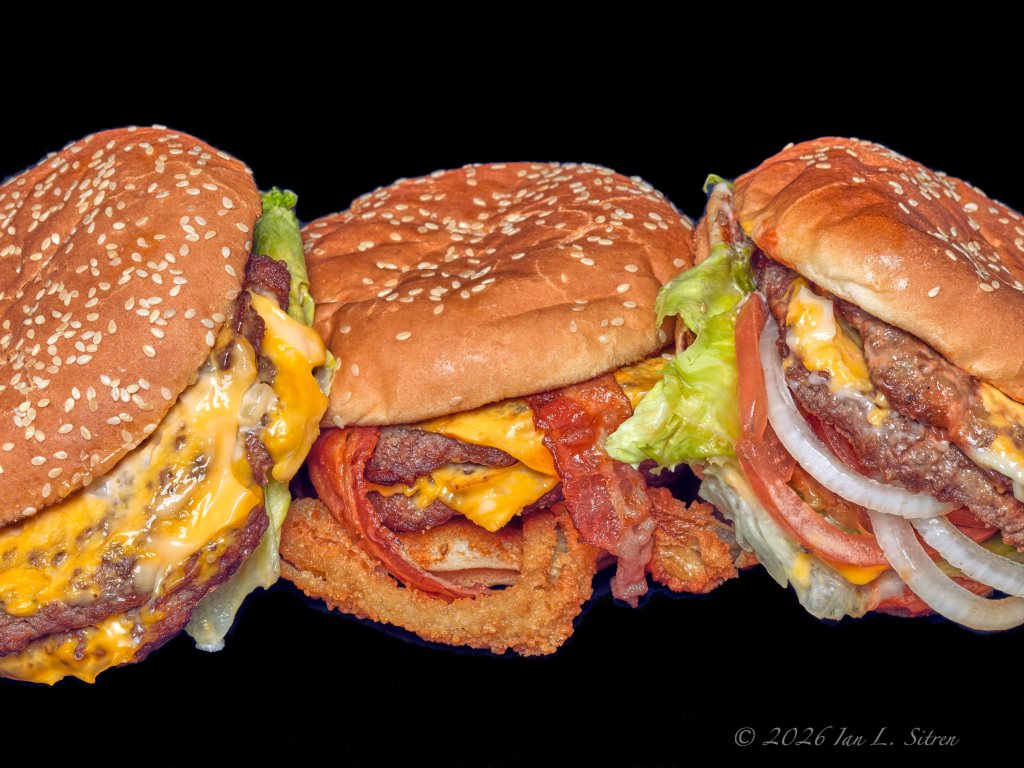
Today is National Carl Day.
Not Carl’s Jr. Day. Not National Cheeseburger Day. Not National Fast Food Day.
Just National Carl Day.
Naturally, that immediately raised an important question.
If there’s a National Carl Day, does Carl’s Jr. get to celebrate too?
I have no idea whether the people behind National Carl Day intended any connection whatsoever to the fast-food chain. My guess is they probably didn’t. But once the thought crossed my mind, there was really only one direction this was going to go.
So today’s photograph features a trio of Carl’s Jr. burgers from my FOOD FROM BAG TO BACKGROUND series.
Carl’s Jr. has always occupied an interesting place in fast-food history. The chain built a reputation around large burgers, unapologetic indulgence, and advertising campaigns that often generated as much discussion as the food itself. Beginning in 2005, a series of very sexy commercials featuring celebrities such as Paris Hilton helped make Carl’s Jr. one of the most talked-about names in fast food.
What makes today’s National Carl Day connection even more amusing for me is that years ago I actually had dinner with Carl, yes, that Carl, and his wife as guests in their home in Anaheim, California. He was a very interesting man, and both Carl and his wife were genuinely warm and welcoming people. At the time I certainly wasn’t thinking that someday there would be a National Carl Day, or that I would be photographing Carl’s Jr. burgers for a food photography project.
The burgers themselves were never subtle. Bigger portions, bigger flavors, and plenty of melted cheese were usually part of the formula. Looking at this photograph, it’s easy to see why Carl’s Jr. developed a reputation for building burgers that demanded attention.
So while National Carl Day almost certainly has nothing to do with Carl’s Jr., it seemed like a good excuse to revisit a brand that has been part of the American fast-food landscape for generations.
Then again, if your name is Carl, perhaps today belongs to you.
And if your name happens to be Carl’s Jr., maybe it does too.
You can see more from my FOOD FROM BAG TO BACKGROUND series, along with aviation photography, collections, and other projects at https://www.secondfocus.com Chances are you’ll find something unexpected waiting there.
National Egg Day and a Fast Food Icon
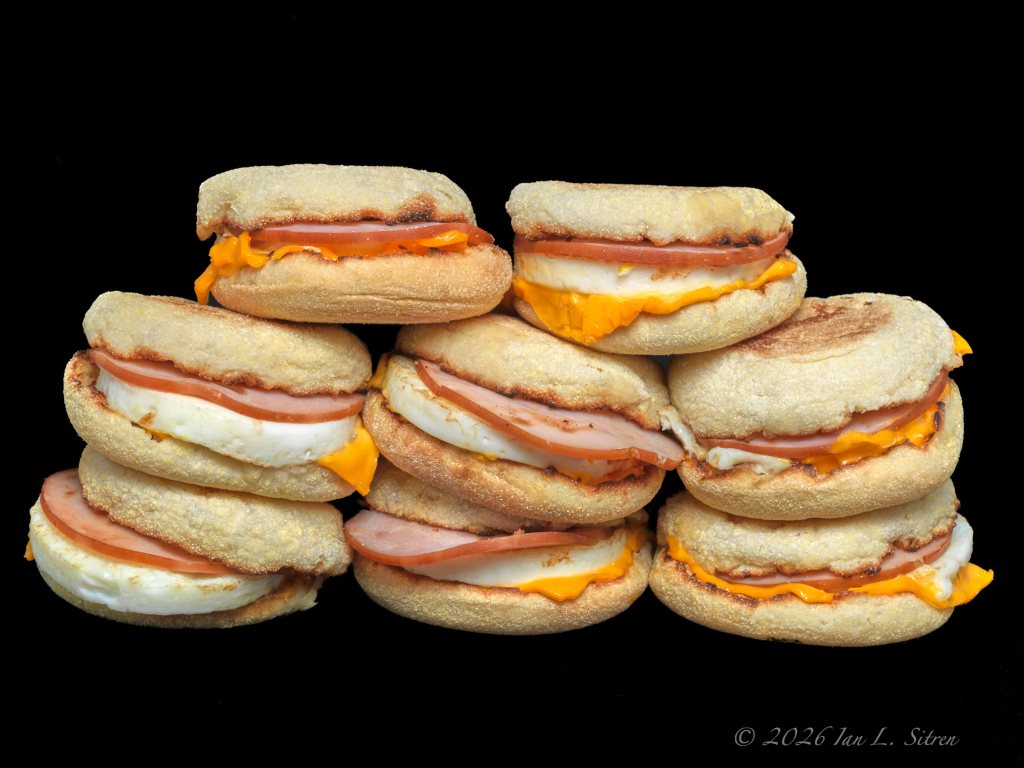
Eggs may be one of the most photographed foods in the world.
They show up in breakfast advertisements, restaurant menus, grocery stores, cooking videos, and enough stock photographs to fill the internet several times over. Yet somehow they remain one of the most recognizable ingredients ever put on a plate.
For National Egg Day, I decided to go in a slightly different direction.
Rather than photograph eggs by themselves, I turned to one of the sandwiches that helped make them a fast-food staple. The McDonald’s Egg McMuffin has been around for more than fifty years and is still one of the most recognizable breakfast sandwiches ever created.
This photograph features a stack of Egg McMuffins from my FOOD FROM BAG TO BACKGROUND series. No stylists. No carefully arranged garnish. No attempt to make them look like advertising. Just the sandwiches as they arrived, isolated against black and given the chance to stand on their own.
What interested me was the repetition. The English muffins, the eggs, the Canadian bacon, and the slices of cheese create a pattern that almost becomes architectural when several are stacked together. Something most people grab through a drive-thru window suddenly becomes a study of shapes, textures, and layers.
The Egg McMuffin wasn’t the first breakfast sandwich, but it helped define what a fast-food breakfast could be. Decades later, it remains a familiar part of morning routines across the country.
Not bad for something built around a simple egg.
You can see more from my FOOD FROM BAG TO BACKGROUND series, along with aviation photography, collections, and other projects, at https://www.secondfocus.com Chances are you’ll find something familiar that looks a little different when removed from its usual surroundings.
National Biscuit Day and the Simplicity of FOOD FROM BAG TO BACKGROUND
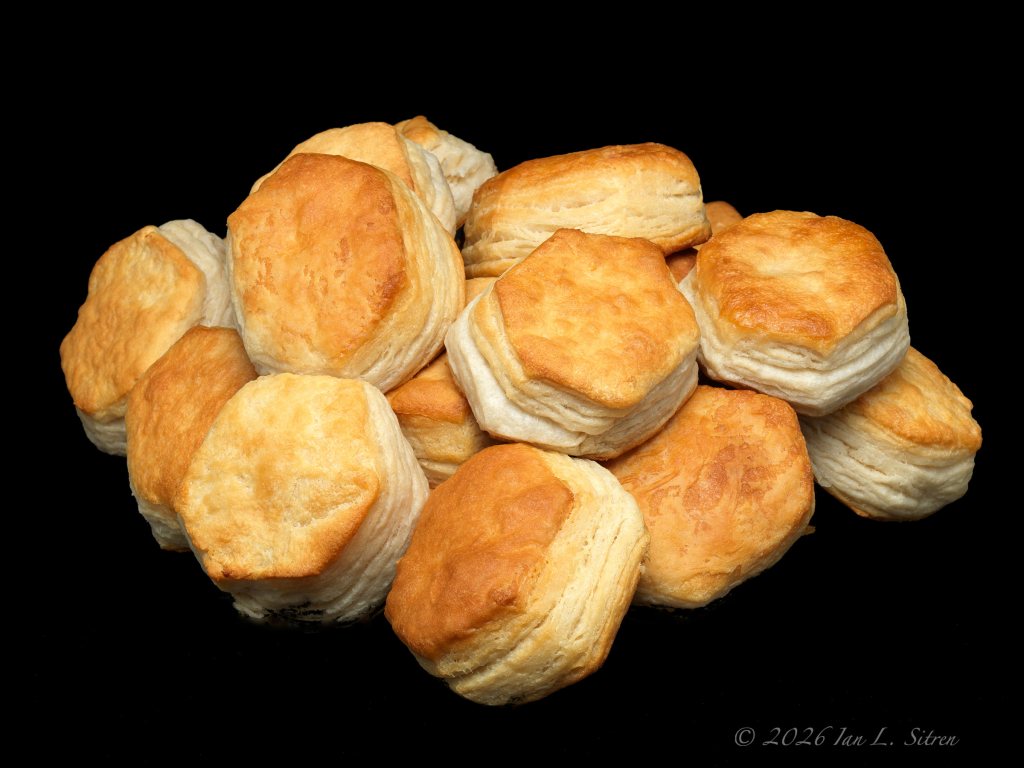
National Biscuit Day.
Some foods don’t really need marketing agencies, AI enhancement, stylists with tweezers, or fake steam drifting through the frame.
Biscuits are one of them.
These are just peel-apart biscuits photographed for my FOOD FROM BAG TO BACKGROUND series exactly the way they came out of the package and oven. No brushed butter, no artificial shine, no tricks to make them look taller, fresher, or more dramatic than they actually were.
And honestly, that was always part of the point of this project.
Fast food and convenience food advertising has trained people to expect food to look exaggerated, oversized, and almost synthetic. But when you isolate something simple against a black background and actually pay attention to it, the real texture starts doing the work by itself. The layers, the uneven browning, the soft edges, the imperfect shapes. Those details are usually hidden behind logos, wrappers, commercials, and speed.
Biscuits are also strangely tied into American fast food culture. Fried chicken chains, drive-thru breakfasts, gas station counters, roadside diners. They exist somewhere between comfort food and convenience food, which is probably why they fit this project so well.
So for National Biscuit Day, no AI animation experiments, no dramatic visual effects, just biscuits.
And when I was a kid, when my mom made these, I could have eaten every one of them, each with a pat of butter melting into the middle.
If this photograph brought back a memory, made you hungry, or simply made you look at something familiar a little differently, there are dozens more waiting in FOOD FROM BAG TO BACKGROUND. Burgers, tacos, pizza, donuts, fries, sandwiches, and other foods pulled straight from the bag and placed under the same black backdrop.
You can explore the entire series here on my website at https://www.secondfocus.com/index/G0000wQ3fbeEezF0
National Brisket Day and the Reality Behind FOOD FROM BAG TO BACKGROUND
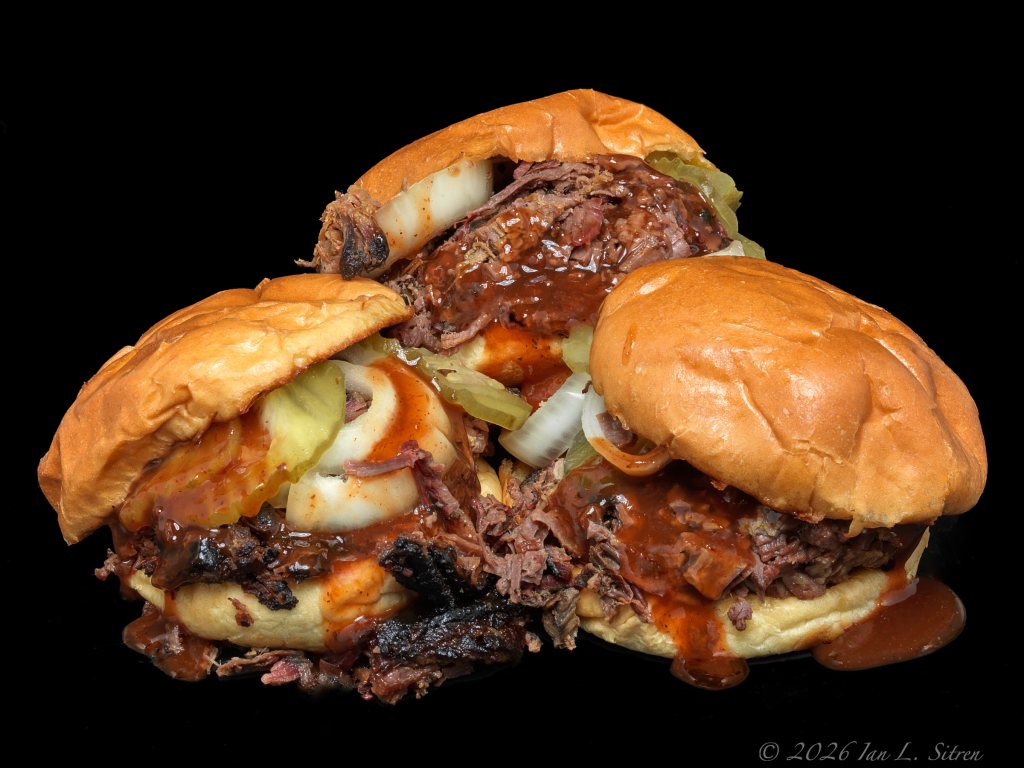
Today is National Brisket Day.
One of the things I wanted to challenge with my “FOOD FROM BAG TO BACKGROUND” project was the idea that food only becomes visually interesting after it passes through a marketing department, a food stylist, an art director, retouching, and increasingly now, AI image generation.
These brisket sandwiches from Dickey’s Barbecue Pit are none of that.
They were bought like any normal takeout order, carried home in a bag, opened, placed onto a black background, and photographed exactly as served. No rearranging. No fake steam. No hidden supports. No motor oil pretending to be sauce. No tweezers moving sesame seeds into place.
And yet they still work visually.
Actually, I would argue they work because they are real.
The overflowing chopped brisket, the uneven piles of smoked meat, the compressed buns, the dripping barbecue sauce, the onions and pickles sliding out of place, all of it feels far more appetizing and believable than the heavily over-engineered perfection seen in so much advertising imagery now.
That tension became one of the central ideas behind FOOD FROM BAG TO BACKGROUND. Fast food and takeout photographed seriously, exactly as it exists in the real world, isolated against black with no attempt to hide the messiness, excess, or reality of what arrived in the bag.
And sometimes the real version ends up looking better than the manufactured one.
More from FOOD FROM BAG TO BACKGROUND:
https://www.secondfocus.com/index/G0000wQ3fbeEezF0
National Hamburger Day and the Fast Food Reality Behind FOOD FROM BAG TO BACKGROUND
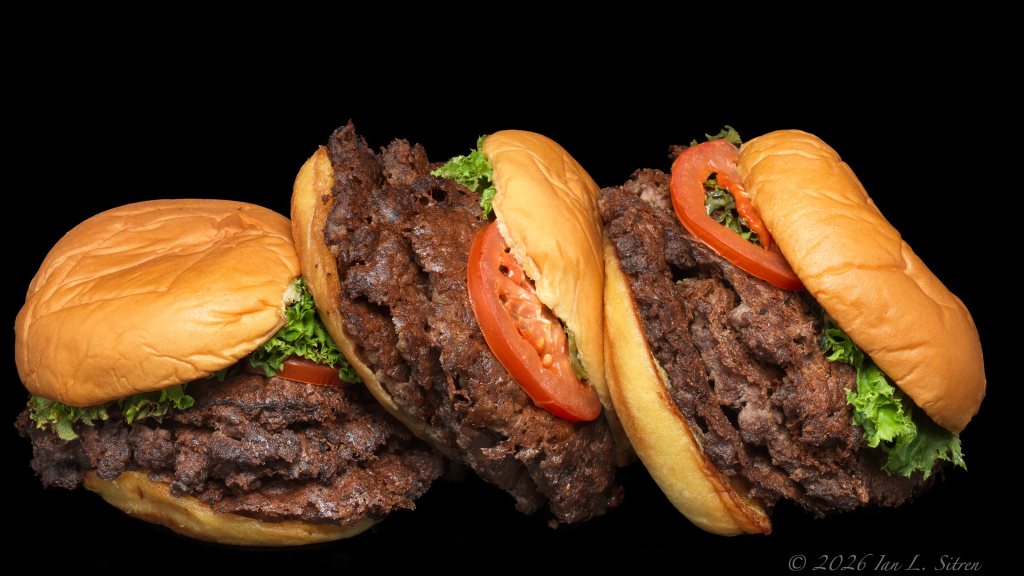
Today is National Hamburger Day.
The hamburger has probably become the defining subject of my “FOOD FROM BAG TO BACKGROUND” project. Fast food photographed exactly as it arrives, no stylists, no reconstruction, no fake versions built for advertising.
And one thing people occasionally ask is where all this food comes from.
The answer is simple: the same place everybody else gets it.
The restaurants and chains have no idea I am photographing their food. There are no sponsorships, no special preparation, no discounts because of photography, and no carefully assembled “photo burgers” arriving from a corporate kitchen. I walk in or use the apps, place an order, pick it up, bring it home, and photograph it exactly as it comes out of the wrapper or bag.
Actually, the apps have become part of the process. The fast food companies constantly push coupons, free items, points, discounts, and combination deals. Surprisingly worthwhile ones. Sometimes I end up planning a shoot around whatever special appears that week.
That is part of what interests me visually about the project. These hamburgers are not idealized advertising concepts. They are real fast food hamburgers, bought like anybody else would buy them, photographed seriously against black backgrounds with the same attention I would give any other subject.
Somewhere between documentary, satire, and food photography, the hamburger became one of the central characters.
And if you have ever wondered what fast food starts looking like when it is pulled out of the bag, isolated against black, and treated like a serious photographic subject, step into the project here on my website at https://www.secondfocus.com

