National Bagel Day Today
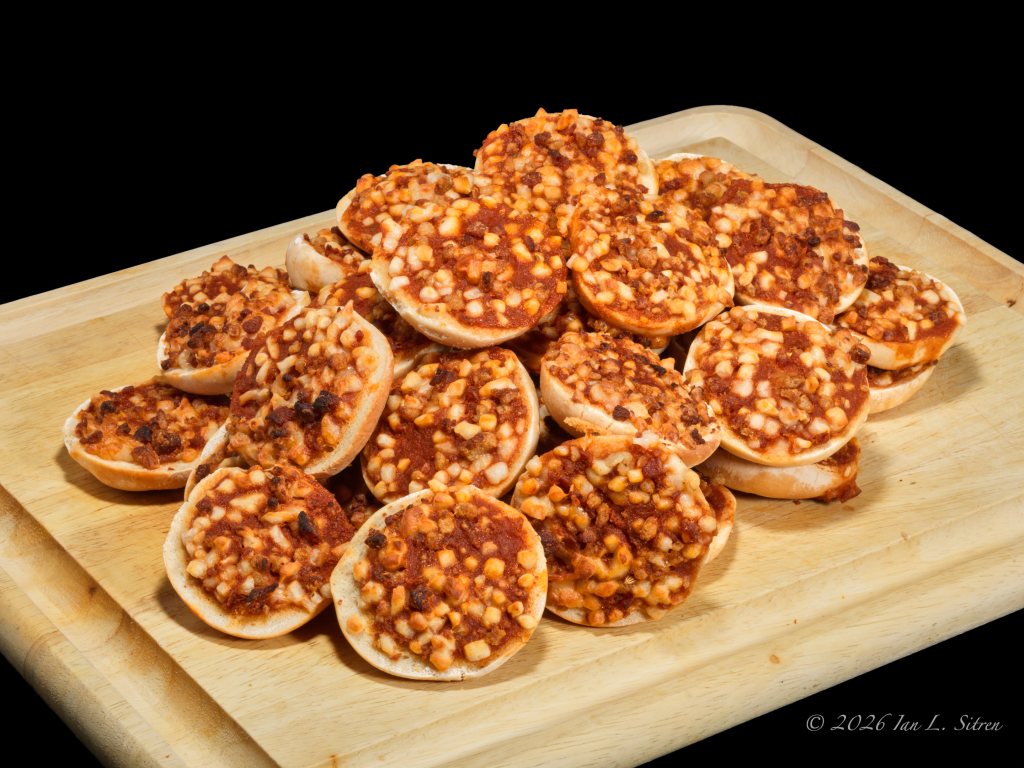
Bagels didn’t start out like this.
Then America got involved.
Rather than photograph a traditional bagel for National Bagel Day, I chose pizza bagels. They keep the shape, discard the ceremony, and replace it with tomato sauce, mozzarella, sausage, and pepperoni. There’s nothing to slice, nothing to decide, and no expectations to meet. Just heat and eat.
Bagels trace their history to Jewish communities in Eastern Europe, where they were boiled, baked, and valued for their practicality as much as their taste. When they arrived in the United States, they carried that tradition with them, at least briefly.
Pizza bagels may be the most American version of the bagel. Frozen, standardized, and designed for speed.
To see more of my Commercial Food Photography, please visit my website at
https://www.secondfocus.com/index/G0000WFAqDJQOgKU
Today is National Spaghetti Day

Spaghetti is usually framed as something slow, traditional, and tied to the kitchen. But for much of the twentieth century in America, spaghetti also became something else entirely: fast food.
Not drive-thru fast, but ready-when-you-are fast.
That idea is what led me to use Chef Boyardee for National Spaghetti Day.
My ongoing food photography focuses on fast food and everyday commercial food, photographed as it actually exists. Food designed for speed, convenience, and consistency. Chef Boyardee fits squarely into that world. It takes a dish associated with tradition and turns it into something shelf-stable, standardized, and immediately accessible. Open the can, heat it, eat it. No preparation, no ceremony.
The brand itself has a long American history. It traces back to Ettore Boiardi, an Italian immigrant chef whose restaurant sauce became popular enough in the 1920s that customers wanted to take it home. What began as a restaurant product quickly evolved into mass-produced canned meals. By the 1930s and 1940s, Chef Boyardee spaghetti had become a pantry staple, feeding families and even supplying military rations.
Long before frozen dinners or microwavable trays, canned spaghetti helped normalize the idea that dinner could come straight from the shelf. In that sense, it belongs to the same lineage as modern fast food, engineered for speed, reliability, and scale.
National Spaghetti Day itself isn’t rooted in Italian tradition. It’s a modern food holiday, more about recognition than ritual. That makes it an appropriate moment to look at spaghetti not as cuisine, but as a product, and to acknowledge how thoroughly it has been absorbed into American convenience culture.
This photograph shows Chef Boyardee spaghetti and meatballs as it exists in that context. Not Italian food, but American fast food, defined by accessibility and familiarity.
To see my actual fast food photography project please visit my website at https://www.secondfocus.com/index/G0000wQ3fbeEezF0 Thanks!
National Bacon Day!
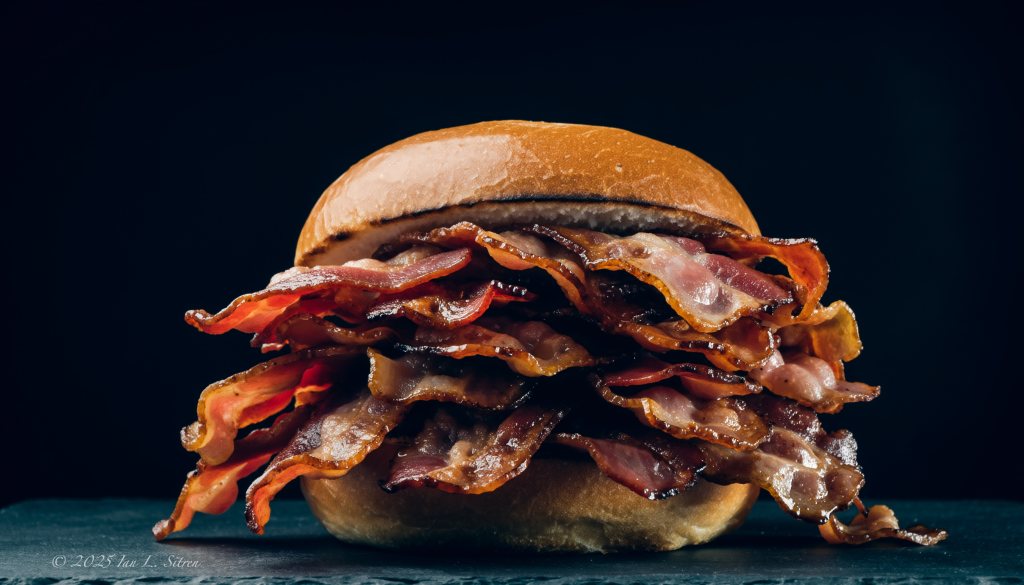
There are few foods people agree on as readily as bacon. Across generations and cultures, it holds a rare position as something almost universally liked, often described as the ingredient that makes everything better. If you asked people to name their ideal sandwich, many would quietly admit this would be it: bread, bacon, and nothing else getting in the way.
Bacon’s appeal is deeply rooted in history. Salt-cured pork dates back thousands of years, used as a practical method of preservation long before refrigeration. Variations appeared across Europe and Asia, but bacon as we recognize it today became firmly embedded in American food culture during the 20th century. By the mid-1900s, it had moved beyond breakfast and into sandwiches, burgers, and fast food, where its smoky, fatty richness became shorthand for indulgence.
Culturally, bacon has taken on a role larger than the ingredient itself. It represents abundance, comfort, and excess, often acknowledged without apology. Entire menus have been built around it, and marketing has leaned heavily into its reputation as something people crave even when they know they shouldn’t. It’s one of the few foods that can be both nostalgic and provocative at the same time.
This photograph leans into that idea by stripping the sandwich down to its core. No lettuce, no tomato, no attempt at balance. Just bacon, stacked high, presented without distraction. It’s easy to imagine this being wildly popular as a fast-food option, ordered impulsively and remembered vividly. Of course, it isn’t something you’ll actually find on a menu. And that absence is part of the point.
My fast food photography project can be found in “Food From Bag to Background” on my website at https://www.secondfocus.com/index/G0000wQ3fbeEezF0
National Submarine-Hoagie-Hero-Grinder Day

Today is National Submarine-Hoagie-Hero-Grinder Day — a sandwich with many names and, apparently, many holidays. Depending on where you look, there’s also National Hoagie Day in May, National Submarine Sandwich Day in November, and even separate days for the Italian Sub, the Turkey Sub, and the Meatball Sub. Few foods have this many national observances, which probably says something about how much Americans love a good sandwich.
The submarine sandwich began with Italian immigrants in the Northeastern United States in the early 1900s, layering meats, cheese, and vegetables inside long rolls. The word “submarine” gained popularity during World War II because of its resemblance to the naval vessels, while “hoagie,” “hero,” and “grinder” each found favor in Philadelphia, New York, and New England.
In 1965, a 17-year-old named Fred DeLuca opened a small sandwich shop in Bridgeport, Connecticut — with funding from a family friend — and called it Pete’s Super Submarines. That would eventually become Subway, now one of the largest restaurant chains in the world. The brand helped turn the regional sub into a fast-food staple recognized everywhere.
The photograph here shows two of Subway’s most popular sandwiches, cut in half and photographed side by side on a black background — stacked with meats, cheese, lettuce, tomato, onion, and mayonnaise. Like all of my Food From Bag to Background series, they’re presented as-is, straight from the bag, with no styling or props.
You can find this and more in my Food From Bag to Background gallery at https://www.secondfocus.com/index/G0000wQ3fbeEezF0
Ten Hot Dogs and a Bite of History

Ten hot dogs from Wienerschnitzel—five with mustard, five with kraut—and photographed them just as they came. Did have to add the mustard from the little packets but otherwise no styling. No filters. Just fast food, lined up against a black background. It’s National Hot Dog Day, and this looks about right.
Americans consume around 20 billion hot dogs a year—an average of 70 per person. The hot dog’s rise began in the late 1800s via German immigrants, exploded with Coney Island vendors, and hasn’t slowed down since.
Wienerschnitzel entered the picture in 1961 thanks to John Galardi, a 23-year-old who started out sweeping floors for Glen Bell—the guy who would go on to found Taco Bell. Galardi turned down Bell’s offer to buy a taco stand and instead took a shot at hot dogs. His wife found the name Wienerschnitzel in a cookbook. Galardi thought it was ridiculous. Three days later, he opened the first stand anyway on Pacific Coast Highway in Wilmington, California.
More than 60 years later, the chain claims over 300 locations and a few hundred million hot dogs served.
These? Just twelve, straight from the drive-thru. Shot for my “From Bag to Background” series:
👉 https://www.secondfocus.com/index/G0000wQ3fbeEezF0/I0000nUG8tfk8Gdc
National Pizza Day x Super Bowl Sunday—A Perfect Pairing 🍕🏈

Today marks the rare overlap of National Pizza Day and Super Bowl Sunday, two occasions that bring people together—one for the love of football and the other for the love of pizza.
Pepperoni pizza isn’t just a favorite; it’s the most popular pizza in the U.S. While pizza’s origins go back to Naples, Italy, it evolved into something uniquely American when it arrived in the States. By the mid-20th century, the combination of crispy, spicy pepperoni and melted cheese became the go-to order, cementing its place in food culture.
One company played a major role in making pepperoni pizza a household staple: Domino’s. What started as a small operation in 1960 grew into the largest pizza chain in both the U.S. and the world, delivering millions of pizzas every day.
My photograph captures a fresh Domino’s pepperoni pizza—golden crust, bubbling cheese, and plenty of pepperoni, set against my signature black background. It’s a simple yet timeless image of the world’s favorite pizza on a day when millions will be enjoying a slice.
See more of my food photography and other work at SecondFocus.com
 SecondFocus Blog
Something On A Stick!
Today is National Something on a Stick Day, and nothing fits the description better than the corn dog. First patented in 1927 and made popular at state fairs in the 1940s, it remains one of the most recognizable American foods on a stick.
This is my latest photo—Foster Farms Honey Crunchy Corn Dogs, shown sliced and stacked against black. It’s part of my ongoing series examining fast food as cultural artifact.
View more from the series here at SecondFocus.com Thanks!
March 28, 2025 | Categories: Uncategorized | Tags: American food culture, black background photography, commercial food aesthetics, Contemporary Photography, corn dogs, fast food art, food on a stick, Food Photography, Foster Farms, from bag to background, National Something on a Stick Day, photo essay, photographic series, processed food, visual commentary | Leave a comment