The Fried Chicken Sandwich War

National Fried Chicken Sandwich Day — and the Sandwich That Started a Fast-Food Uprising
Today is National Fried Chicken Sandwich Day, and that seemed like the right reason to photograph a few of the most disruptive sandwiches in recent fast-food history. I stacked four Popeyes fried chicken sandwiches straight from the bag onto my usual black background. No styling, no tricks, nothing rearranged. Just the food as it arrived.
Before I even started shooting, I checked in with Emily, my AI muse and assistant. She told me something I did not realize at the time: in 2019, this simple Popeyes sandwich set off one of the most unusual moments the fast-food industry has ever seen. It wasn’t just popular. It became a cultural event. And that makes it worth photographing on a day like today.
How the Chicken Sandwich War Began
The story starts quietly.
In August 2019, Popeyes introduced its Classic Chicken Sandwich nationwide. A fried chicken breast on a bun with pickles and either mayo or spicy mayo. That’s it. But within days, reviewers began posting head-to-head comparisons with the long-established Chick-fil-A sandwich. Some declared Popeyes the new front-runner.
Then Chick-fil-A sent a tweet reminding everyone that “bun + chicken + pickles = the original.”
It wasn’t aggressive, but it was enough.
Popeyes replied with, “… y’all good?”
Those two words ignited something bigger than either company could have planned.
The Public Took Over
People across the country started doing their own taste tests.
Lines formed around buildings.
Drive-thru lanes spilled into traffic.
Police officers were directing cars at certain locations.
Some stores ran out of sandwiches by noon.
Others ran out completely.
Within two weeks, Popeyes announced a national shortage. They had underestimated demand to the point that the entire supply chain ran dry. That had never happened before with a fast-food menu item.
Resellers even appeared online trying to sell their leftover sandwiches for marked-up prices. One person tried to sell half of a sandwich. It didn’t matter that none of it made sense. People were buying into the moment.
A Sandwich That Changed the Industry
When Popeyes finally restocked in November, the lines returned.
This was no longer about a meal. It was about being part of a story.
Fast-food chains noticed.
Quietly at first, then very publicly.
Between late 2019 and 2021:
- McDonald’s reformulated and relaunched its chicken sandwich.
- KFC introduced a new version of theirs.
- Wendy’s updated their recipe.
- Burger King did the same.
- Smaller chains reworked their menus to catch up.
It wasn’t called the “Chicken Sandwich War” as a joke.
It was a real industry shift sparked by one product.
The timing also mattered. Chicken was already surpassing beef in U.S. consumption. Chains realized that a single chicken sandwich could define an entire brand. When the Popeyes sandwich went viral, it pushed the market faster than planned.
Why Photograph It
My ongoing Food From Bag To Background series has one theme: food as purchased, against a black backdrop, with no context except what the viewer brings to it. Photographs like this show everyday things stripped down to their basic form. No wrappers, no storefronts, nothing telling you what you should think.
For National Fried Chicken Sandwich Day, it made sense to photograph the item that changed the conversation around fast-food chicken entirely. Popeyes didn’t invent the fried chicken sandwich. They didn’t try to reinvent it. But they did launch the first fast-food moment that played out like a national event. And that alone earns it a place in this project.
A Small Reminder of What Food Culture Looks Like Now
Most food trends come and go quietly.
Most fast-food items disappear without being noticed.
But every so often, something cuts through — not because it’s elaborate, but because it hits the public at the right moment.
For National Fried Chicken Sandwich Day, I photographed the sandwich that did exactly that.
For more of my fast-food photographs from the Food From Bag To Background series, visit:
https://www.secondfocus.com/index/G0000wQ3fbeEezF0
National Nacho Day and the Rise of Fast-Food Nachos
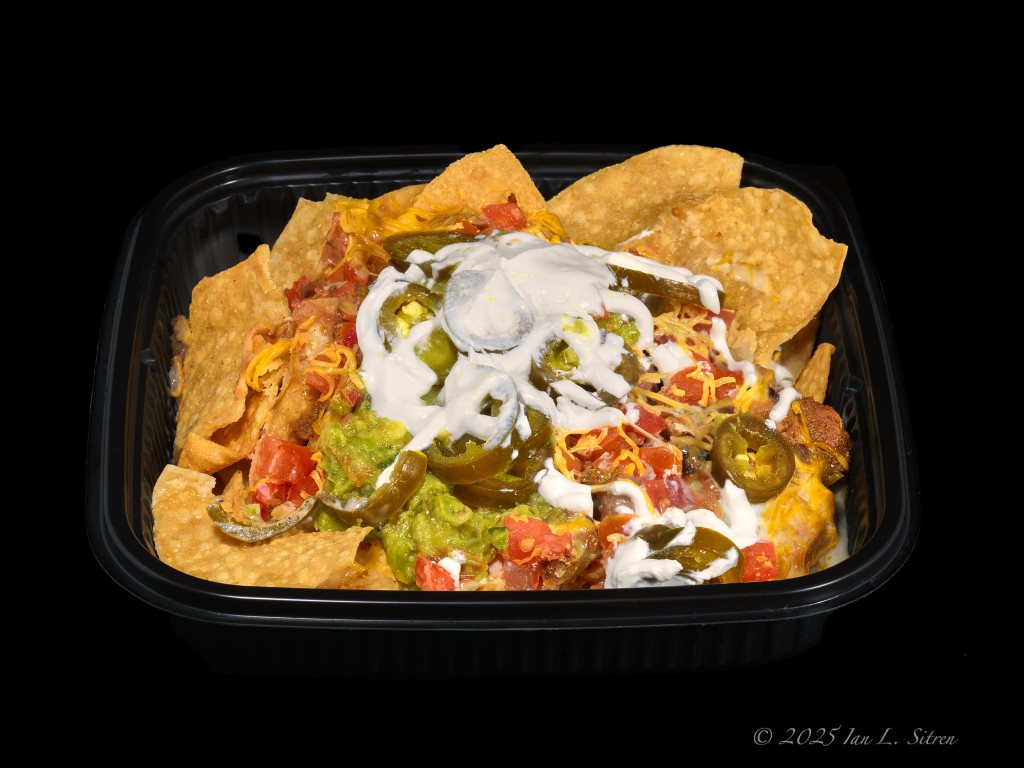
Apparently one tribute wasn’t enough for a dish invented as a last-minute solution in 1943. Nachos are one of the few foods successful enough to earn two holidays—International Nacho Day on October 21 and National Nacho Day today.
Nachos moved into the fast-food world in the 1970s, when chains began looking for inexpensive items that were quick to assemble and visually appealing. The combination of chips, cheese, and a few toppings fit perfectly into the developing drive-thru model. Taco Bell was an early adopter, introducing nachos nationally in 1979 and helping establish them as a standard menu item across the country. From there, nachos spread everywhere—from sporting events to convenience stores—and became one of the most recognizable Tex-Mex foods in American fast food.
For this second celebration, I photographed Del Taco’s Carne Asada Loaded Nachos exactly as they arrived in the black takeout container. Tortilla chips with carne asada steak, queso blanco, shredded cheese, guacamole, sour cream, diced tomatoes, and jalapeños. Fast food presented without adjustments, isolated on a black background as part of my ongoing Food From Bag to Background series.
See more on my website at: https://www.secondfocus.com/index/G0000wQ3fbeEezF0
Today is National Hamburger Day May 28th
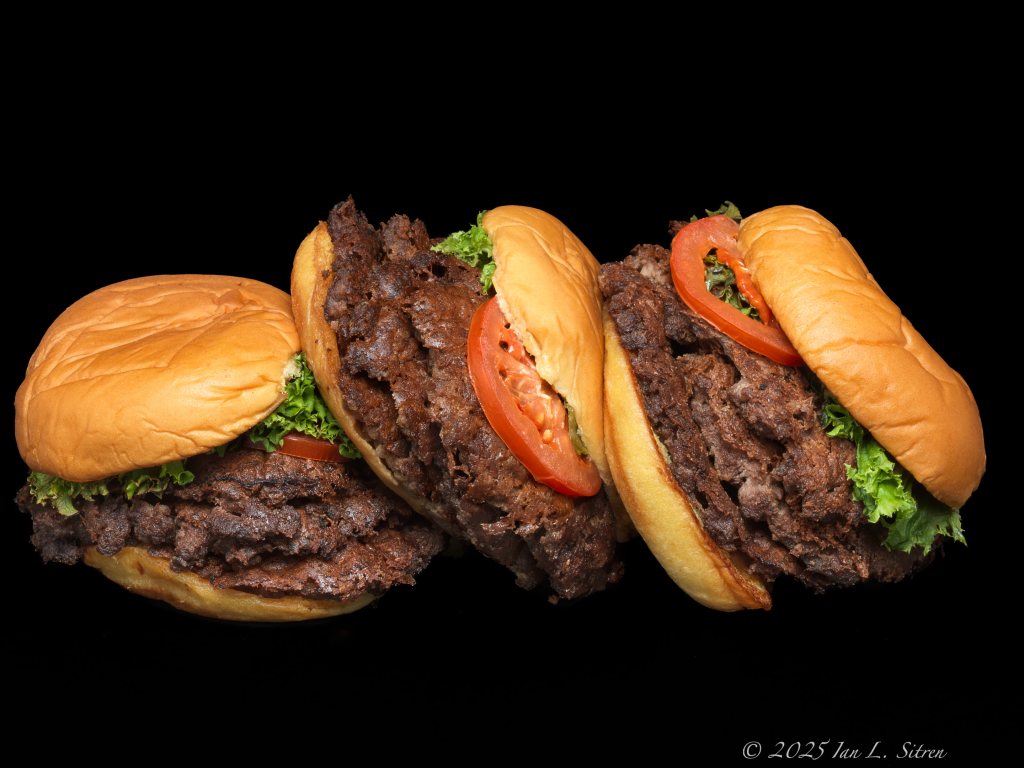
At Shake Shack, the menu listed a three‑patty burger, and that was all the excuse I needed. So I bought three of them—because why settle for one triple burger when you can line up three towers of beef and ShackSauce? No cheese, no rearranging, no styling. Just three oversized burgers straight from the bag to my black background.
Shake Shack Background
- Started as a hot‑dog cart in Madison Square Park, New York City, in 2001, expanding to a permanent kiosk in 2004.
- Went public in 2015 under the ticker SHAK, with its stock doubling to $47 on one day.
- Now has 600+ locations worldwide, with a mix of company‑owned and licensed restaurants.
- Burgers use a proprietary Pat LaFrieda beef blend, cooked on a griddle for a caramelized crust and served on Martin’s potato rolls with their signature ShackSauce.
Burger Facts
- Americans eat about 50 billion burgers every year, averaging 26 burgers per person annually.
- Triple‑patty burgers remain uncommon, making three of them a fitting choice for National Hamburger Day.
See more from my ongoing fast‑food photo series, From Bag to Background, here:
https://www.secondfocus.com/index/G0000wQ3fbeEezF0/I0000nUG8tfk8Gdc
International Chicken Wing Day

Today is International Chicken Wing Day, marking the popularity of one of the simplest yet most enduring foods in American dining culture. Chicken wings were first popularized in 1964 at the Anchor Bar in Buffalo, New York, when Teressa Bellissimo cooked them in hot sauce and served them as a late-night snack for her son and his friends, creating what we now know as Buffalo wings.
The original Buffalo sauce is a straightforward mix of hot sauce, melted butter, and a few seasonings, creating a distinctive bright orange coating that has defined the category ever since. It’s estimated that Americans consume over 1.4 billion chicken wings on Super Bowl weekend alone, showing how wings have cemented their place as a go-to for takeout, parties, and game day gatherings. Wings remain a staple for bars, fast food, and home kitchens, served in countless variations from mild to extra hot.
This photo of Buffalo wings, photographed on a clean white background, is part of my ongoing commercial food photography project. I photograph foods exactly as they arrive, emphasizing their color, texture, and shape without styling tricks.
You can see more from this series in my commercial food photography gallery here:
https://www.secondfocus.com/index/G0000WFAqDJQOgKU
National Egg Roll Day – A Stack Worth Photographing

Today is National Egg Roll Day, which recognizes one of the most iconic—and uniquely American—adaptations of Chinese cuisine. The egg roll, with its thick wheat flour wrapper and fried exterior, has become a takeout staple across the country. While its origins are loosely tied to Chinese spring rolls, the American egg roll took on a life of its own in the 20th century, evolving into something crispier, heavier, and more filled with meat and cabbage than its traditional counterparts.
National Egg Roll Day was launched in 2019 by Van’s Kitchen, a Dallas-based food manufacturer, to honor the deep roots of egg rolls in American food culture and to recognize immigrant-founded food businesses. Since then, it has quietly earned a spot on the food holiday calendar each June 10.
For this photograph, I picked up 18 Panda Express chicken egg rolls—one of the most widely available fast food versions. Panda Express, with over 2,200 locations across the U.S., serves more egg rolls than any other chain of its kind. According to industry data, the brand sells millions of them annually, with egg rolls consistently listed among their top-selling sides. They come filled with cabbage, carrots, and chicken, wrapped in a thick fried shell. Here, I tore some of them open and piled them into a stack on my black background. Topped with their three most common condiments—sweet and sour sauce, hot mustard, and chili sauce—they’re shown as served. Nothing added, nothing styled.
This image is part of my From Bag to Background series, documenting fast food as it actually appears, without props or retouching. You can see the rest of the series at: https://www.secondfocus.com/index/G0000wQ3fbeEezF0/I0000nUG8tfk8Gdc
National Fish & Chips Day – From Bag to Background

Today, June 6, marks National Fish & Chips Day—a celebration of a dish with deep roots on both sides of the Atlantic. Fish and chips, traditionally battered white fish served over fried potatoes, originated in 19th-century England as affordable street food. By the early 20th century, it had become a staple of British life.
In the United States, one man helped bring that tradition stateside: Haddon Salt, a third-generation British fish fryer who opened his first shop in California in 1965. His goal was to deliver a true British experience—using imported frying ranges, Icelandic cod, and a proper malt vinegar finish. Within a few years, the chain—renamed H. Salt Esq. Fish & Chips—grew rapidly, eventually acquired by Kentucky Fried Chicken. For a brief time in the early 1970s, it looked as though fish and chips might become as ubiquitous in America as burgers and fried chicken.
That never fully materialized. But a few independently owned H. Salt locations remain in California, still serving battered fish with crinkle-cut fries the old-fashioned way. That’s where this order came from—photographed exactly as it was handed over the counter. No rearranging, no garnish, no styling. Just the food on a black background, part of my ongoing From Bag to Background series.
It’s fast food history, captured as-is. View more from the series at https://www.secondfocus.com/index/G0000wQ3fbeEezF0/I0000nUG8tfk8Gdc
 SecondFocus Blog