Happy Anniversary Burger King: From Insta-Burger King to the Whopper
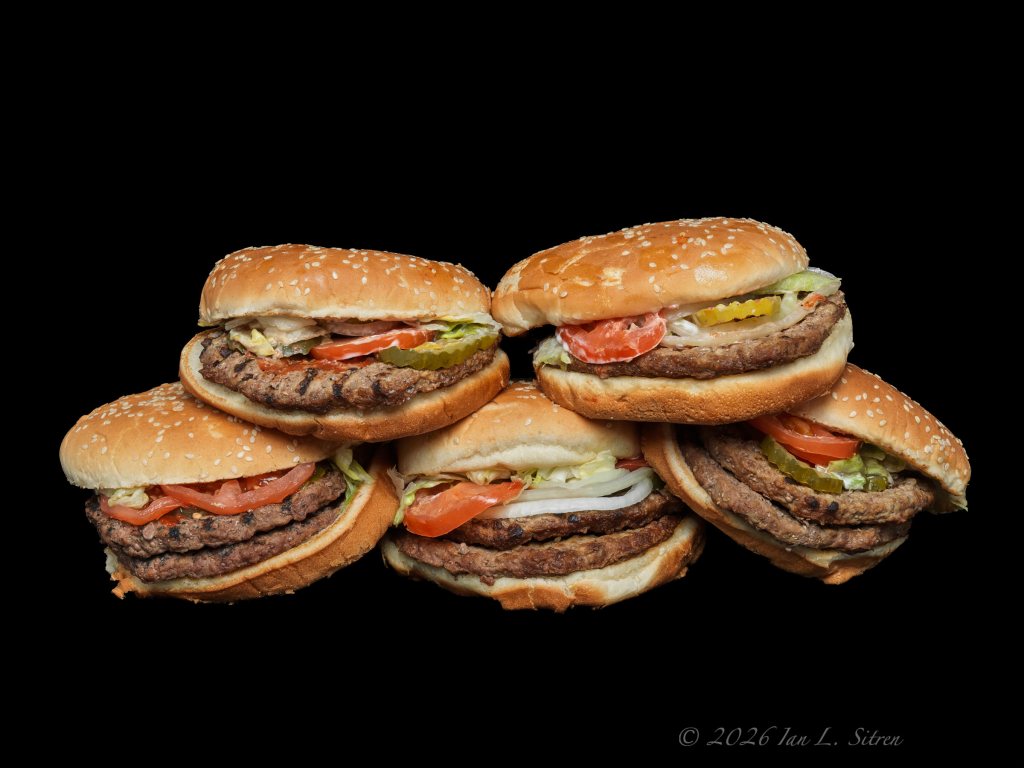
Today, July 23, marks the anniversary of the beginnings of Burger King, going back to 1953 and a restaurant in Jacksonville, Florida, called Insta-Burger King.
The story changed considerably from there. James McLamore and David Edgerton opened an Insta-Burger King franchise in Miami in 1954, eventually acquired the company, dropped the “Insta” from the name, and built Burger King into one of the biggest fast food chains in the world.
Then came the sandwich that would define the company.
The Whopper was introduced in 1957 and went on to become one of the most recognizable hamburgers in fast food. “Home of the Whopper” became part of the Burger King identity, and the Whopper itself has remained at the center of the menu for almost 70 years.
For my Food From Bag To Background photography project, I photographed both Whoppers and Double Whoppers, straight from Burger King, out of the wrappers and onto my very black black background.
And apparently one Whopper wasn’t enough for the photograph either.
Happy Anniversary Burger King!
You can see more of my photography, projects, motion, and my Blog on my website at https://www.secondfocus.com
Thank You!
National Hamburger Month, The Whopper Strikes Back in the BIG ARCH Authenticity War
Yesterday I wrote about the introduction of the BIG ARCH from McDonald’s and the strange corporate authenticity debate that unexpectedly formed around it. That post ended up becoming less about hamburgers themselves and more about how massive fast food companies now perform for the public in real time, with every detail immediately analyzed, mocked, defended, or turned into marketing.
If you missed it, the first part is here:
But the story really did not stop with McDonald’s.
Burger King quickly responded using the Whopper as its counterargument. Not a new burger. Not a limited-time release. Just the Whopper itself, the company essentially arguing that authenticity did not need to be engineered because they already had it.
That became the fascinating part of this entire fast food moment.
McDonald’s presented the BIG ARCH almost like a flagship corporate object, oversized, stacked, carefully engineered, heavily promoted. Burger King responded with flame-grilled familiarity and a deliberately less controlled image. The companies were no longer simply competing on taste or price. They were competing on who appeared more believable.
And honestly, that may be the most modern form of advertising possible.
The Whopper itself has a long history. Introduced in 1957, it actually predates the Big Mac and became Burger King’s defining product for decades. Larger, messier, harder to eat cleanly, more physically uneven than the carefully stacked advertising versions most companies prefer to show.
Which is why this photograph interested me.
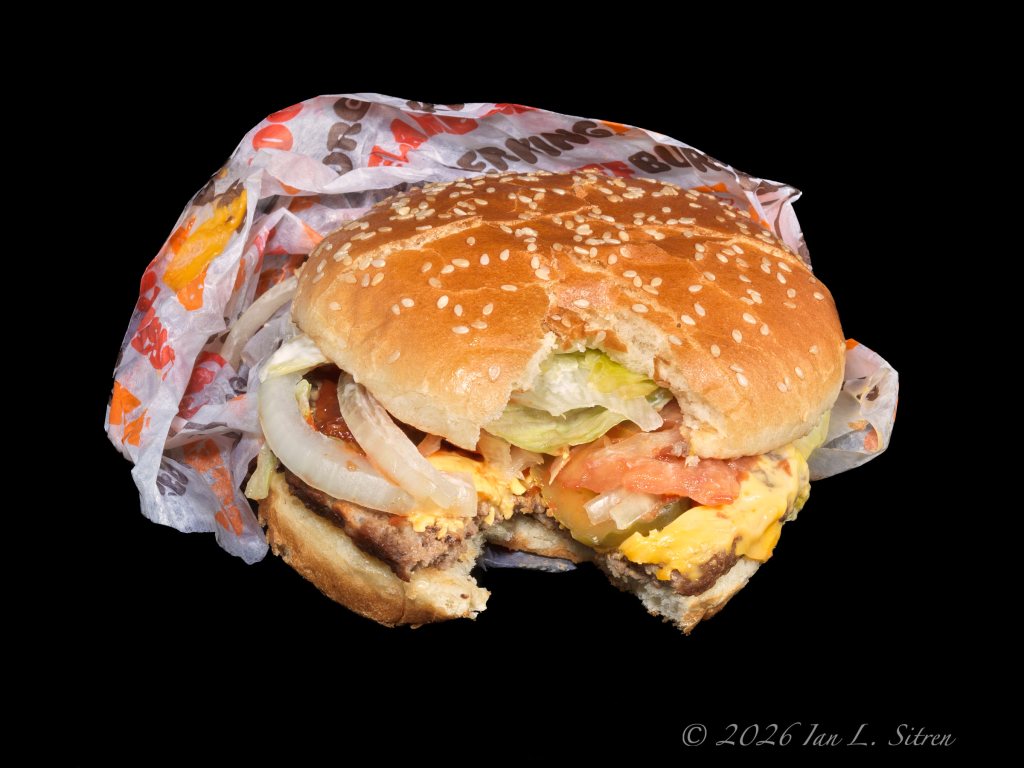
Unlike the BIG ARCH image I photographed earlier, this one already has a good sized bite taken out of it. The wrapper is still there. The burger is compressed from the bite. Sauce and onions are shifting out of place. It looks handled because it was handled.
That changes the photograph completely.
The image stops being about idealized presentation and becomes more about evidence, consumption, and the strange reality of how people actually interact with fast food. The burger becomes less like advertising and more like an object moving through someone’s life for a few minutes before disappearing.
That tension has become part of what I am exploring with the Food From Bag To Background project.
Fast food companies spend billions trying to construct images around products like this. Commercials, slogans, campaigns, celebrity promotions, social media teams, engineered branding language. But once the wrapper opens and someone takes a bite, the entire performance starts collapsing back into something very physical and very ordinary.
And somehow that may be the most authentic part of the entire thing.
More from the Food From Bag To Background project at https://www.secondfocus.com
Three Steakburgers, Or Something Close
National Steakburger Day is upon us, a holiday with just enough
legitimacy to sound historic and just enough marketing behind it to make
you pause.
It was self-declared by Freddy’s Frozen Custard and Steakburgers to
honor co-founder Freddy Simon and their version of the steakburger. Like
many food observances, it began as branding and now comfortably lives on
the calendar beside everything else we are told to recognize.
A steakburger traditionally suggests ground steak cuts, something closer
to a steakhouse than a standard hamburger. It carries implication.
Heavier. Better. More serious.
For my Food From Bag To Background project, focus is a different
direction.
I chose the fast food interpretation.
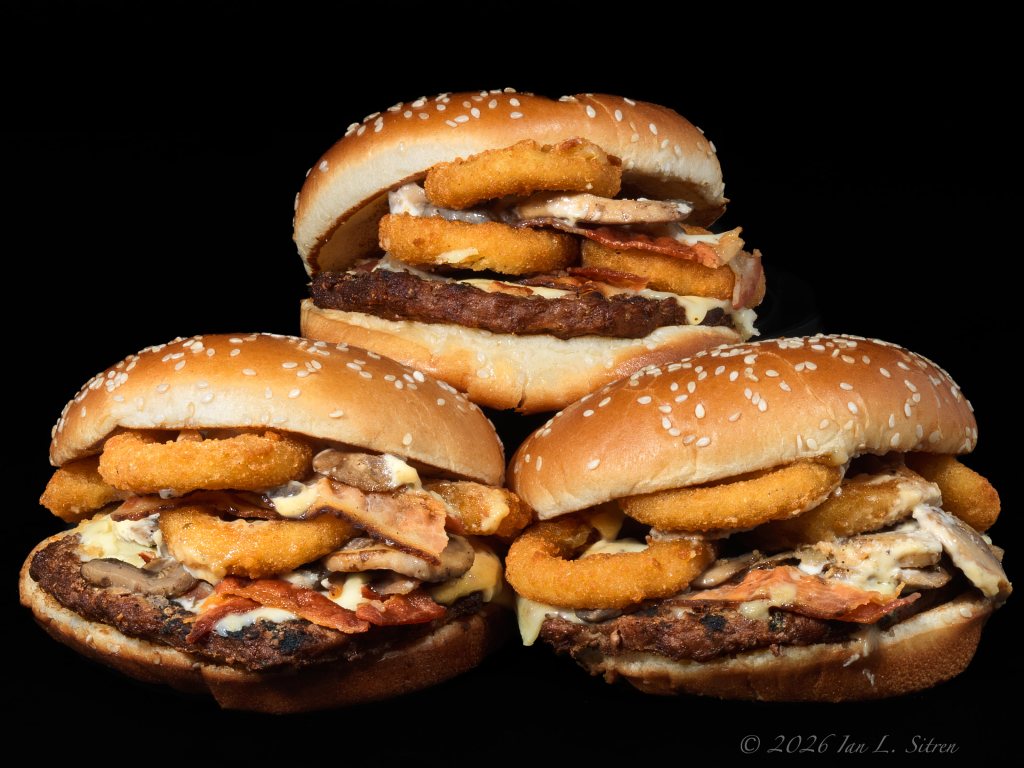
Burger King’s Ultimate Steakhouse Whopper is not technically a
steakburger. It is a flame-grilled beef patty layered with bacon, onion
rings, mushrooms, and sauce on a sesame seed bun. It borrows the
language of the steakhouse, packages it for the drive-thru, and lets the
name do the work.
Pulled from the bag and placed against a black background, three of them
become something else. Not a value meal. Not a combo. Just stacked
excess, isolated and direct.
National Steakburger Day may be brand-born, but the burger is real.
See more from the Food From Bag To Background series here:
https://www.secondfocus.com/index/G0000wQ3fbeEezF0
Whopper Birthday
Some birthdays sneak up on you. Today happens to be the birthday of the Burger King Whopper, introduced in 1957 when a Miami burger stand decided America deserved something larger and more structurally ambitious than anything on the menu board.
James McLamore, one of the Burger King founders, noticed customers flocking to oversized burgers at rival drive-ins. His solution was simple: go bigger. Much bigger. The original Whopper sold for 37 cents and immediately rewired American expectations for how much beef should fit inside a bun. From there, fast-food evolution took over. The Double Whopper showed up because of course it did. The Angry Whopper arrived for people who needed emotional intensity with their lunch. The Brisket Whopper made a brief appearance to remind us that barbecue can be a personality trait. And then the Impossible Whopper landed in 2019, launching the plant-based arms race and proving that even vegetarians sometimes want a burger the size of a paperback novel.
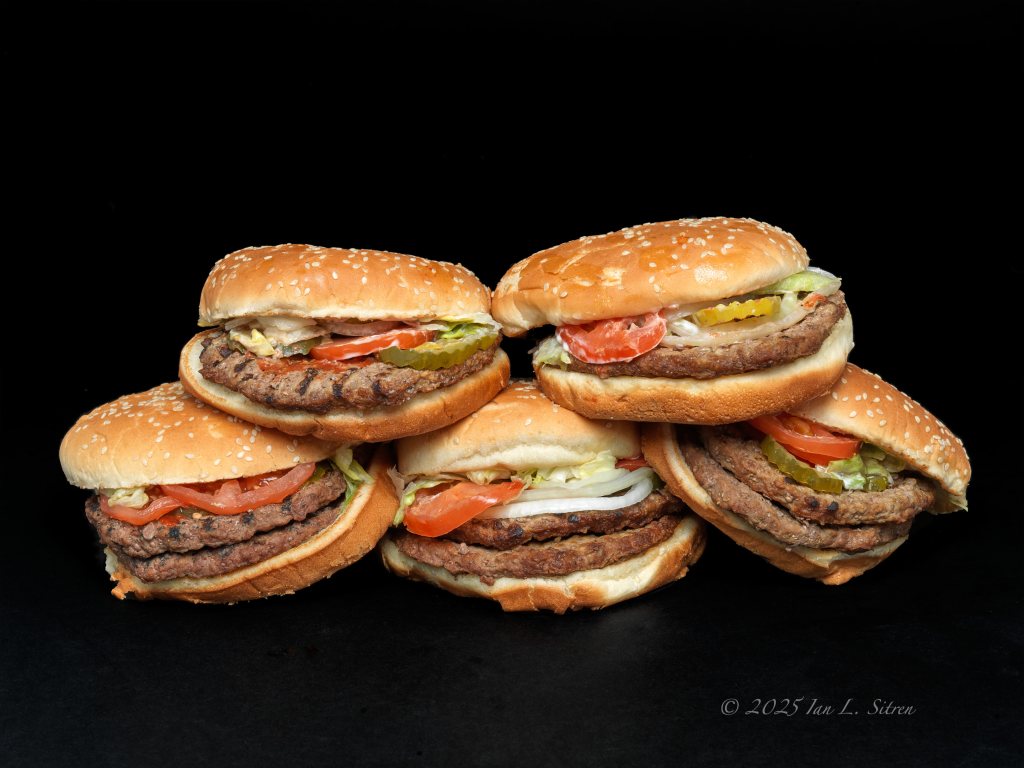
This is my stack of Double Whoppers, photographed earlier. I didn’t have time to run out and buy new ones, but double is my personal preference anyway.
There is much more of my fast food project “Food From Bag To Background” on my website at
https://www.secondfocus.com/index/G0000wQ3fbeEezF0 You might find something to make you hungry, take a look. Thanks.
Real Whoppers!

What a Whopper Really Looks Like
A Whopper of a lawsuit is making headlines. In Coleman v. Burger King, the fast food giant is being accused of deceptive advertising, with claims that its famous burgers don’t look nearly as appetizing in real life as they do in the company’s promotional images.
The lawsuit has sparked a wave of comparison photos, with media coverage highlighting images of Whoppers looking deflated, sparse, and unappealing.
But let’s be clear: the so-called “real” Whopper photos being circulated tell a story of their own — shot in bad lighting, at awkward angles, with a sickly green hue that distorts the appearance of the food. That’s not reality either; it’s just the opposite kind of spin.
The photo here wasn’t taken for this lawsuit or in reaction to it. It’s one I shot previously as part of my ongoing fast food photography series, and it’s been on my website for some time.
These are actual Burger King Whoppers and Double Whoppers, photographed as they came out of the bag — no styling, no manipulation, just carefully lit against a black background. And they look good — and in my opinion, taste good too.
This isn’t an endorsement or a takedown. It’s just documentation — what these burgers really look like. Not inflated, not degraded. There’s a difference between advertising and reality, but there’s also a difference between reality and an intentionally bad photograph.
This is what Whoppers really look like.
You can see more of my fast food photography series — everything from burgers and tacos to shrimp and sandwiches — at 👉 SecondFocus.com “From Bag to Background.”
The Whopper!
The Whopper, Burger King’s iconic sandwich, first created in 1957 as a direct competitor to the McDonald’s Quarter-Pounder. It’s legendary slogan, ‘Home of the Whopper,’ became unforgettable over the years. And right here, we have three of them rotating before your eyes. Check out my Food Photography and much more on my website at http://SecondFocus.com Thanks!


National Hamburger Month and the Billion Dollar Authenticity War Behind the BIG ARCH
May is National Hamburger Month.
Which sounds simple enough until you stop and realize how much of modern American culture quietly revolves around hamburgers.
This year, the biggest burger story has probably been the introduction of the BIG ARCH from McDonald’s. Not just because it was another fast food launch, but because the entire thing unexpectedly turned into a strange cultural event involving corporate marketing, social media authenticity, public reaction, and billions of dollars sitting underneath all of it.
The burger itself was designed to be bigger, heavier, and more excessive than the traditional McDonald’s lineup. Two large beef patties, layered cheese, onions, lettuce, pickles, special sauce, and a large sesame and poppy seed bun. McDonald’s positioned it almost like a flagship object, the “most McDonald’s McDonald’s burger yet,” which is such a corporate sentence it almost becomes satire on its own.
Earlier this year, McDonald’s CEO Chris Kempczinski posted a promotional tasting video for the BIG ARCH. Instead of focusing on the burger, people focused on him. The small bite. The awkward delivery. The careful corporate language. Whether he looked comfortable eating it at all.
The clips spread everywhere. TikTok, YouTube reactions, business media, late-night commentary, memes, marketing discussions. Burger King even took shots at the situation publicly. Business writers started describing the entire thing as an “authenticity war” between fast food companies trying to appear relatable in an era where consumers instantly dissect every detail.
Which is fascinating when you step back and look at the scale of what we are talking about.
McDonald’s serves roughly 69 million customers every day around the world. Annual revenue exceeds 25 billion dollars. The global burger market itself is estimated well over 100 billion dollars annually. Entire supply chains, agricultural systems, marketing departments, packaging systems, social media strategies, and public corporations revolve around products like this.
And after all of that planning, testing, engineering, and advertising, public discussion ended up collectively debating whether a CEO looked natural taking a bite out of a hamburger.
That may actually be the most 2026 thing imaginable.
This photograph became part of that larger observation for me. The image strips away the advertising language and isolates the object itself. No restaurant interior, no fries, no smiling family, no campaign graphics. Just the burgers against black.
That approach has become part of what I’m doing with the Food From Bag To Background project. Taking fast food out of its marketing environment and presenting it almost like an artifact. The layers, the excess, the construction, the familiarity of it all. Things people see constantly but rarely stop and actually look at.
And whether people love it, criticize it, joke about it, or eat it in their car without thinking twice, the hamburger remains one of the defining products of modern American culture.
More at https://www.secondfocus.com
May 18, 2026 | Categories: Uncategorized | Tags: American culture, BIG ARCH burger, black background food photography, burger history, burger industry, Burger King, burger marketing, Burger Photography, burger wars, Chris Kempczinski, commercial food photography, cultural commentary, fast food culture, fast food history, fast food industry, fast food marketing, fast food photography, food blog, food culture, Food From Bag to Background, hamburger culture, McDonald’s, McDonald’s Big Arch, National Hamburger Month, restaurant industry, secondfocus, whopper | 1 Comment