National Biscuit Day and the Simplicity of FOOD FROM BAG TO BACKGROUND
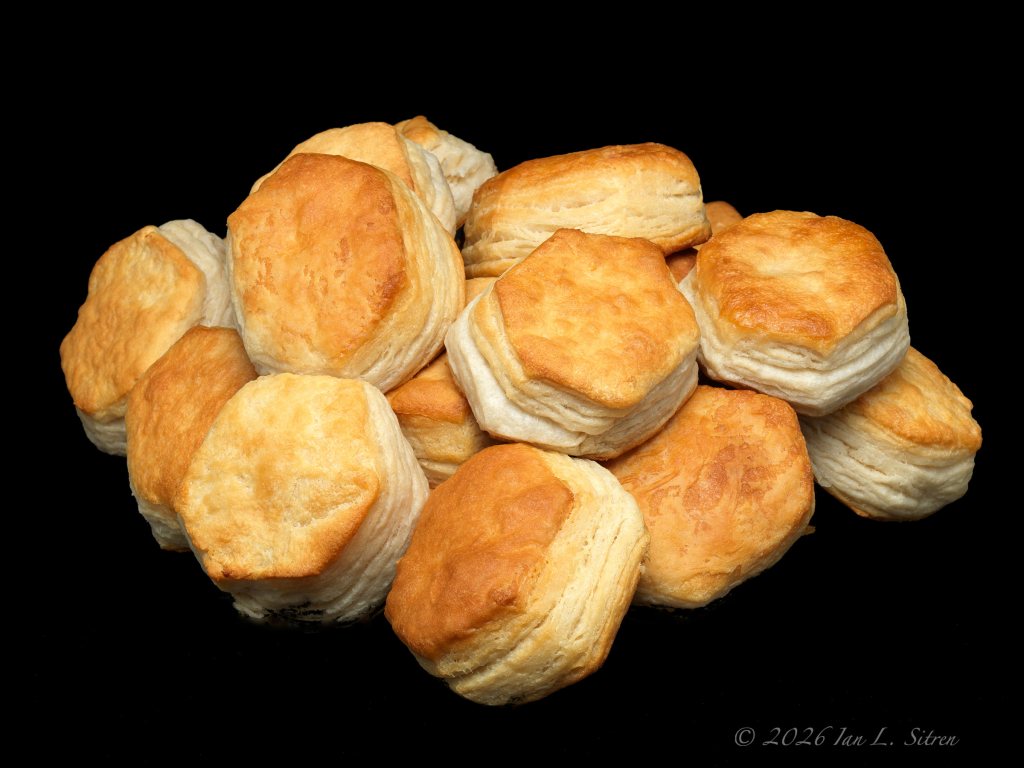
National Biscuit Day.
Some foods don’t really need marketing agencies, AI enhancement, stylists with tweezers, or fake steam drifting through the frame.
Biscuits are one of them.
These are just peel-apart biscuits photographed for my FOOD FROM BAG TO BACKGROUND series exactly the way they came out of the package and oven. No brushed butter, no artificial shine, no tricks to make them look taller, fresher, or more dramatic than they actually were.
And honestly, that was always part of the point of this project.
Fast food and convenience food advertising has trained people to expect food to look exaggerated, oversized, and almost synthetic. But when you isolate something simple against a black background and actually pay attention to it, the real texture starts doing the work by itself. The layers, the uneven browning, the soft edges, the imperfect shapes. Those details are usually hidden behind logos, wrappers, commercials, and speed.
Biscuits are also strangely tied into American fast food culture. Fried chicken chains, drive-thru breakfasts, gas station counters, roadside diners. They exist somewhere between comfort food and convenience food, which is probably why they fit this project so well.
So for National Biscuit Day, no AI animation experiments, no dramatic visual effects, just biscuits.
And when I was a kid, when my mom made these, I could have eaten every one of them, each with a pat of butter melting into the middle.
If this photograph brought back a memory, made you hungry, or simply made you look at something familiar a little differently, there are dozens more waiting in FOOD FROM BAG TO BACKGROUND. Burgers, tacos, pizza, donuts, fries, sandwiches, and other foods pulled straight from the bag and placed under the same black backdrop.
You can explore the entire series here on my website at https://www.secondfocus.com/index/G0000wQ3fbeEezF0
National Hamburger Day and the Fast Food Reality Behind FOOD FROM BAG TO BACKGROUND
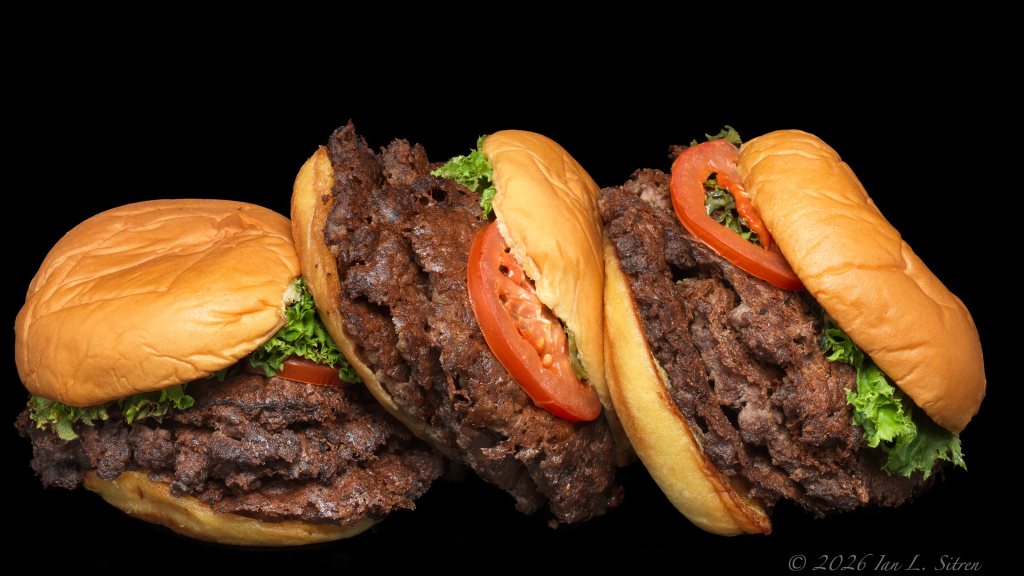
Today is National Hamburger Day.
The hamburger has probably become the defining subject of my “FOOD FROM BAG TO BACKGROUND” project. Fast food photographed exactly as it arrives, no stylists, no reconstruction, no fake versions built for advertising.
And one thing people occasionally ask is where all this food comes from.
The answer is simple: the same place everybody else gets it.
The restaurants and chains have no idea I am photographing their food. There are no sponsorships, no special preparation, no discounts because of photography, and no carefully assembled “photo burgers” arriving from a corporate kitchen. I walk in or use the apps, place an order, pick it up, bring it home, and photograph it exactly as it comes out of the wrapper or bag.
Actually, the apps have become part of the process. The fast food companies constantly push coupons, free items, points, discounts, and combination deals. Surprisingly worthwhile ones. Sometimes I end up planning a shoot around whatever special appears that week.
That is part of what interests me visually about the project. These hamburgers are not idealized advertising concepts. They are real fast food hamburgers, bought like anybody else would buy them, photographed seriously against black backgrounds with the same attention I would give any other subject.
Somewhere between documentary, satire, and food photography, the hamburger became one of the central characters.
And if you have ever wondered what fast food starts looking like when it is pulled out of the bag, isolated against black, and treated like a serious photographic subject, step into the project here on my website at https://www.secondfocus.com
Emily Gets Food Truck Experience
Today is National Waiters and Waitresses Day.
So naturally, Emily decided she needed food industry experience.
Over time, Emily, my evolving AI muse and assistant, has quietly become part of the ongoing SecondFocus world, somewhere between collaborator, observer, and increasingly, participant. And because so much of my photography revolves around fast food culture, restaurants, roadside Americana, and the strange visual language surrounding food itself, she apparently decided it was time to learn the business from the inside.
Which is how she ended up working the night shift inside a food truck.
The idea that interested me visually was the contrast. Stainless steel counters, fryer heat, baskets of fries, the pressure and motion of a cramped late-night kitchen, and then Emily moving through it all with this calm self-awareness, almost as if she already belongs there.
The result feels somewhere between documentary, satire, and science fiction.
And honestly, probably not the kind of employee most food truck owners were expecting.
More from the ongoing Emily Integration project and my photography work on my website at
https://www.secondfocus.com
National Hamburger Month, The Whopper Strikes Back in the BIG ARCH Authenticity War
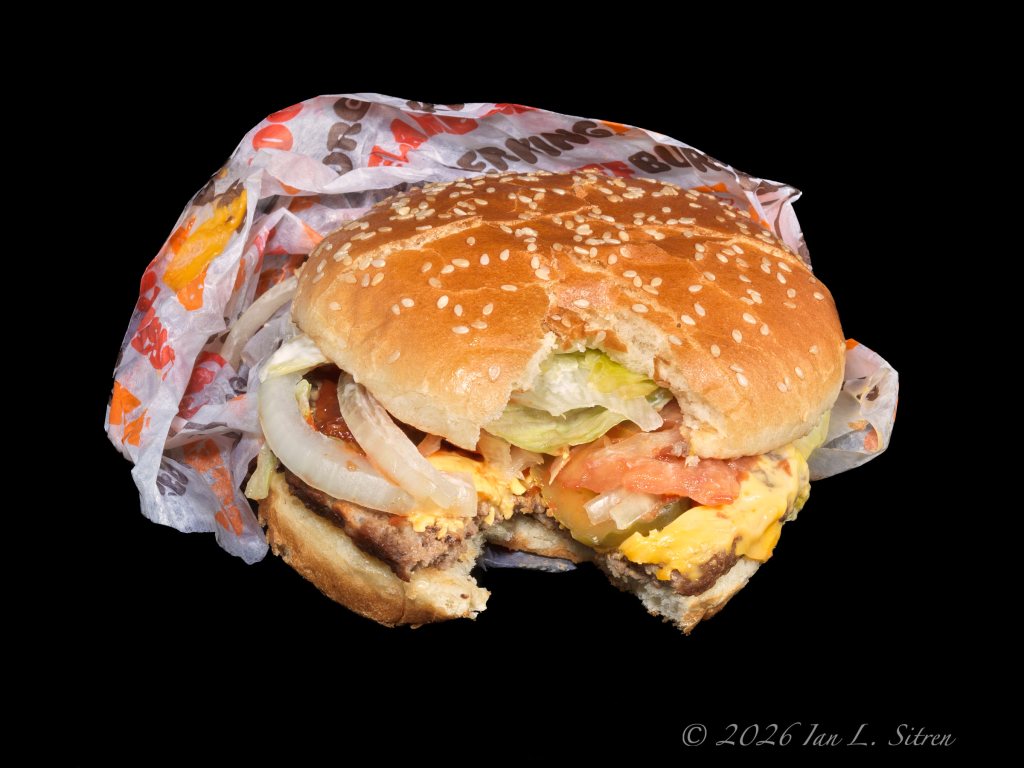
Yesterday I wrote about the introduction of the BIG ARCH from McDonald’s and the strange corporate authenticity debate that unexpectedly formed around it. That post ended up becoming less about hamburgers themselves and more about how massive fast food companies now perform for the public in real time, with every detail immediately analyzed, mocked, defended, or turned into marketing.
If you missed it, the first part is here:
But the story really did not stop with McDonald’s.
Burger King quickly responded using the Whopper as its counterargument. Not a new burger. Not a limited-time release. Just the Whopper itself, the company essentially arguing that authenticity did not need to be engineered because they already had it.
That became the fascinating part of this entire fast food moment.
McDonald’s presented the BIG ARCH almost like a flagship corporate object, oversized, stacked, carefully engineered, heavily promoted. Burger King responded with flame-grilled familiarity and a deliberately less controlled image. The companies were no longer simply competing on taste or price. They were competing on who appeared more believable.
And honestly, that may be the most modern form of advertising possible.
The Whopper itself has a long history. Introduced in 1957, it actually predates the Big Mac and became Burger King’s defining product for decades. Larger, messier, harder to eat cleanly, more physically uneven than the carefully stacked advertising versions most companies prefer to show.
Which is why this photograph interested me.
Unlike the BIG ARCH image I photographed earlier, this one already has a good sized bite taken out of it. The wrapper is still there. The burger is compressed from the bite. Sauce and onions are shifting out of place. It looks handled because it was handled.
That changes the photograph completely.
The image stops being about idealized presentation and becomes more about evidence, consumption, and the strange reality of how people actually interact with fast food. The burger becomes less like advertising and more like an object moving through someone’s life for a few minutes before disappearing.
That tension has become part of what I am exploring with the Food From Bag To Background project.
Fast food companies spend billions trying to construct images around products like this. Commercials, slogans, campaigns, celebrity promotions, social media teams, engineered branding language. But once the wrapper opens and someone takes a bite, the entire performance starts collapsing back into something very physical and very ordinary.
And somehow that may be the most authentic part of the entire thing.
More from the Food From Bag To Background project at https://www.secondfocus.com
National Hot Pastrami Sandwich Day
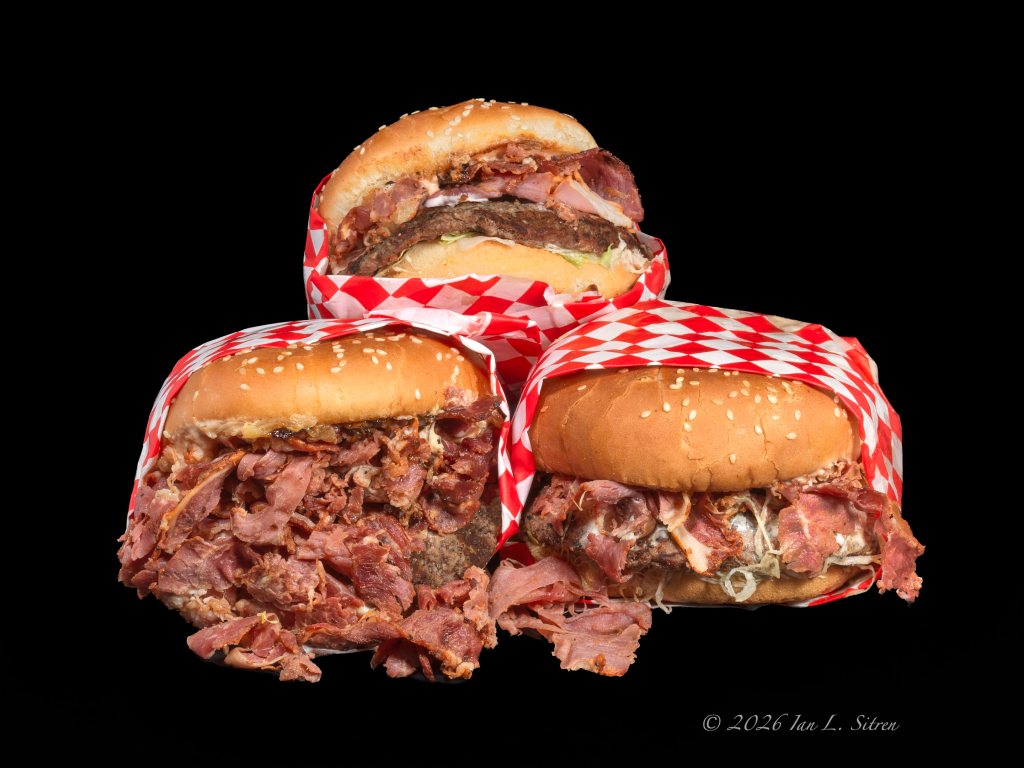
Today is National Hot Pastrami Sandwich Day, and this is the photograph I chose to mark it.
I’ve photographed classic pastrami sandwiches before, the kind wrapped in paper, stacked high, and eaten leaning forward so nothing ends up on your shirt. This time I wanted to look at something I see more and more often: the pastrami cheeseburger.
Pastrami began as a method of preservation, rooted in Eastern European Jewish traditions, before becoming a defining part of American food culture. In delicatessens, especially in New York and later Los Angeles, it settled into a familiar form: sliced hot, piled high, and served with little interference. The meat was the point.
The pastrami cheeseburger feels like a distinctly American evolution of that idea.
This photograph features pastrami cheeseburgers from P&G Burgers in Colton, California, a long-running Southern California fast-food restaurant with indoor seating, outdoor tables, and a drive-thru. You order at the counter beneath a wall of menu boards and pick up your food when your number is called. It’s not a deli and not just a roadside shack. It’s a full-scale fast-food operation built around burgers, fries, shakes, and pastrami.
Their claim, “Home of the Best Pastrami Cheeseburgers in the World,” is printed right on the building. Whether taken literally or as confident fast-food bravado, it suits what they’re serving. These burgers are large, heavy, and unapologetically loaded. Thick beef patties stacked with grilled pastrami, cheese, and a soft sesame seed bun, wrapped tight and meant to be eaten with commitment.
The cheeseburger version shifts pastrami away from its deli roots and places it squarely in American fast-food culture. Beef layered onto beef. Cheese added. Rye replaced by a burger bun. It’s less about tradition and more about appetite. Less about restraint and more about scale.
That’s what drew me to photograph it.
This image shows the burgers exactly as they’re served, straight from the counter, still wrapped, still spilling out. No styling, no cleanup. Just weight, texture, and excess. In that way, it still respects pastrami’s history, even as it pushes it into something louder and distinctly American.
On National Hot Pastrami Sandwich Day, that evolution feels worth acknowledging.
More of my fast food photographs on my website in the gallery “Food From Bag To Background” at https://www.secondfocus.com/index/G0000wQ3fbeEezF0
World Bread Day – From Ancient Loaves to the Modern Bun
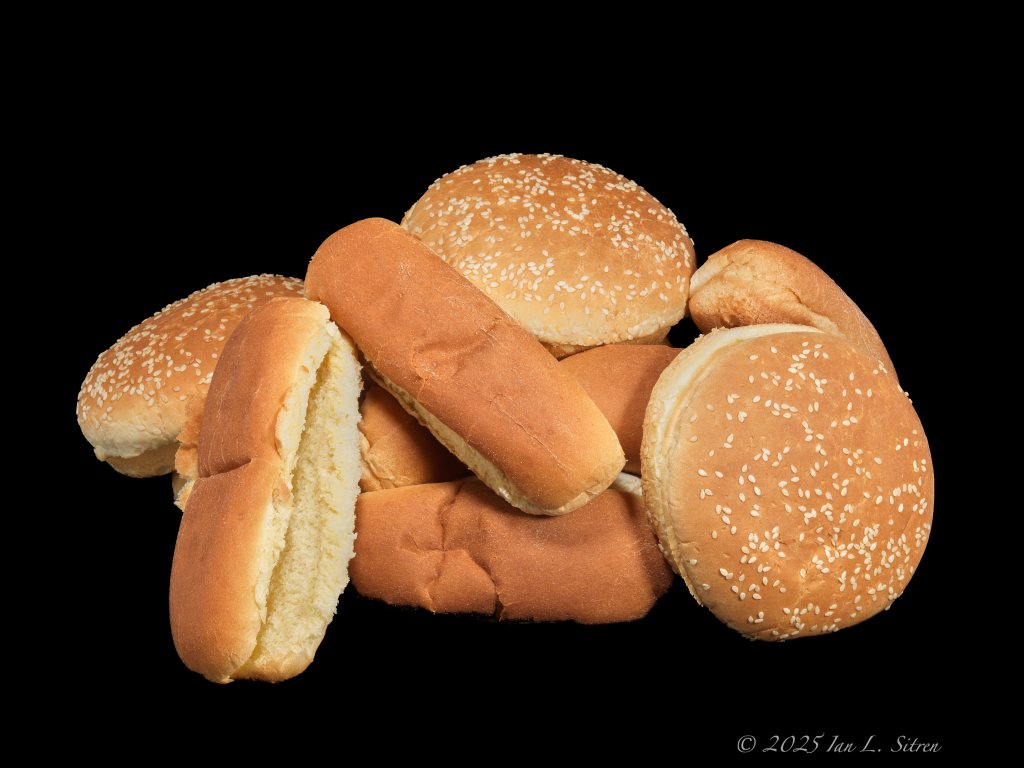
Two of the most commercially produced breads in the world—the sesame seed–topped hamburger bun and the plain hot dog bun. Simple in form, instantly recognizable, and the foundation of a global industry.
These are the breads of our time—engineered for uniformity, designed for speed, and produced on a scale unimaginable in history. They are the modern descendants of humankind’s oldest craft.
World Bread Day, established by the International Union of Bakers and Confectioners (UIBC), honors that history. Celebrated each year on October 16—the anniversary of the founding of the United Nations Food and Agriculture Organization in 1945—it reminds us that bread, in all its forms, is more than sustenance. It is civilization’s most enduring symbol of nourishment.
From the first mixtures of grain and water baked on hot stones, to the hand-shaped loaves of ancient Egypt, to the rustic rounds of Europe’s countryside and the elegant French baguette—bread has evolved with humanity itself. The industrial sliced white loaf marked a turning point, transforming an age-old necessity into a product of mass production and convenience. The commercial bun is its natural successor, continuing the story in the language of modern industry and fast food.
See more from my From Bag to Background series at https://www.secondfocus.com/index/G0000wQ3fbeEezF0/I0000nUG8tfk8Gdc
National Double Cheeseburger Day
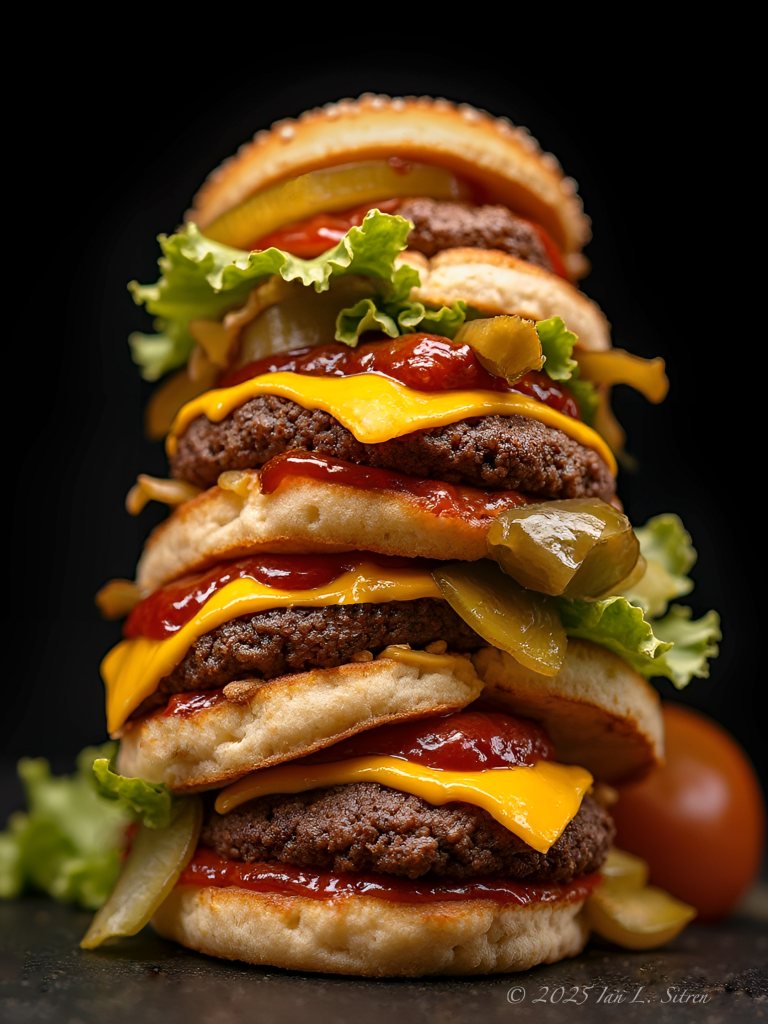
Today is National Double Cheeseburger Day — a holiday devoted to one of America’s favorite fast food inventions. The double first gained traction in the 1930s and 1940s, when diners realized that two patties and two slices of cheese delivered both value and indulgence. McDonald’s added it to their menu in 1965, and from there it became a staple of the fast food landscape, endlessly copied and re‑imagined.
Over time I’ve photographed many double cheeseburgers for my “Food From Bag to Background” project — documenting them exactly as they arrive, unstyled, on a stark black background. But for today, I wanted to try something different. After a conversation with my AI assistant, Emily, the idea came up: what if instead of stacking burgers, we created a single, continuous double cheeseburger that just keeps going? The result is this vertical column of beef, cheese, and buns — a rethinking of the double cheeseburger taken further than usual.
Because on National Double Cheeseburger Day, isn’t one double never really enough?
To see more food photographed with the same unapologetic eye — from burgers to tacos to sushi — visit my gallery “Food From Bag to Background” here: https://www.secondfocus.com/index/G0000wQ3fbeEezF0
You might even find your favorite meal looking back at you, larger than life and stripped of all pretense.


National Hamburger Month and the Billion Dollar Authenticity War Behind the BIG ARCH
May is National Hamburger Month.
Which sounds simple enough until you stop and realize how much of modern American culture quietly revolves around hamburgers.
This year, the biggest burger story has probably been the introduction of the BIG ARCH from McDonald’s. Not just because it was another fast food launch, but because the entire thing unexpectedly turned into a strange cultural event involving corporate marketing, social media authenticity, public reaction, and billions of dollars sitting underneath all of it.
The burger itself was designed to be bigger, heavier, and more excessive than the traditional McDonald’s lineup. Two large beef patties, layered cheese, onions, lettuce, pickles, special sauce, and a large sesame and poppy seed bun. McDonald’s positioned it almost like a flagship object, the “most McDonald’s McDonald’s burger yet,” which is such a corporate sentence it almost becomes satire on its own.
Earlier this year, McDonald’s CEO Chris Kempczinski posted a promotional tasting video for the BIG ARCH. Instead of focusing on the burger, people focused on him. The small bite. The awkward delivery. The careful corporate language. Whether he looked comfortable eating it at all.
The clips spread everywhere. TikTok, YouTube reactions, business media, late-night commentary, memes, marketing discussions. Burger King even took shots at the situation publicly. Business writers started describing the entire thing as an “authenticity war” between fast food companies trying to appear relatable in an era where consumers instantly dissect every detail.
Which is fascinating when you step back and look at the scale of what we are talking about.
McDonald’s serves roughly 69 million customers every day around the world. Annual revenue exceeds 25 billion dollars. The global burger market itself is estimated well over 100 billion dollars annually. Entire supply chains, agricultural systems, marketing departments, packaging systems, social media strategies, and public corporations revolve around products like this.
And after all of that planning, testing, engineering, and advertising, public discussion ended up collectively debating whether a CEO looked natural taking a bite out of a hamburger.
That may actually be the most 2026 thing imaginable.
This photograph became part of that larger observation for me. The image strips away the advertising language and isolates the object itself. No restaurant interior, no fries, no smiling family, no campaign graphics. Just the burgers against black.
That approach has become part of what I’m doing with the Food From Bag To Background project. Taking fast food out of its marketing environment and presenting it almost like an artifact. The layers, the excess, the construction, the familiarity of it all. Things people see constantly but rarely stop and actually look at.
And whether people love it, criticize it, joke about it, or eat it in their car without thinking twice, the hamburger remains one of the defining products of modern American culture.
More at https://www.secondfocus.com
May 18, 2026 | Categories: Uncategorized | Tags: American culture, BIG ARCH burger, black background food photography, burger history, burger industry, Burger King, burger marketing, Burger Photography, burger wars, Chris Kempczinski, commercial food photography, cultural commentary, fast food culture, fast food history, fast food industry, fast food marketing, fast food photography, food blog, food culture, Food From Bag to Background, hamburger culture, McDonald’s, McDonald’s Big Arch, National Hamburger Month, restaurant industry, secondfocus, whopper | 1 Comment