National Ice Cream Sandwich Day

Today is National Ice Cream Sandwich Day, and that gave me a good reason to revisit one of my favorite food photographs from last year.
The ice cream sandwich has been around for more than a century. Early versions were sold by New York City street vendors for just a penny, making them one of the first frozen treats that almost anyone could afford. More than a hundred years later, the recipe is still remarkably simple. Vanilla ice cream between two soft chocolate wafers. Sometimes the best ideas don’t need to be reinvented.
For this photograph, I bought a whole box instead of just one. Stacked together against my very black black background, they stopped looking like something from the grocery store freezer and became a study in repetition, texture, and contrast. The chocolate wafers, bright white ice cream, and imperfect edges created exactly the kind of photograph I was hoping for.
One of the things I enjoy most about food photography is finding subjects that people see every day and presenting them in a way they probably haven’t seen before. The ice cream sandwich isn’t rare, expensive, or complicated. It’s simply an American classic that deserved a few minutes in front of the camera.
You can see more of my photography, projects, motion, and my Blog on my website at https://www.secondfocus.com
Thank You!
National Avocado Day Through the Camera Lens

Today is National Avocado Day, and it seemed like the perfect opportunity to revisit one of my favorite food photographs. I photographed these three avocados last year, and I still like the way they came together.
It’s easy to take avocados for granted because they seem to be everywhere. They appear on restaurant menus, in grocery stores year-round, and in countless recipes. Yet the Hass avocado, which dominates today’s market, traces its origins to a single tree planted by California mail carrier Rudolph Hass in the 1920s. Nearly every Hass avocado grown today is descended from that one remarkable tree.
For this photograph, I used three avocados to show the progression from whole fruit to the rich green interior and the familiar pit. Against my very black black background, the color, texture, and shape become the entire subject. Sometimes the simplest foods are the most rewarding to photograph because there is nothing to hide behind. Everything depends on the light, the composition, and the details.
That’s one reason I still enjoy looking at this photograph a year later.
You can see more of my photography, projects, motion, and my Blog on my website at https://www.secondfocus.com
Thank You!
National Biscuit Day and the Simplicity of FOOD FROM BAG TO BACKGROUND
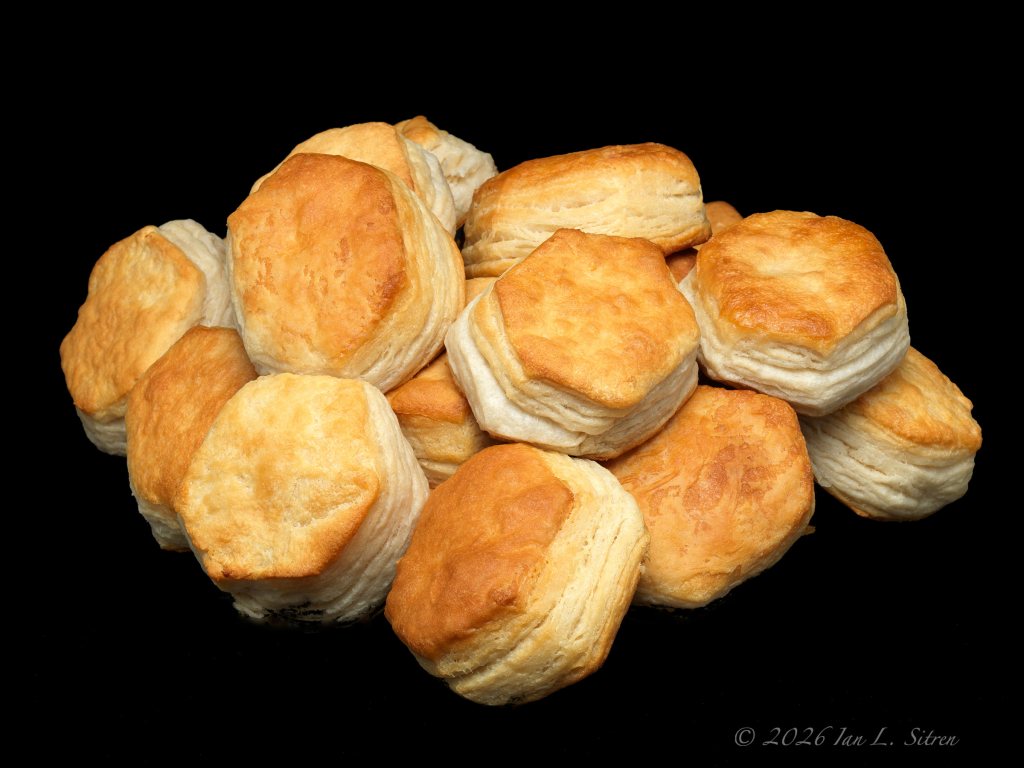
National Biscuit Day.
Some foods don’t really need marketing agencies, AI enhancement, stylists with tweezers, or fake steam drifting through the frame.
Biscuits are one of them.
These are just peel-apart biscuits photographed for my FOOD FROM BAG TO BACKGROUND series exactly the way they came out of the package and oven. No brushed butter, no artificial shine, no tricks to make them look taller, fresher, or more dramatic than they actually were.
And honestly, that was always part of the point of this project.
Fast food and convenience food advertising has trained people to expect food to look exaggerated, oversized, and almost synthetic. But when you isolate something simple against a black background and actually pay attention to it, the real texture starts doing the work by itself. The layers, the uneven browning, the soft edges, the imperfect shapes. Those details are usually hidden behind logos, wrappers, commercials, and speed.
Biscuits are also strangely tied into American fast food culture. Fried chicken chains, drive-thru breakfasts, gas station counters, roadside diners. They exist somewhere between comfort food and convenience food, which is probably why they fit this project so well.
So for National Biscuit Day, no AI animation experiments, no dramatic visual effects, just biscuits.
And when I was a kid, when my mom made these, I could have eaten every one of them, each with a pat of butter melting into the middle.
If this photograph brought back a memory, made you hungry, or simply made you look at something familiar a little differently, there are dozens more waiting in FOOD FROM BAG TO BACKGROUND. Burgers, tacos, pizza, donuts, fries, sandwiches, and other foods pulled straight from the bag and placed under the same black backdrop.
You can explore the entire series here on my website at https://www.secondfocus.com/index/G0000wQ3fbeEezF0
National Brisket Day and the Reality Behind FOOD FROM BAG TO BACKGROUND
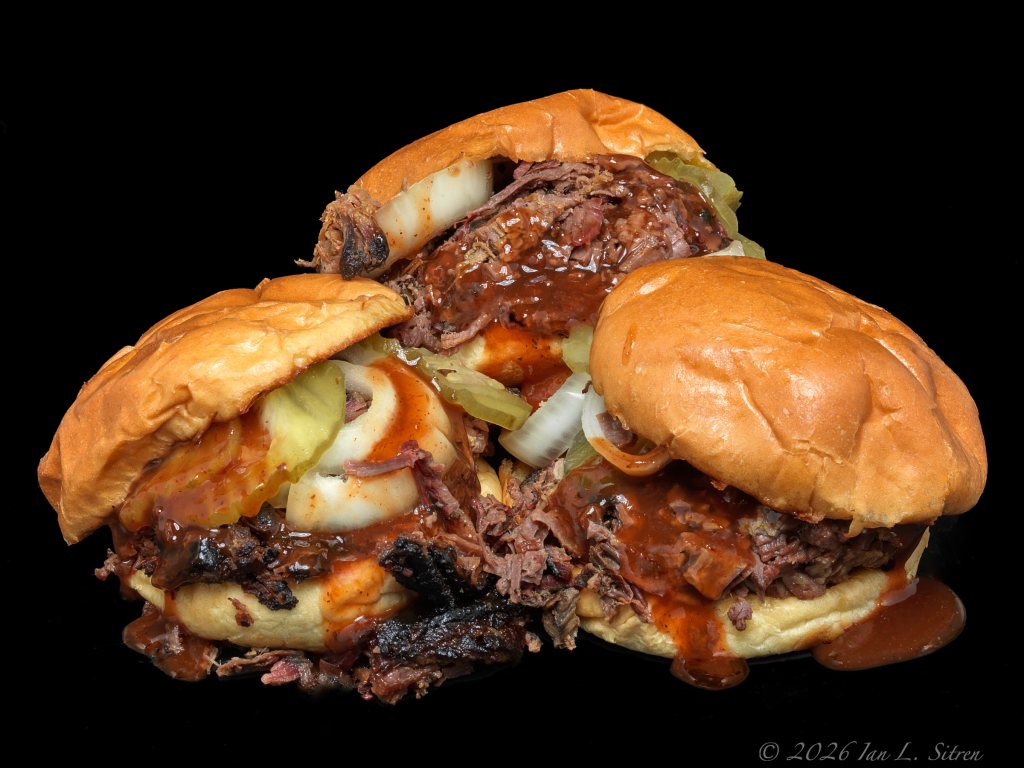
Today is National Brisket Day.
One of the things I wanted to challenge with my “FOOD FROM BAG TO BACKGROUND” project was the idea that food only becomes visually interesting after it passes through a marketing department, a food stylist, an art director, retouching, and increasingly now, AI image generation.
These brisket sandwiches from Dickey’s Barbecue Pit are none of that.
They were bought like any normal takeout order, carried home in a bag, opened, placed onto a black background, and photographed exactly as served. No rearranging. No fake steam. No hidden supports. No motor oil pretending to be sauce. No tweezers moving sesame seeds into place.
And yet they still work visually.
Actually, I would argue they work because they are real.
The overflowing chopped brisket, the uneven piles of smoked meat, the compressed buns, the dripping barbecue sauce, the onions and pickles sliding out of place, all of it feels far more appetizing and believable than the heavily over-engineered perfection seen in so much advertising imagery now.
That tension became one of the central ideas behind FOOD FROM BAG TO BACKGROUND. Fast food and takeout photographed seriously, exactly as it exists in the real world, isolated against black with no attempt to hide the messiness, excess, or reality of what arrived in the bag.
And sometimes the real version ends up looking better than the manufactured one.
More from FOOD FROM BAG TO BACKGROUND:
https://www.secondfocus.com/index/G0000wQ3fbeEezF0
National Hamburger Day and the Fast Food Reality Behind FOOD FROM BAG TO BACKGROUND
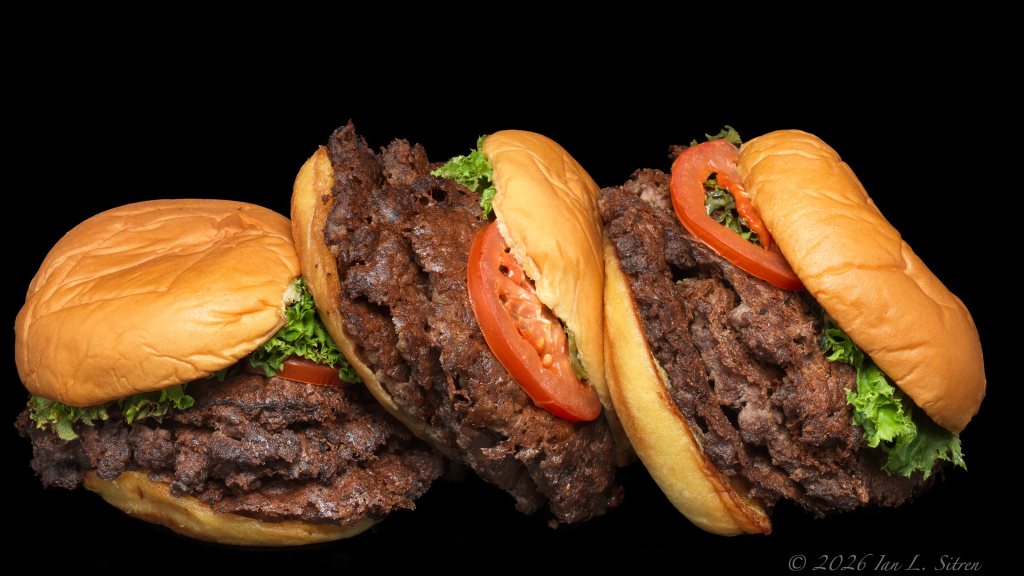
Today is National Hamburger Day.
The hamburger has probably become the defining subject of my “FOOD FROM BAG TO BACKGROUND” project. Fast food photographed exactly as it arrives, no stylists, no reconstruction, no fake versions built for advertising.
And one thing people occasionally ask is where all this food comes from.
The answer is simple: the same place everybody else gets it.
The restaurants and chains have no idea I am photographing their food. There are no sponsorships, no special preparation, no discounts because of photography, and no carefully assembled “photo burgers” arriving from a corporate kitchen. I walk in or use the apps, place an order, pick it up, bring it home, and photograph it exactly as it comes out of the wrapper or bag.
Actually, the apps have become part of the process. The fast food companies constantly push coupons, free items, points, discounts, and combination deals. Surprisingly worthwhile ones. Sometimes I end up planning a shoot around whatever special appears that week.
That is part of what interests me visually about the project. These hamburgers are not idealized advertising concepts. They are real fast food hamburgers, bought like anybody else would buy them, photographed seriously against black backgrounds with the same attention I would give any other subject.
Somewhere between documentary, satire, and food photography, the hamburger became one of the central characters.
And if you have ever wondered what fast food starts looking like when it is pulled out of the bag, isolated against black, and treated like a serious photographic subject, step into the project here on my website at https://www.secondfocus.com
Hasselblad Shooting Rolleiflex
Using the new Hasselblad X1DII camera to shoot an old vintage Rolleiflex camera. Lens was the Hasselblad XCD 3.5 120mm with Broncolor F160 LED lighting. Shot handheld at Camera West in Rancho Mirage CA.


First World Problem
My photograph First World Problem is now on exhibit as part of “Through The Lens” at the Artists Center in Palm Desert, on view through April 5, 2026.
The exhibit is presented in a museum-standard facility and is shown alongside a special presentation of celebrity photography by Harry Langdon and Jimmy Steinfeldt.
The photograph itself is direct.
These are not takeout containers. They are proof.
Portions continue to expand, whether or not appetite keeps pace. What isn’t finished is boxed and transported, a polite acknowledgment that even excess has exceeded demand. In Palm Springs, where many diners are older and eat less, the surplus becomes routine.
Stacked together, the containers resemble a monument. Not to hunger, but to overabundance. The problem is not that there is too little. It is that there is too much.
Issued as an Artist Proof and signed, the photograph is printed using archival dye infusion on aluminum.
Please visit Wednesday through Sunday, 11am to 4pm.
The Artists Center at the Galen
72-567 Highway 111
Palm Desert, CA
https://www.artistscouncil.com
Thank you!
March 19, 2026 | Categories: Uncategorized | Tags: aluminum print photography, American excess, Artists Center Palm Desert, coachella valley art, conceptual photography, Contemporary Photography, dye infused aluminum print, fine art photography, First World Problem, food culture photography, gallery exhibition California, Ian L Sitren, modern art Palm Springs, Palm Desert art exhibit, Palm Springs Art, photographic art exhibit, social commentary photography, still life photography, things to do Palm Desert, Through The Lens exhibit | Leave a comment