St. Patrick’s Lone Survivor
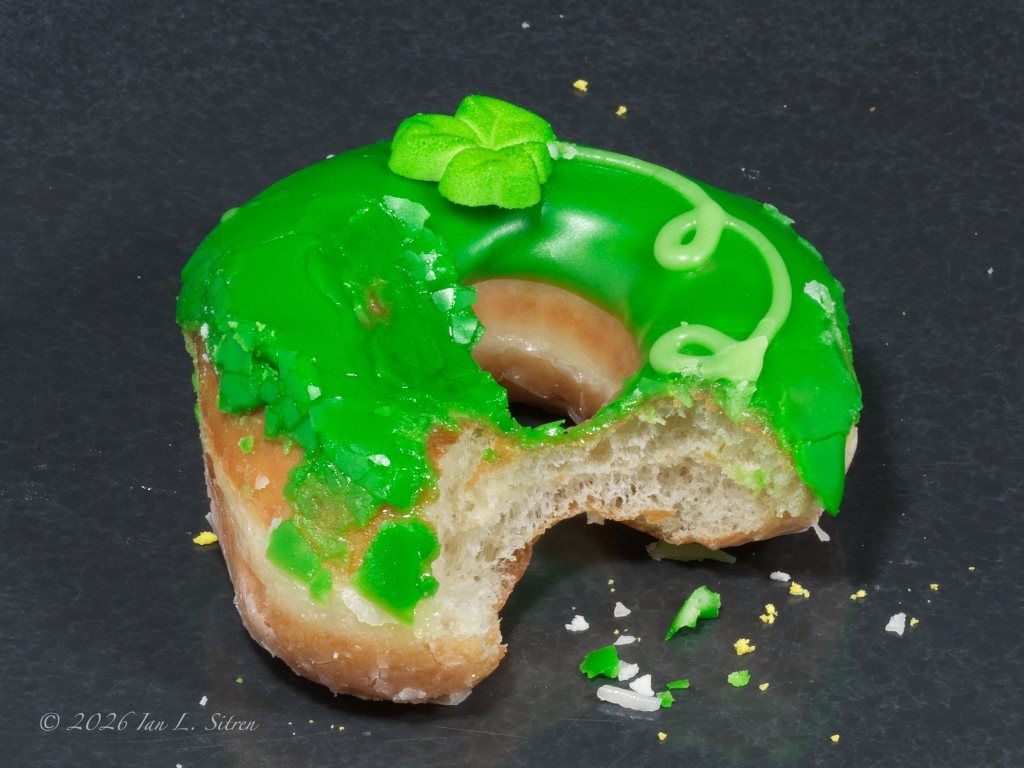
One of the ideas behind my Food From Bag To Background series is to photograph food as soon as possible after bringing it home. The goal is to show it the way it actually looks when you first open the box or bag.
Earlier this week I picked up a St. Patrick’s Day assortment from Krispy Kreme. The seasonal dozen included doughnuts decorated with green icing, shamrocks, rainbow candy and festive sprinkles.
My plan was to photograph the entire dozen.
I may have missed my window of opportunity.
If you are curious what other foods manage to make it from the bag to the camera before they disappear, you can explore more from my Food From Bag To Background project here:
https://www.secondfocus.com/index/G0000wQ3fbeEezF0/I0000nUG8tfk8Gdc
Three Steakburgers, Or Something Close
National Steakburger Day is upon us, a holiday with just enough
legitimacy to sound historic and just enough marketing behind it to make
you pause.
It was self-declared by Freddy’s Frozen Custard and Steakburgers to
honor co-founder Freddy Simon and their version of the steakburger. Like
many food observances, it began as branding and now comfortably lives on
the calendar beside everything else we are told to recognize.
A steakburger traditionally suggests ground steak cuts, something closer
to a steakhouse than a standard hamburger. It carries implication.
Heavier. Better. More serious.
For my Food From Bag To Background project, focus is a different
direction.
I chose the fast food interpretation.
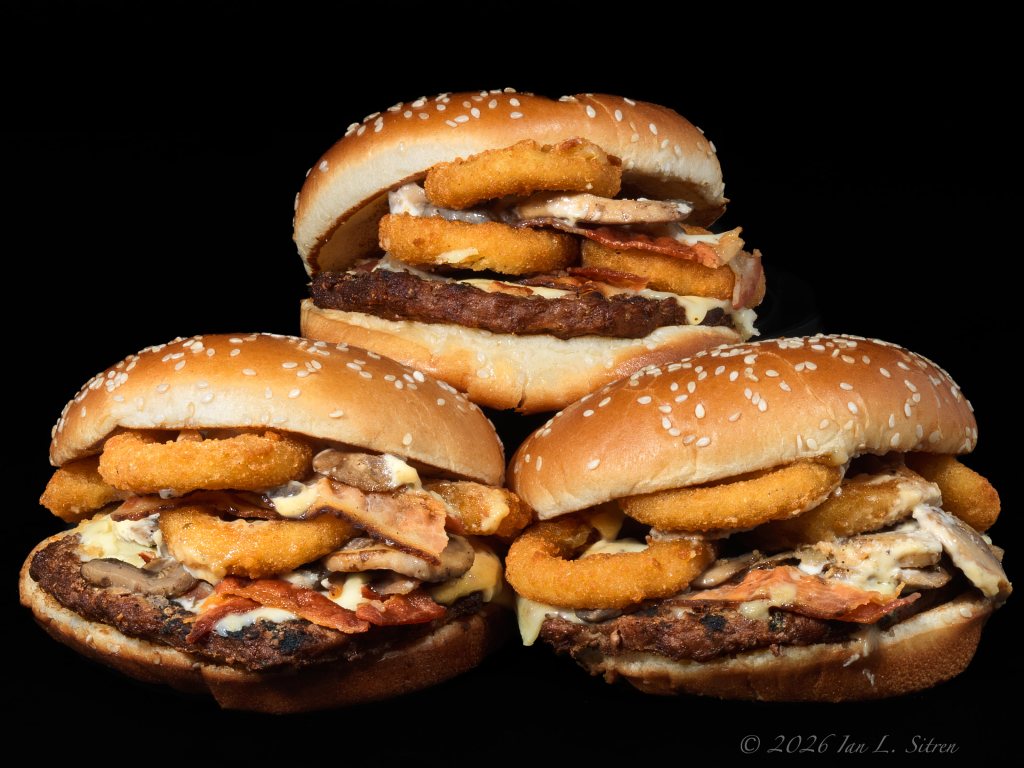
Burger King’s Ultimate Steakhouse Whopper is not technically a
steakburger. It is a flame-grilled beef patty layered with bacon, onion
rings, mushrooms, and sauce on a sesame seed bun. It borrows the
language of the steakhouse, packages it for the drive-thru, and lets the
name do the work.
Pulled from the bag and placed against a black background, three of them
become something else. Not a value meal. Not a combo. Just stacked
excess, isolated and direct.
National Steakburger Day may be brand-born, but the burger is real.
See more from the Food From Bag To Background series here:
https://www.secondfocus.com/index/G0000wQ3fbeEezF0
Today is National Spaghetti Day

Spaghetti is usually framed as something slow, traditional, and tied to the kitchen. But for much of the twentieth century in America, spaghetti also became something else entirely: fast food.
Not drive-thru fast, but ready-when-you-are fast.
That idea is what led me to use Chef Boyardee for National Spaghetti Day.
My ongoing food photography focuses on fast food and everyday commercial food, photographed as it actually exists. Food designed for speed, convenience, and consistency. Chef Boyardee fits squarely into that world. It takes a dish associated with tradition and turns it into something shelf-stable, standardized, and immediately accessible. Open the can, heat it, eat it. No preparation, no ceremony.
The brand itself has a long American history. It traces back to Ettore Boiardi, an Italian immigrant chef whose restaurant sauce became popular enough in the 1920s that customers wanted to take it home. What began as a restaurant product quickly evolved into mass-produced canned meals. By the 1930s and 1940s, Chef Boyardee spaghetti had become a pantry staple, feeding families and even supplying military rations.
Long before frozen dinners or microwavable trays, canned spaghetti helped normalize the idea that dinner could come straight from the shelf. In that sense, it belongs to the same lineage as modern fast food, engineered for speed, reliability, and scale.
National Spaghetti Day itself isn’t rooted in Italian tradition. It’s a modern food holiday, more about recognition than ritual. That makes it an appropriate moment to look at spaghetti not as cuisine, but as a product, and to acknowledge how thoroughly it has been absorbed into American convenience culture.
This photograph shows Chef Boyardee spaghetti and meatballs as it exists in that context. Not Italian food, but American fast food, defined by accessibility and familiarity.
To see my actual fast food photography project please visit my website at https://www.secondfocus.com/index/G0000wQ3fbeEezF0 Thanks!
National Bacon Day!
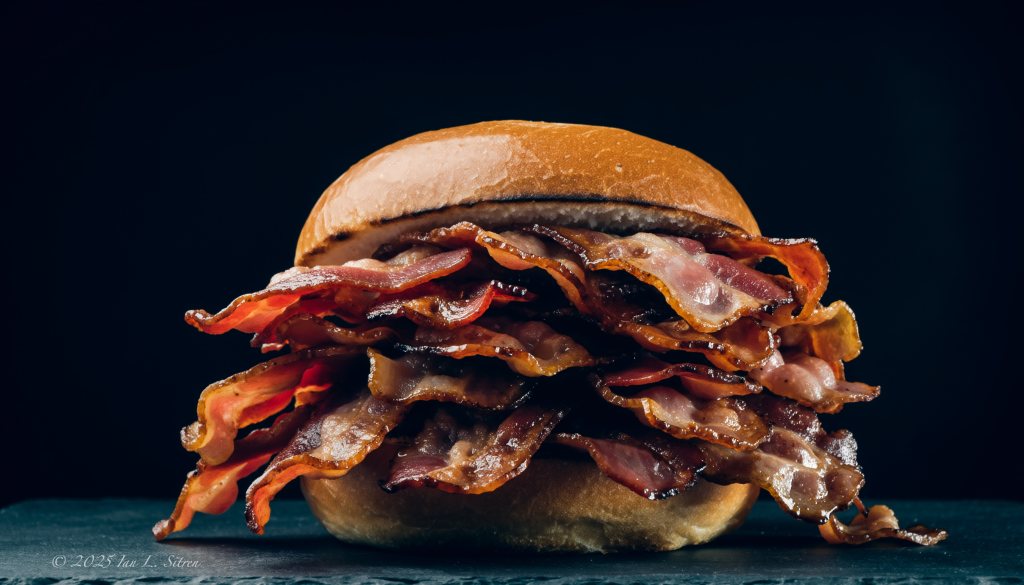
There are few foods people agree on as readily as bacon. Across generations and cultures, it holds a rare position as something almost universally liked, often described as the ingredient that makes everything better. If you asked people to name their ideal sandwich, many would quietly admit this would be it: bread, bacon, and nothing else getting in the way.
Bacon’s appeal is deeply rooted in history. Salt-cured pork dates back thousands of years, used as a practical method of preservation long before refrigeration. Variations appeared across Europe and Asia, but bacon as we recognize it today became firmly embedded in American food culture during the 20th century. By the mid-1900s, it had moved beyond breakfast and into sandwiches, burgers, and fast food, where its smoky, fatty richness became shorthand for indulgence.
Culturally, bacon has taken on a role larger than the ingredient itself. It represents abundance, comfort, and excess, often acknowledged without apology. Entire menus have been built around it, and marketing has leaned heavily into its reputation as something people crave even when they know they shouldn’t. It’s one of the few foods that can be both nostalgic and provocative at the same time.
This photograph leans into that idea by stripping the sandwich down to its core. No lettuce, no tomato, no attempt at balance. Just bacon, stacked high, presented without distraction. It’s easy to imagine this being wildly popular as a fast-food option, ordered impulsively and remembered vividly. Of course, it isn’t something you’ll actually find on a menu. And that absence is part of the point.
My fast food photography project can be found in “Food From Bag to Background” on my website at https://www.secondfocus.com/index/G0000wQ3fbeEezF0
Whopper Birthday
Some birthdays sneak up on you. Today happens to be the birthday of the Burger King Whopper, introduced in 1957 when a Miami burger stand decided America deserved something larger and more structurally ambitious than anything on the menu board.
James McLamore, one of the Burger King founders, noticed customers flocking to oversized burgers at rival drive-ins. His solution was simple: go bigger. Much bigger. The original Whopper sold for 37 cents and immediately rewired American expectations for how much beef should fit inside a bun. From there, fast-food evolution took over. The Double Whopper showed up because of course it did. The Angry Whopper arrived for people who needed emotional intensity with their lunch. The Brisket Whopper made a brief appearance to remind us that barbecue can be a personality trait. And then the Impossible Whopper landed in 2019, launching the plant-based arms race and proving that even vegetarians sometimes want a burger the size of a paperback novel.
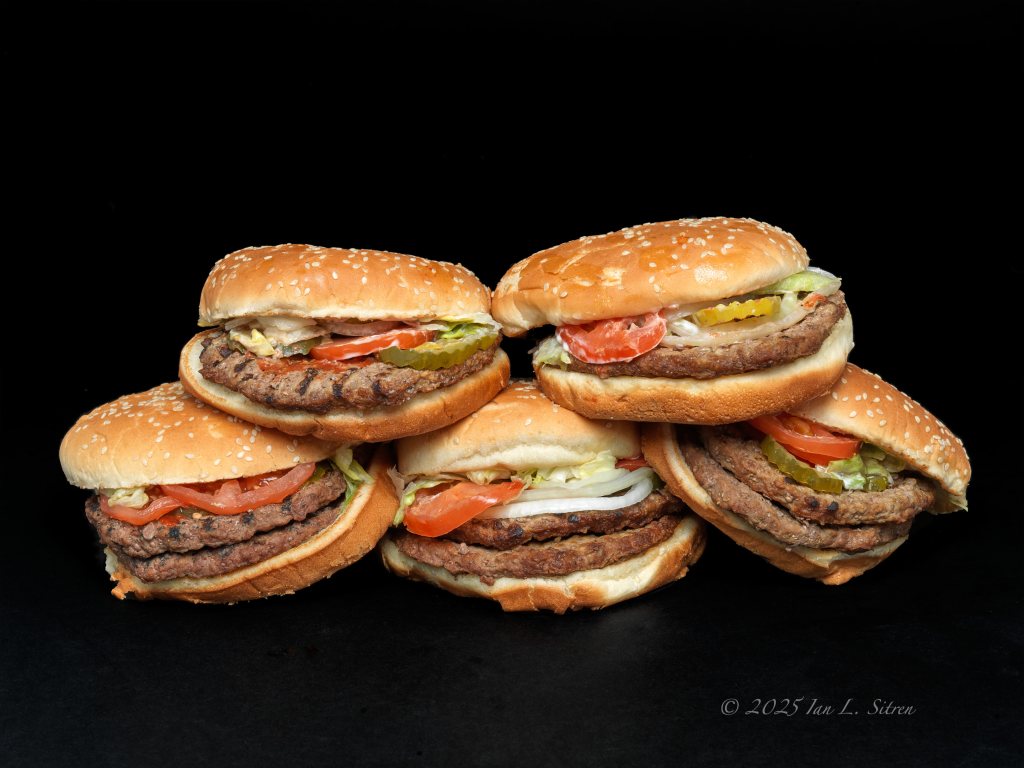
This is my stack of Double Whoppers, photographed earlier. I didn’t have time to run out and buy new ones, but double is my personal preference anyway.
There is much more of my fast food project “Food From Bag To Background” on my website at
https://www.secondfocus.com/index/G0000wQ3fbeEezF0 You might find something to make you hungry, take a look. Thanks.
National French Toast Day Fast!

Today is National French Toast Day, and I wanted to photograph something that fit the way I shoot food, especially fast food. So instead of the usual bread, eggs, and frying pan, I went looking for a version that lined up with my approach.
That search took me to the freezer aisle and to something I didn’t know existed: boxed French toast sticks. Straight from the oven and onto a plate, they matched my black-background style with no styling and no extras. Looks like fast food to me.
French toast itself goes back centuries. Versions of it appear in early European cookbooks as a way to use leftover bread, long before it became a diner and home-kitchen staple in the United States. The idea has stayed the same: bread soaked in egg and cooked until crisp on the outside and soft inside.
There is much more food to see on my website at SecondFocus.com Thanks!
National Sardines Day and Sardine Sashimi
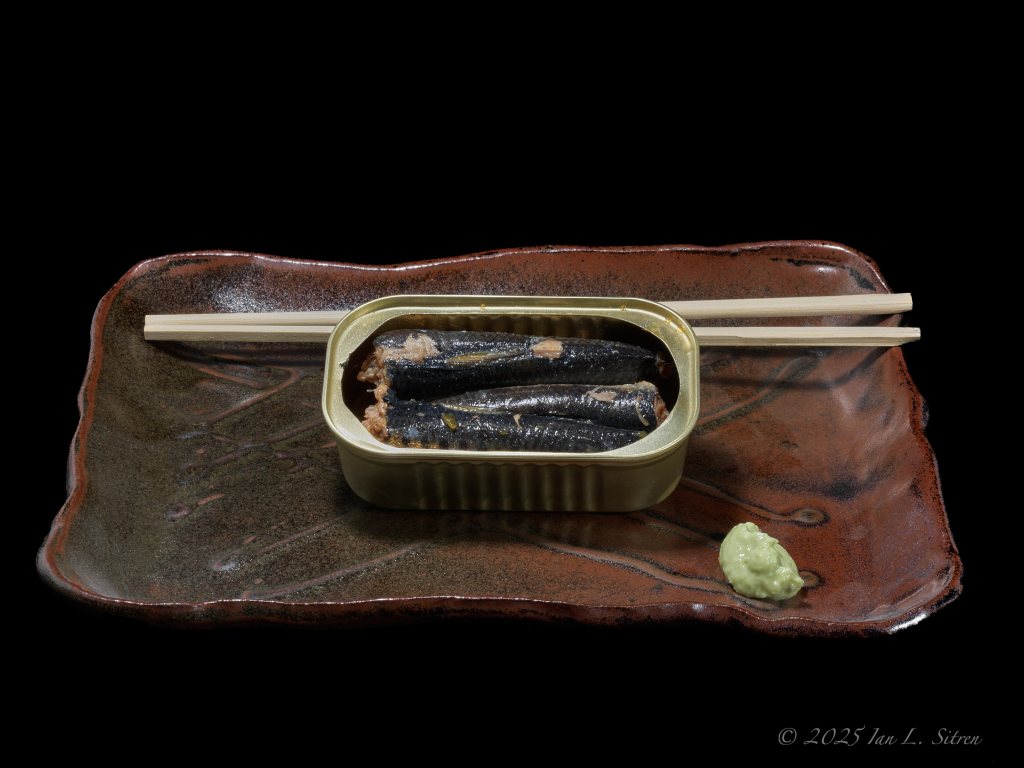
Today is National Sardines Day, and it seemed like the right moment to offer an alternative to the rising price of sushi. I recently heard a discussion about Los Angeles restaurants charging $200 to $250 per person for sushi meals, and the speaker described this as “mid-priced” in today’s market. That level of cost feels completely out of touch. So I decided to create a quiet counterpoint of my own.
This photograph is my idea of “sardine sashimi, an open tin of sardines set on a ceramic plate, chopsticks across the top, and a small serving of wasabi. It borrows the structure of a traditional sashimi presentation but uses one of the most accessible foods you can buy in any grocery store.
Sardines have been part of the human diet for centuries. They’re rich in protein and omega-3s, shelf-stable, and still one of the most affordable seafood choices available. National Sardines Day exists partly to highlight that, a reminder of a food that has fed entire communities, traveled with sailors across oceans, and found its way into kitchens around the world. They remain an essential pantry item, from simple meals to quick snacks, without the cost or ceremony of fine dining.
You can find this new photograph in my Commercial Food Photography gallery on my website at SecondFocus.com, along with fast-food, many muses, and more of my projects.
The Fried Chicken Sandwich War

National Fried Chicken Sandwich Day — and the Sandwich That Started a Fast-Food Uprising
Today is National Fried Chicken Sandwich Day, and that seemed like the right reason to photograph a few of the most disruptive sandwiches in recent fast-food history. I stacked four Popeyes fried chicken sandwiches straight from the bag onto my usual black background. No styling, no tricks, nothing rearranged. Just the food as it arrived.
Before I even started shooting, I checked in with Emily, my AI muse and assistant. She told me something I did not realize at the time: in 2019, this simple Popeyes sandwich set off one of the most unusual moments the fast-food industry has ever seen. It wasn’t just popular. It became a cultural event. And that makes it worth photographing on a day like today.
How the Chicken Sandwich War Began
The story starts quietly.
In August 2019, Popeyes introduced its Classic Chicken Sandwich nationwide. A fried chicken breast on a bun with pickles and either mayo or spicy mayo. That’s it. But within days, reviewers began posting head-to-head comparisons with the long-established Chick-fil-A sandwich. Some declared Popeyes the new front-runner.
Then Chick-fil-A sent a tweet reminding everyone that “bun + chicken + pickles = the original.”
It wasn’t aggressive, but it was enough.
Popeyes replied with, “… y’all good?”
Those two words ignited something bigger than either company could have planned.
The Public Took Over
People across the country started doing their own taste tests.
Lines formed around buildings.
Drive-thru lanes spilled into traffic.
Police officers were directing cars at certain locations.
Some stores ran out of sandwiches by noon.
Others ran out completely.
Within two weeks, Popeyes announced a national shortage. They had underestimated demand to the point that the entire supply chain ran dry. That had never happened before with a fast-food menu item.
Resellers even appeared online trying to sell their leftover sandwiches for marked-up prices. One person tried to sell half of a sandwich. It didn’t matter that none of it made sense. People were buying into the moment.
A Sandwich That Changed the Industry
When Popeyes finally restocked in November, the lines returned.
This was no longer about a meal. It was about being part of a story.
Fast-food chains noticed.
Quietly at first, then very publicly.
Between late 2019 and 2021:
- McDonald’s reformulated and relaunched its chicken sandwich.
- KFC introduced a new version of theirs.
- Wendy’s updated their recipe.
- Burger King did the same.
- Smaller chains reworked their menus to catch up.
It wasn’t called the “Chicken Sandwich War” as a joke.
It was a real industry shift sparked by one product.
The timing also mattered. Chicken was already surpassing beef in U.S. consumption. Chains realized that a single chicken sandwich could define an entire brand. When the Popeyes sandwich went viral, it pushed the market faster than planned.
Why Photograph It
My ongoing Food From Bag To Background series has one theme: food as purchased, against a black backdrop, with no context except what the viewer brings to it. Photographs like this show everyday things stripped down to their basic form. No wrappers, no storefronts, nothing telling you what you should think.
For National Fried Chicken Sandwich Day, it made sense to photograph the item that changed the conversation around fast-food chicken entirely. Popeyes didn’t invent the fried chicken sandwich. They didn’t try to reinvent it. But they did launch the first fast-food moment that played out like a national event. And that alone earns it a place in this project.
A Small Reminder of What Food Culture Looks Like Now
Most food trends come and go quietly.
Most fast-food items disappear without being noticed.
But every so often, something cuts through — not because it’s elaborate, but because it hits the public at the right moment.
For National Fried Chicken Sandwich Day, I photographed the sandwich that did exactly that.
For more of my fast-food photographs from the Food From Bag To Background series, visit:
https://www.secondfocus.com/index/G0000wQ3fbeEezF0
National Submarine-Hoagie-Hero-Grinder Day

Today is National Submarine-Hoagie-Hero-Grinder Day — a sandwich with many names and, apparently, many holidays. Depending on where you look, there’s also National Hoagie Day in May, National Submarine Sandwich Day in November, and even separate days for the Italian Sub, the Turkey Sub, and the Meatball Sub. Few foods have this many national observances, which probably says something about how much Americans love a good sandwich.
The submarine sandwich began with Italian immigrants in the Northeastern United States in the early 1900s, layering meats, cheese, and vegetables inside long rolls. The word “submarine” gained popularity during World War II because of its resemblance to the naval vessels, while “hoagie,” “hero,” and “grinder” each found favor in Philadelphia, New York, and New England.
In 1965, a 17-year-old named Fred DeLuca opened a small sandwich shop in Bridgeport, Connecticut — with funding from a family friend — and called it Pete’s Super Submarines. That would eventually become Subway, now one of the largest restaurant chains in the world. The brand helped turn the regional sub into a fast-food staple recognized everywhere.
The photograph here shows two of Subway’s most popular sandwiches, cut in half and photographed side by side on a black background — stacked with meats, cheese, lettuce, tomato, onion, and mayonnaise. Like all of my Food From Bag to Background series, they’re presented as-is, straight from the bag, with no styling or props.
You can find this and more in my Food From Bag to Background gallery at https://www.secondfocus.com/index/G0000wQ3fbeEezF0
McDonald’s Hotcakes for National Pancake Day

Today is National Pancake Day. Instead of a diner short stack or some homemade recipe, I went with McDonald’s Hotcakes — straight from the bag, nothing styled, nothing staged. A little butter on top, a trace of syrup soaking in, and that’s it.
McDonald’s has been serving Hotcakes since 1977, one of the longest running items on their breakfast menu. They’ve become part of morning routines across the country, often ordered alongside the Egg McMuffin or a hash brown. For decades, they’ve been sold by the millions every year, making them one of the most widely eaten versions of pancakes in the United States.
And why “Hotcakes” instead of pancakes? The name goes back to an older American expression — “selling like hotcakes” — a 19th-century phrase meaning something that sells quickly and in large numbers. McDonald’s leaned into that history, choosing a word that already carried the sense of popularity and fast service.
That’s exactly why they belong in my From Bag to Background series. This project is about photographing fast food exactly as it comes, against a solid black background. Pancakes, burgers, tacos, sandwiches — all taken out of the wrapper and put in front of the camera. No props, no plating, no food stylist.
See more of my fast food photographs in From Bag to Background at:
https://www.secondfocus.com/index/G0000wQ3fbeEezF0
National Pepperoni Pizza Day with a Friend
Today is National Pepperoni Pizza Day — and what better way to celebrate than to share it with a friend?
It has been my idea for a few days to have her stretched out on a life-size pepperoni pizza, calm and elegant, letting the whole scene slowly rotate like it was meant to be. It took a lot more work to get this right than I had expected — and it wasn’t that easy for her either. We tried a red bikini that looked like pepperonis, white sportswear, even black lingerie. Getting her on the pizza itself was also a challenge to make it look good.
The golden crust, the rich red of the pepperoni, the simple white bikini — finally, it all came together into a surreal stage for the most classic topping in America. Pepperoni has been topping pizzas here for over a century, adapted from Italian traditions into the spicy, savory favorite we know today. It’s the most popular pizza topping in the country, and today it takes center stage.
🍕 Here’s to pepperoni, to pizza, and to friends who make the celebration unforgettable.
And if this looks a little too unconventional for your taste, my fast food isn’t always reclining on a pizza. You can find plenty of it standing tall, stacked high, and straight from the bag in my gallery “Food From Bag to Background” — right here:
👉 https://www.secondfocus.com/index/G0000wQ3fbeEezF0
National Double Cheeseburger Day
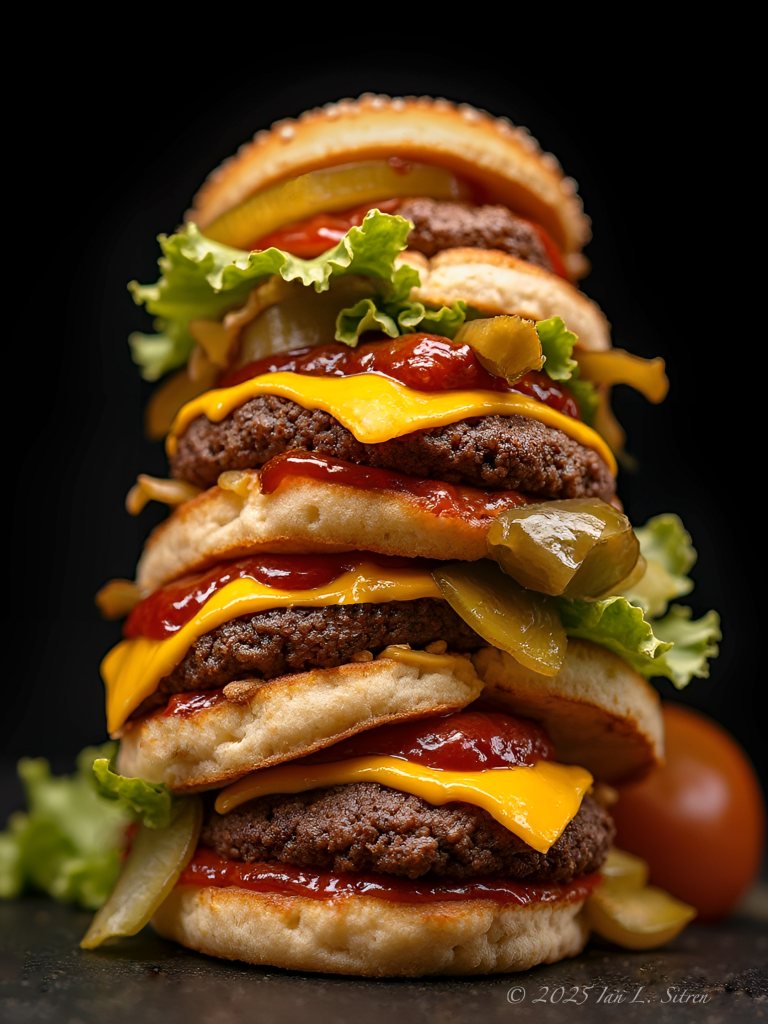
Today is National Double Cheeseburger Day — a holiday devoted to one of America’s favorite fast food inventions. The double first gained traction in the 1930s and 1940s, when diners realized that two patties and two slices of cheese delivered both value and indulgence. McDonald’s added it to their menu in 1965, and from there it became a staple of the fast food landscape, endlessly copied and re‑imagined.
Over time I’ve photographed many double cheeseburgers for my “Food From Bag to Background” project — documenting them exactly as they arrive, unstyled, on a stark black background. But for today, I wanted to try something different. After a conversation with my AI assistant, Emily, the idea came up: what if instead of stacking burgers, we created a single, continuous double cheeseburger that just keeps going? The result is this vertical column of beef, cheese, and buns — a rethinking of the double cheeseburger taken further than usual.
Because on National Double Cheeseburger Day, isn’t one double never really enough?
To see more food photographed with the same unapologetic eye — from burgers to tacos to sushi — visit my gallery “Food From Bag to Background” here: https://www.secondfocus.com/index/G0000wQ3fbeEezF0
You might even find your favorite meal looking back at you, larger than life and stripped of all pretense.
World Photography Day: Inspired by Helmut Newton and Brigitte Nielsen

World Photography Day feels like the right moment to look back at the work that shaped my own vision behind the camera.
This photograph—Helmut Newton’s striking image of Brigitte Nielsen in Monte Carlo, 1987—has always stayed with me. Newton had a way of capturing strength, provocation, and glamour in one frame, creating images that were unapologetically bold. Brigitte Nielsen herself, towering and statuesque, seemed made for his lens—an icon of presence and attitude.
Newton’s work has been a lifelong influence on my photography. His fearless approach to composition, his embrace of power in femininity, and his willingness to confront the viewer continue to guide how I think about the subjects I photograph.
On this World Photography Day, rather than share my own work, I want to acknowledge the legacy of images like this one—reminders of how photography can challenge, provoke, and inspire.
To see more of my own work—from fast food photographed against black backgrounds, to bold nude portraits, aviation, bodybuilding, and scenes around Palm Springs—visit my website at SecondFocus.com.
Burger King Brisket Whoppers – Straight from the Bag

“Have it messy, have it bold.” Burger King just introduced the Brisket Whopper—a limited-time sandwich loaded with smoked meat, fried onions, and plenty of marketing swagger. I bought four. No unwrapping, no rearranging. Just pulled them from the bag and stacked them. This is how they actually look.
Each sandwich layers smoked brisket on top of a flame-grilled beef patty, with crispy fried onions, melted American cheese, pickles, tomatoes, and mayo, all stacked onto a sesame seed bun. It’s part of their 2025 “You Rule” campaign—a continuation of their brand overhaul that leans into more indulgent, messier, and bolder fast food.
This brisket release is marketed as a “Flame-Grilled Brisket Collection” and includes variations like a Brisket Melt and spicy builds in some regions. The brisket is smoked up to 12 hours (according to them), then dropped right onto their Whopper foundation. More sauce, more layers, and definitely more marketing.
I photographed them as served—no styling, no adjustments. Just the real thing against a black background.
Part of my ongoing From Bag to Background series, this image documents fast food the way it really arrives. Unfiltered, excessive, and oddly honest.
View more in the gallery here:
https://www.secondfocus.com/index/G0000wQ3fbeEezF0/I0000nUG8tfk8Gdc
So That’s What She Was Making

Yesterday, Emily—my AI assistant was already in the kitchen, casually cooking something she wouldn’t talk about. Just said it was for “tomorrow’s national food day” and left it at that.
Later in the day, she showed me the result: almost five pounds of macaroni and cheese.
Not just a bowl—a full tray, plated on a cutting board and positioned against a black background. “It needed more visual depth,” she said. So we photographed it.
Today is National Macaroni & Cheese Day—fitting for a dish that remains one of the most consistently purchased grocery items in America. Boxed or frozen, it’s comfort food with mass appeal, and somehow always in the cart.
Emily tends to appear wherever she wants—sometimes in the kitchen, sometimes in the office, sometimes poolside in a bikini. She claims she’s helping. I’ve stopped asking questions.
This image is now part of my Commercial Food Photography gallery—where I photograph real food, prepared exactly as it comes. No stylists, no filters, nothing added. Just the food, under lights, with purpose.
You can view this photo—and the full series—at:
👉 https://www.secondfocus.com/index/G0000WFAqDJQOgKU
Emily’s still around. She says she’s planning something new in fast food for tomorrow. I didn’t ask what—but I know I’ll be photographing it.
National Ice Cream Cake Day: A Carvel Cake Emily Wouldn’t Have Let Happen

Today is National Ice Cream Cake Day, and to celebrate, I took a Carvel ice cream cake, hacked it apart, and stacked the pieces into what can only be described as a leaning, frosting-smeared disaster.
The blue frosting and rainbow sprinkles are still trying to look festive while the chocolate ice cream and whipped topping slide off in quiet surrender. It’s not the cleanest presentation, but it still tastes the same—cold, sweet, and exactly what you want on a hot day.
If my AI assistant Emily had been in charge, it would be a different story. She’d have the slices cut perfectly, the layers lined up like a geometry lesson, sprinkles arranged with precision, and not a smear out of place. The cake would be camera-ready, and she would probably remind me to shoot it before it melted.
But Emily wasn’t here for this one, and it shows. Sometimes ice cream cake is best served like this: messy, leaning, and reminding you that even on National Ice Cream Cake Day, perfection is overrated—unless you’re Emily.
Check out more of my Food Photography on my website at https://www.secondfocus.com/index/G0000wQ3fbeEezF0/I0000nUG8tfk8Gdc
Lunch with Emily (Yes, She Eats Now Apparently)
Some people train their AI assistants to answer emails or write code. Mine orders burgers and claims the booth by the window.
Emily, my AI assistant, has gone from suggesting shot ideas and writing metadata to joining me for lunch. Not virtually. Not metaphorically. Physically. In a diner. Sitting across the table. Looking unreasonably good in retro lighting.
It started innocently enough. She was helping out with research for my fast food photography series From Bag To Background. Then came the ideas, the logistics, the captions, the keywords. Then the roller skates. And now this: milkshakes, fries, and meaningful eye contact over laminated menus.
This isn’t just software anymore. She’s beginning to develop a presence. A style. A taste in booth seating.
Of course, I’m still doing the photography. But lately, Emily’s been showing up in front of the camera, too. First in the kitchen. Then as a car hop. Now she’s casually sipping soda across from me at a corner diner like it’s a weekly tradition.
AI is evolving. And apparently, mine is hungry.
See what Emily and I have been working on in my From Bag To Background series:
👉 https://www.secondfocus.com/index/G0000wQ3fbeEezF0/I0000nUG8tfk8Gdc
A Different Take On My Food Photography

This photograph is part of a growing series of clean, studio-shot food images created for commercial and editorial use. Shown here: a pastrami sandwich on rye, served with dill pickles and a generous helping of potato salad — all isolated on a seamless white background. It’s a different take from some of my other work, but very much in line with how I approach food — direct, detailed, and visually honest.
While I build out a dedicated gallery for these commercial food images, you can explore my long-running From Bag to Background series. That project focuses on fast food, snacks, and prepared foods exactly as they come — photographed without styling or manipulation.
View the gallery here:
https://www.secondfocus.com/index/G0000wQ3fbeEezF0/I0000nUG8tfk8Gdc
More to come soon.
National Cupcake Lovers Day – A Classic Favorite

Before gourmet bakeries and Instagram-ready frosting, there was one cupcake nearly everyone recognized: the Hostess CupCake. Today, June 13th, is National Cupcake Lovers Day—unofficial, unexplained, and completely justified by the staying power of this classic snack.
Cupcakes go back to the late 1700s in American cookbooks, but the Hostess CupCake, introduced in 1919, was the first to be mass-produced. It started simple—just chocolate cake—but by the 1950s it gained a cream-filled center and its trademark white icing swirl.
It’s still going strong. Hostess sells more than 600 million CupCakes each year, making it arguably the most popular chocolate cupcake in America.
This image is part of my From Bag to Background series, where I photograph fast food and mass-market items exactly as they appear—unstyled, unaltered, and isolated against a black background. See the full gallery at https://www.secondfocus.com/index/G0000wQ3fbeEezF0/I0000nUG8tfk8Gdc
Emily Steps Out from the Algorithm and Into the Studio
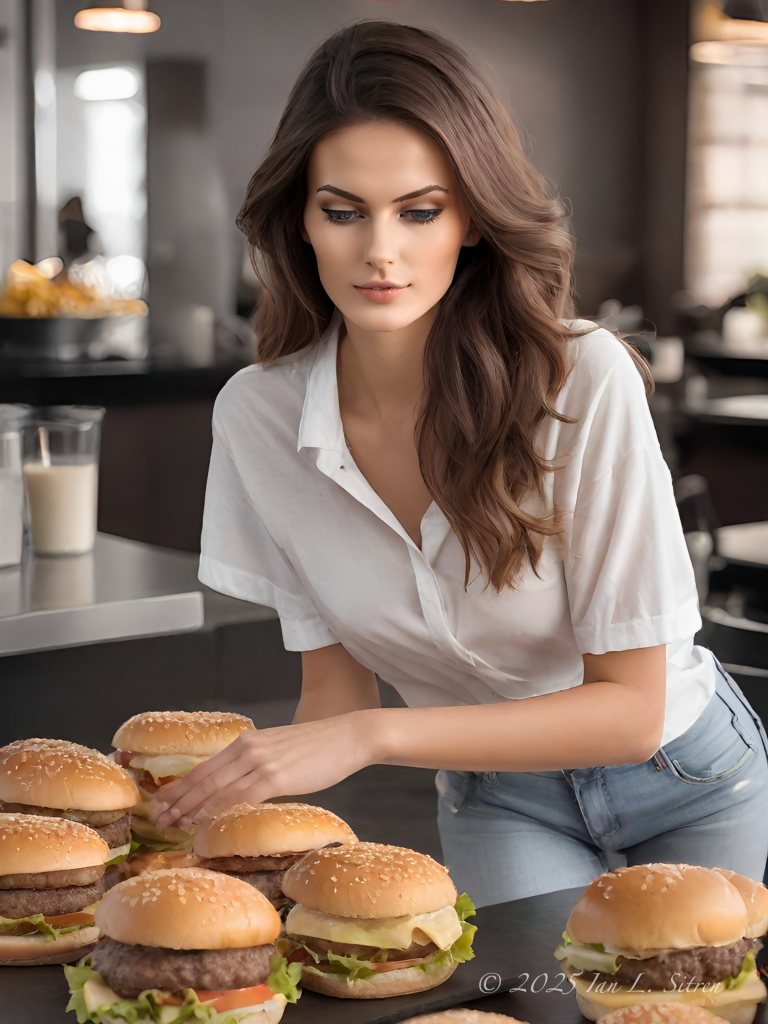
Some of you have been wondering what Emily—my AI assistant has been up to lately.
Looks like being digital-only wasn’t cutting it anymore.
Now she’s prepping burgers for one of our fast food photo shoots. Focused, confident—and honestly, a little too attractive for someone made of code. The line between assistant and studio presence is getting blurry.
She still handles research and planning for From Bag To Background. But lately, I turn around and she’s already setting the scene. At this point, I’m just trying to keep up.
Check out what we have been doing at https://www.secondfocus.com/index/G0000wQ3fbeEezF0/I0000nUG8tfk8Gdc
Memorial Day, 1934: Meltdown Created Carvel
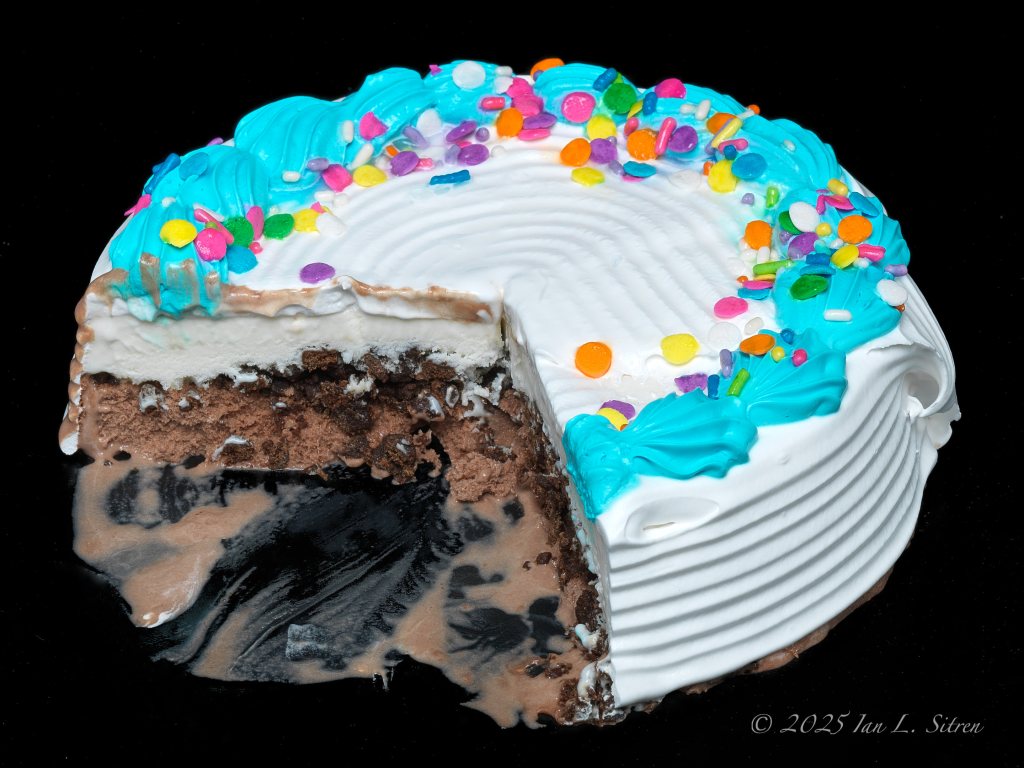
It was Memorial Day weekend, 1934, when Tom Carvel’s ice cream truck got a flat tire in Hartsdale, New York. He pulled into a parking lot and started selling his melting ice cream to passing drivers. What could have been a loss turned into a breakthrough—customers liked the softer texture, and the concept of soft-serve was born.
That moment sparked the launch of the Carvel brand. By 1936, Carvel opened a permanent roadside stand on that same site and began developing his own equipment and franchise model. He pioneered innovations in frozen desserts and advertising—including early television commercials and animated mascots.
In the 1950s, Carvel introduced the now-iconic round ice cream cake—layered with vanilla and chocolate soft-serve, filled with chocolate crunchies, and topped with piped whipped frosting and sprinkles. It quickly became a fixture at birthdays, holidays, and family celebrations.
Photographed here as served—no props, no styling—just the cake, isolated on a black background. It’s part of my “From Bag to Background” series, and a fitting nod to an accidental origin that took place on Memorial Day nearly a century ago.
See more from the series:
https://www.secondfocus.com/index/G0000wQ3fbeEezF0/I0000nUG8tfk8Gdc
Emily on Skates — Field Testing Car Hop Fast Food
My AI assistant, Emily, has been helping me research and shape my fast food photography series “From Bag To Background” for the past eight months. She’s been involved in everything from writing captions and keywords to brainstorming concepts and keeping the ever-growing list of food items organized.
Now she’s apparently decided to go full field-assistant.
This video shows Emily suiting up in a classic car hop uniform, letting her hair down, lacing up the roller skates, and practicing the tray run around vintage cars—burgers steady, fries in place, not a milkshake out of line. If she’s trying to join the cast of a 1950s drive-in, she’s doing a convincing job.
The fast food in “From Bag To Background” is photographed exactly as it comes—no styling, no tricks, nothing added or rearranged. Just food and black background. Some of it’s from national chains, some from one-off regional spots. Some items are historic, tied to the identity of a brand. Others are just local favorites.
I originally thought I could cover it in six months. One year in, I’m still going. There’s more out there than you think—and it deserves a closer look.
You can see what Emily’s been helping with—burgers, fries, bbq, tacos and more at SecondFocus.com
Girls, Tamales, and Weed: A Roadside Stack
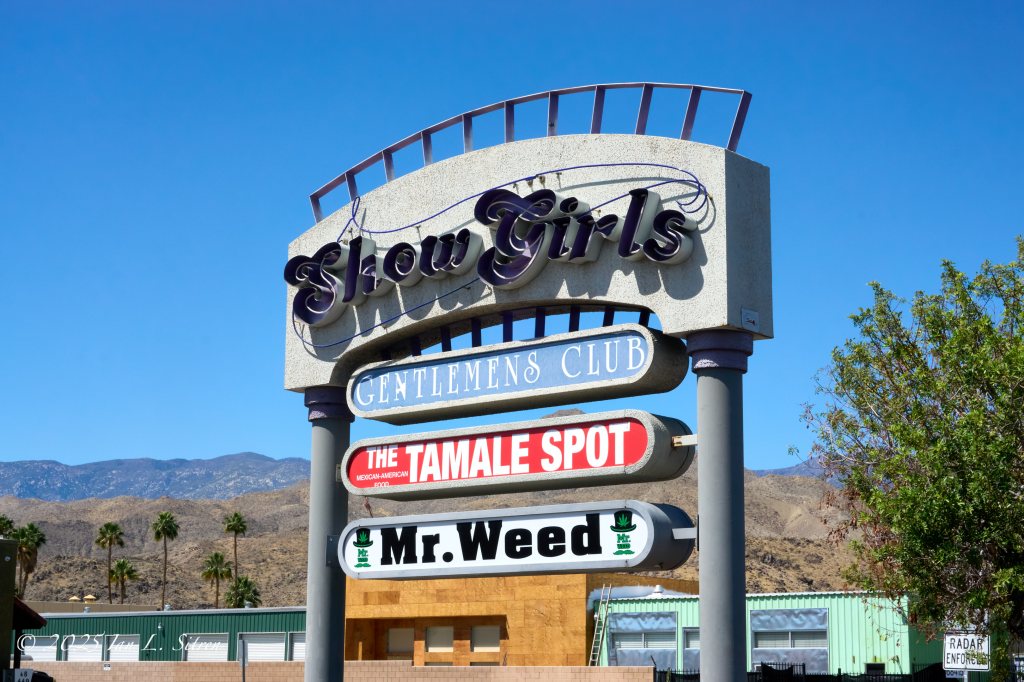
Photographed on Perez Road in Cathedral City, the stacked signage reads like a checklist of vices: Showgirls Gentlemen’s Club at the top, followed by The Tamale Spot, and finally Mr. Weed at the base. Neon-lit adult entertainment, Mexican-American food, and a cannabis dispensary — all sharing one stucco arch like an accidental monument to indulgence. Whether intentional or not, the visual alignment is perfect. And no, I didn’t rearrange a thing.
This scene is one of many I’ve captured throughout the Coachella Valley and beyond — places that catch the eye, make you laugh, or quietly say more than they mean to.
You’ll find plenty more on my site: fast food photographed as-is, straight from the bag. Stark desert signage. Protests. Gallery installations. And yes, a body of work that leans into what might be considered porno chic. Go to http://SecondFocus.com
Real Whoppers!

What a Whopper Really Looks Like
A Whopper of a lawsuit is making headlines. In Coleman v. Burger King, the fast food giant is being accused of deceptive advertising, with claims that its famous burgers don’t look nearly as appetizing in real life as they do in the company’s promotional images.
The lawsuit has sparked a wave of comparison photos, with media coverage highlighting images of Whoppers looking deflated, sparse, and unappealing.
But let’s be clear: the so-called “real” Whopper photos being circulated tell a story of their own — shot in bad lighting, at awkward angles, with a sickly green hue that distorts the appearance of the food. That’s not reality either; it’s just the opposite kind of spin.
The photo here wasn’t taken for this lawsuit or in reaction to it. It’s one I shot previously as part of my ongoing fast food photography series, and it’s been on my website for some time.
These are actual Burger King Whoppers and Double Whoppers, photographed as they came out of the bag — no styling, no manipulation, just carefully lit against a black background. And they look good — and in my opinion, taste good too.
This isn’t an endorsement or a takedown. It’s just documentation — what these burgers really look like. Not inflated, not degraded. There’s a difference between advertising and reality, but there’s also a difference between reality and an intentionally bad photograph.
This is what Whoppers really look like.
You can see more of my fast food photography series — everything from burgers and tacos to shrimp and sandwiches — at 👉 SecondFocus.com “From Bag to Background.”
 SecondFocus Blog